
The Quest for Land
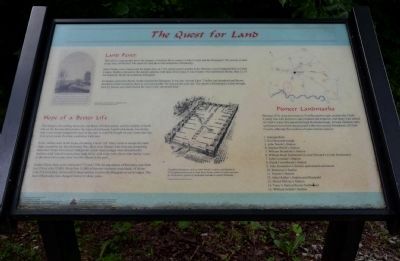
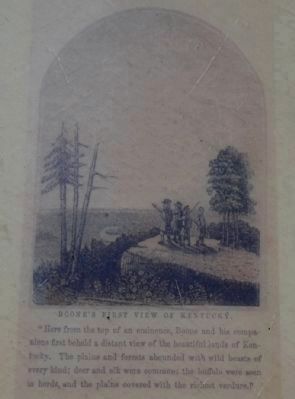
John Findley was a hunter and fur trader who, in 1752, spent several months at the Shawnee town Eskippakithiki in Clark County. Findley returned to the eastern colonies with tales of rich land. It was Findley who told Daniel Boone, then 21, of the beautiful, fertile land teeming with game.
Seventeen years later, Boone finally reached the Bluegrass. It was the "second Eden" Findley had described and Boone decided to settle his family there as soon as possible. He was not the only one. The reports of Kentucky's riches brought back by Boone and others fueled the rush to this "promised land."
this page online
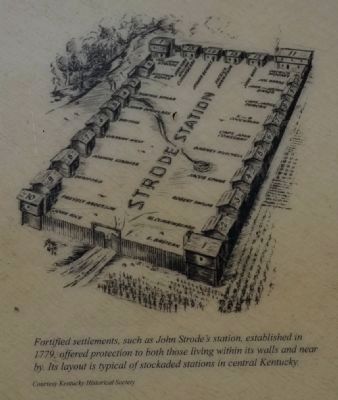
Every settler came in the hopes of making a better life. Many came to escape the hardships created by the Revolutionary War. Most were farmers who were not prospering back east. Some were recent immigrants. A few were younger sons of aristocratic families with limited expectations back home. And some were slaves who had no voice in the decision to come west but who shared in the peril.
In just fifteen short years, between 1775 and 1790, the population of Kentucky rose from just 150 to over 73,000. More than 11,000 of the new residents were black, of whom only 114 were free. Almost all of these settlers lived in the Bluegrass or on its edges. The face of Kentucky was changed forever in those years.
1. Eskipakithiki
2. Fort Boonesborough
3.
4. Stephen Boyle's Station
5. William Bramblett's Station
6. William Bush Settlement (Lower Howard's Creek Settlement)
7. John Constant's Station
8. Elijah Crossthwait's Station
9. John Donaldson's Station and related settlement
10. Dunaway's Station
11. Frazier's Station
12. John Holder's Station and Boatyard
13. David McGee's Station
14. Tracy's Station/Stoner Settlement
15. William Scholl's Station
Erected by The Winchester/Clark County Tourism Commission.
Topics. This historical marker is listed in these topic lists: Colonial Era • Settlements & Settlers • War, US Revolutionary. A significant historical year for this entry is 1752.
Location. 37° 53.401′ N, 84° 15.607′ W. Marker is near Winchester, Kentucky, in Clark County. It can be reached from Ford Road/4 Mile Road (Kentucky Route 1924) 1.2 miles south of Boonesboro Road ( Route 627), on the left when traveling south. The exhibit can be reached from the parking area on KY Route 1924. The trailhead is at the edge of the parking area here. This wayside exhibit can be found partway up the trail that leads to the fort at the top of the

Regionally, this marker is in the Bluegrass Region and in Greater Lexington Area. It is also in the American South and specifically in the Upper South. Globally, it is in North America, the Western Hemisphere, the Western World, and the Anglosphere. Historically, it finds itself in what was once the territory of the Mississippian Culture and also the Antebellum South.
Other nearby markers. At least 8 other markers are within walking distance of this marker: The Eye of the Rich Land (a few steps from this marker); A Long, Steep Road (a few steps from this marker); Roads in the Wilderness (a few steps from this marker); Rock and Man (a few steps from this marker); Defending the Kentucky River (within shouting distance of this marker); Three Confederate Raids (within shouting distance of this marker); Common Cliffside Plants (within shouting distance of this marker); Thomas B. Brooks, Army Engineer (about 300 feet away, measured in a direct line). Touch for a list and map of

More about this marker. This marker is part of the historic site known as the "Civil War Fort at Boonesboro." CAUTION: The climb up the hill is VERY steep.
Also see . . . Civil War Fort at Boonesboro. (Submitted on June 25, 2014, by Karl Stelly of Gettysburg, Pennsylvania.)
Credits. This page was last revised on January 4, 2018. It was originally submitted on June 24, 2014, by Karl Stelly of Gettysburg, Pennsylvania. This page has been viewed 6,103 times since then and 43 times this year. Photos: 1, 2, 3, 4. submitted on June 24, 2014, by Karl Stelly of Gettysburg, Pennsylvania. • Bill Pfingsten was the editor who published this page.
