Goffs in San Bernardino County, California — The American West (Pacific Coastal)
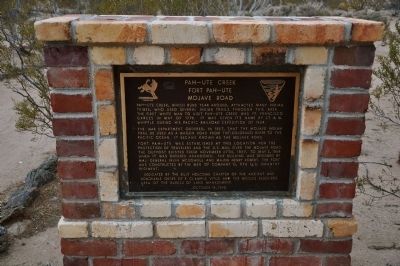
Pah-Ute Creek
Fort Pah-Ute
| — | Mojave Road | — |

Photographed by Craig Baker, December 20, 2024
1. Pah-Ute Creek Marker
The War Department ordered, in 1857, that the Mojave Indian Trail be used as a wagon road from the Colorado River to the Pacific Ocean. It became known as the Mojave Road.
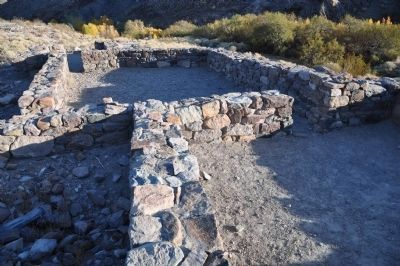
Fort Pah-Ute was established at this location for the protection of travelers and the U.S. Mail over the Mojave Road. The outpost existed from November 27th, 1867, to May 3, 1868 when it was ordered abandoned. The building was designed by Maj. General Irvin McDowell and Major Henry Robert. The fort was constructed by the men of Company D, 9th U.S. Infantry Regiment.
Erected 1990 by Billy Holcomb Chapter No. 1069, E Clampus Vitus and the Needles Resource Area of the Bureau of Land Management. (Marker Number 61.)
Topics and series. This historical marker is listed in these topic lists: Anthropology & Archaeology • Forts and Castles • Indigenous Peoples and Communities
this page online
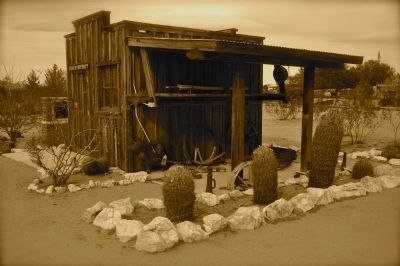
Location. 34° 55.23′ N, 115° 4.068′ W. Marker is in Goffs, California, in San Bernardino County. It is at the intersection of Lanfair Road and Goffs Road, on the right when traveling south on Lanfair Road. Marker is located approximately 500 feet northwest of this intersection, behind the Mojave Road Shack building on the Mojave Desert Heritage & Cultural Association property. Touch for map. Marker is at or near this postal address: 37198 Lanfair Road, Essex CA 92332, United States of America. Touch for directions.

Regionally, this marker is in Greater Los Angeles, in the Mojave Desert, in the Peninsular Ranges, and specifically in the Transverse Ranges. It is also in the American Southwest. Globally, it is in North America, on the Ring of Fire, on the Pacific Rim, in the Western Hemisphere, in the Western World, and in the Anglosphere. Historically, it finds itself in what was once New Spain and also Mexico’s Alta California.
Other nearby markers. At
Photographed by Michael Kindig, December 5, 2009
2. Pah-Ute Creek Marker
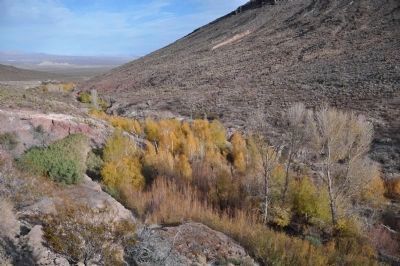
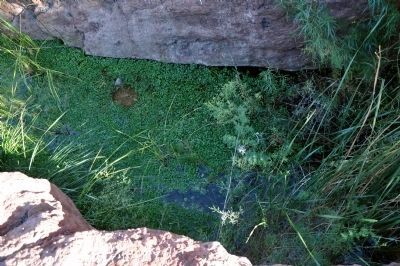
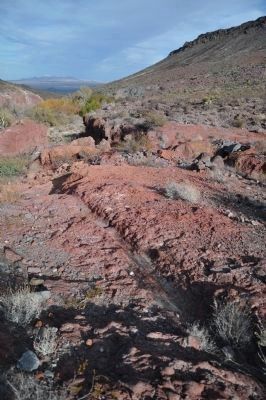
Regarding Pah-Ute Creek. Lt. Amiel Whipple, U.S. Army, while exploring the 35th parallel for a cross-country railroad route, camped at Piute Creek on March 3, 1854 and gave the Creek its name. The Whipple survey party, traveling with an equipment wagon, could not take the direct route up the canyon. They continued the trip by crossing Piute Hill. The grade over Piute Hill developed the reputation as one of the worst grades of all western roads. Upstream may be seen wheel ruts from steel-rimmed wagon wheels climbing up out
Photographed by Michael Kindig, December 5, 2009
3. Mojave Road Shack
Related marker. Click here for another marker that is related to this marker. Fort Pah-Ute, the original location of this plaque.
Also see . . .
1. Historic California Posts: Fort Piute (Fort Beale, Fort Piute Hill). Established in late 1859 by Captain James H. Carleton, 1st Dragoons, this desert post was located near Piute Springs in the foothills of the Mute Mountain range, about 25 miles west of Fort Mojave and 10 miles north of Goffs in San Bernardino County, a few miles west of the California-Nevada border Captain Carleton named the post Fort Beale for Lieutenant Edward F. Beale, U.S. Navy, who, in 1857-59, with his caravan of camels, explored the area for a wagon road. The fort, actually a subpost of Camp Cady, was one of a chain of military stations erected to protect the travel route from San Bernardino across the Mojave Desert to Fort Mojave. (Submitted on December 20, 2011, by Michael Kindig of Elk Grove, California.)
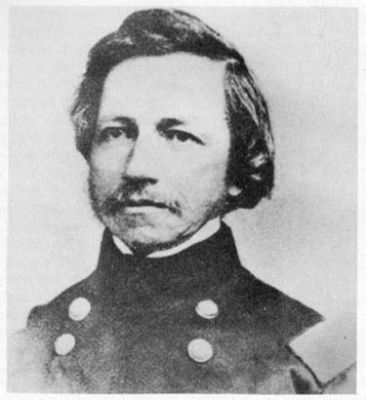
2. Amiel Weeks Whipple (1818 - 1863). American soldier and topographical engineer.

Photographed by Craig Baker, December 20, 2024
4. Pah-Ute Creek Marker and Shack
Goffs Schoolhouse Museum is in the background.
Photographed by Michael Kindig, December 5, 2009
5. Pah-Ute Creek
Photographed by Michael Kindig, November 21, 2009
6. Pah-Ute Creek
Photographed by Michael Kindig, December 5, 2009
7. Wagon Ruts
"Upstream may be seen wheel ruts from steel-rimmed wagon wheels climbing up out of the canyon."
Photographed by Michael Kindig, December 5, 2009
8. Fort Pah-Ute
Photographed by Wikipedia
9. Amiel Weeks Whipple
Photographed by Michael Kindig, October 14, 1990
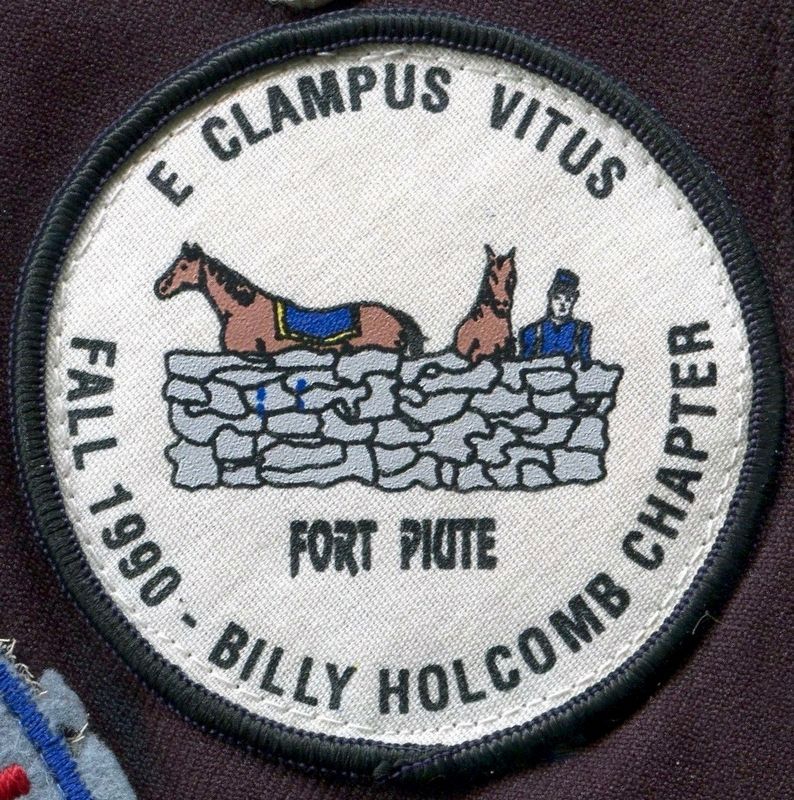
10. Event Patch
E Clampus Vitus, Fall 1990 - Billy Holcomb Chapter, Fort Piute
Credits. This page was last revised on December 21, 2024. It was originally submitted on December 19, 2011, by Michael Kindig of Elk Grove, California. This page has been viewed 1,374 times since then and 31 times this year. Last updated on November 3, 2014, by Michael Kindig of Elk Grove, California. Photos: 1. submitted on December 21, 2024, by Craig Baker of Sylmar, California. 2. submitted on December 19, 2011, by Michael Kindig of Elk Grove, California. 3. submitted on December 24, 2011, by Michael Kindig of Elk Grove, California. 4. submitted on December 21, 2024, by Craig Baker of Sylmar, California. 5, 6, 7, 8. submitted on December 24, 2011, by Michael Kindig of Elk Grove, California. 9. submitted on December 22, 2011, by Michael Kindig of Elk Grove, California. 10. submitted on August 8, 2016, by Michael Kindig of Elk Grove, California. • Bill Pfingsten was the editor who published this page.
