Near St. Francis in Cheyenne County, Kansas — The American Midwest (Upper Plains)
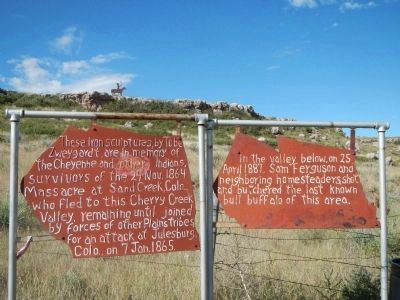
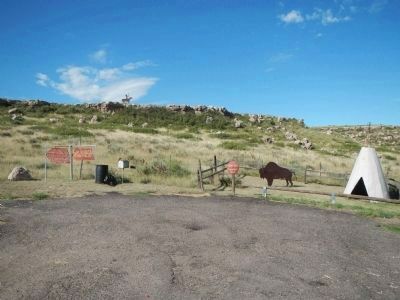
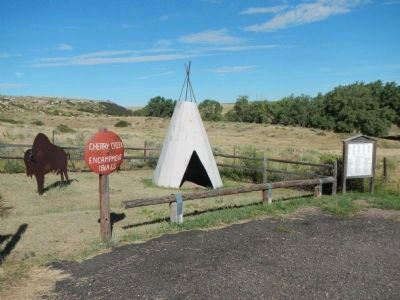
Cherry Creek Encampment, 1864-65
Last Buffalo
Photographed by Barry Swackhamer, August 21, 2014
1. Cherry Creek Encampment, 1864-65 Marker
In the valley below, on 25 April 1887, Sam Ferguson and neighboring homesteaders shot and butchered the last known bull buffalo of this area.
Erected by Todie Zweygardt.
Topics. This historical marker is listed in these topic lists: Animals • Indigenous Peoples and Communities • Wars, US Indian. A significant historical date for this entry is April 25, 1887.
Location. 39° 47.209′ N, 101° 50.342′ W. Marker is near St. Francis, Kansas, in Cheyenne County. It is on State Highway 27 near U.S. 36, on the left when traveling north. Touch for map. Marker is in this post office area: Saint Francis KS 67756, United States of America. Touch for directions.

Regionally, this marker is in the American Midwest, in the Corn Belt, on the prairies, on the Great Plains, on the Southern Plains, and specifically on the High Plains. Globally,
this page online
Other nearby markers. At least one other marker is within 3 miles of this marker, measured as the crow flies: Cheyenne County Veterans Memorial (approx. 2.3 miles away).
Also see . . .
1. Sand Creek massacre - Wikipedia. The Sand Creek Massacre (also known as the Chivington Massacre, the Battle of Sand Creek or the Massacre of Cheyenne Indians) was an atrocity in the American Indian Wars that occurred on November 29, 1864, when a 700-man force of Colorado Territory militia attacked and destroyed a peaceful village of Cheyenne and Arapaho inhabited in southeastern Colorado Territory, killing and mutilating an estimated 70–163 Indians, about two-thirds of whom were women and children. (Submitted on November 14, 2014, by Barry Swackhamer of Brentwood, California.)
2. Julesburg, Colorado - Wikipedia. Julesburg was a large and prominent stagecoach station and the site of Fort Rankin (later Fort Sedgwick). In revenge for the Sand Creek Massacre, one thousand Cheyenne, Arapaho, and Lakota warriors attacked Julesburg on January 7, 1865. In the battle the Indians defeated about 60 soldiers of the U.S. army and 50 armed civilians.
Photographed by Barry Swackhamer, August 21, 2014
2. Cherry Creek Encampment, 1864-65 Marker
Photographed by Barry Swackhamer, August 21, 2014
3. Cherry Creek Encampment, 1864-65 Memorial
Photographed by Barry Swackhamer, August 21, 2014
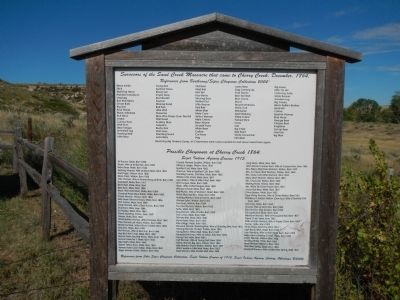
4. List of Sand Creek Survivors and Cheyennes at Cherry Creek, Christmas 1864
Click on this image to enlarge and read it.
Credits. This page was last revised on June 16, 2016. It was originally submitted on November 14, 2014, by Barry Swackhamer of Brentwood, California. This page has been viewed 3,415 times since then and 75 times this year. Photos: 1, 2, 3, 4. submitted on November 14, 2014, by Barry Swackhamer of Brentwood, California. • Al Wolf was the editor who published this page.
