Sweet Spring Hotel - Huntington Infirmary - Sweet Spring Home
Sweet Spring Hotel
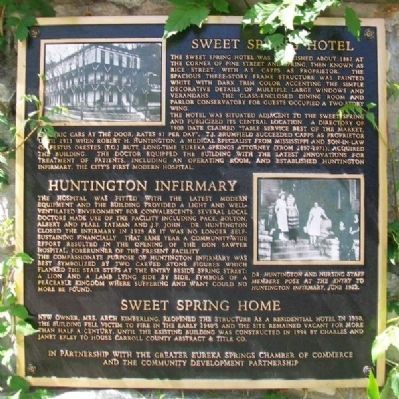
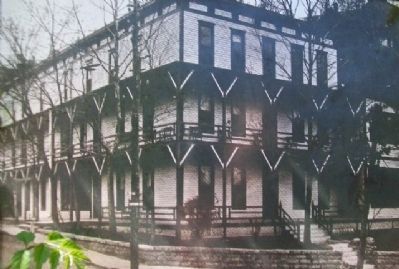
The Sweet Spring Hotel was established about 1887 at the corner of Pine Street and Spring, then known as Rice Street, with A.S. Capps as proprietor. The spacious three-story frame structure was painted white with dark trim color accenting the simple decorative details of multiple large windows and verandahs. The glass-enclosed dining room and parlor conservatory for guests occupied a two-story wing.
The hotel was situated adjacent to the Sweet Spring and publicized its central location. A directory of 1900 date claimed "table service best of the market, electric cars at the door, rates $1 per day". T.J. Brumfield succeeded Capps as proprietor until 1913 when Robert H. Huntington, a medical specialist from Mississippi and son-in-law of Festus Orestes (F.O.) Butt, long-time Eureka Springs attorney (from 1897-1971), acquired the building. The doctor equipped the building with the latest innovations for treatment of patients, including an operating room, and established Huntington Infirmary, the city's first modern hospital.
Huntington Infirmary
The hospital was fitted with the latest modern equipment
this page online
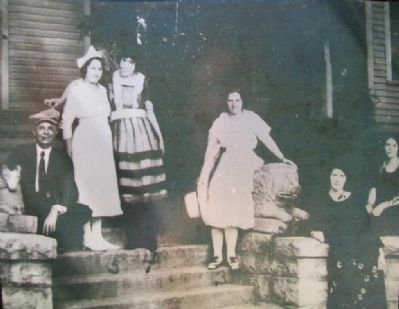
The compassionate purpose of Huntington Infirmary was best symbolized by two carved stone figures which flanked the stair steps at the entry beside Spring Street: a lion and a lamb lying side by side, symbols of a peaceable kingdom where suffering and want could no longer be found.
Sweet Spring Home
New owner, Mrs. Arch Kimberling, reopened the structure as a residential hotel in 1930. The building fell victim to fire in the early 1940's and the site remained vacant for more than half a century, until the existing building was constructed in 1994 by Charles and Janet Epley to house Carroll County Abstract & Title Co.
Erected by Greater Eureka Springs Chamber of Commerce and the Community Development Partnership.
Topics.
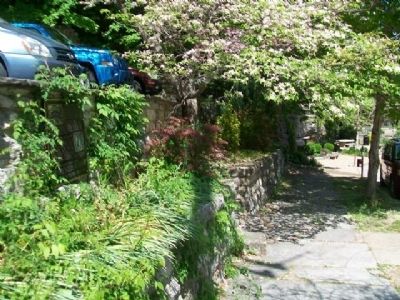
Location. 36° 24.267′ N, 93° 44.309′ W. Marker is in Eureka Springs, Arkansas, in Carroll County. It is at the intersection of Spring Street and Pine Street, on the left when traveling east on Spring Street. Touch for map. Marker is at or near this postal address: 101 Spring Street, Eureka Springs AR 72632, United States of America. Touch for directions.

Regionally, this marker is on the Ozark Plateau, in the Cherokee Heritage Region, and in Osage Territory. It is also in the American South, specifically in the Upper South, and in the Ozarks. Globally, it is in North America, the Western Hemisphere, the Western World, and the Anglosphere. Historically, it finds itself in what was once the territory of the Mississippian Culture, the Louisiana Purchase, one of the Confederate States of America, and the Antebellum South.
Other nearby markers. At least 8 other markers are within walking distance of this marker: Fire and Brick & Stone
Credits. This page was last revised on August 16, 2020. It was originally submitted on January 4, 2015, by William Fischer, Jr. of Reynoldsburg, Ohio. This page has been viewed 886 times since then and 46 times this year. Photos: 1, 2, 3, 4. submitted on January 4, 2015, by William Fischer, Jr. of Reynoldsburg, Ohio.
