Onward in Sharkey County, Mississippi — The American South (East South Central)
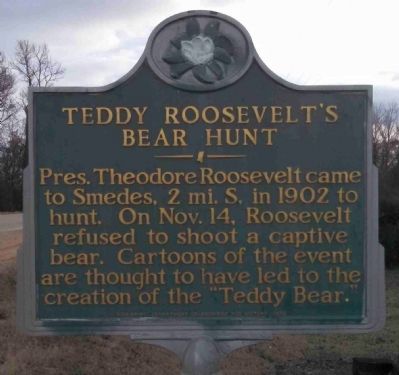
Teddy Roosevelt's Bear Hunt
Photographed by Cleo Robertson, January 4, 2015
1. Teddy Roosevelt's Bear Hunt Marker
Pres. Theodore Roosevelt came to Smedes, 2 mi. S, in 1902 to hunt. On Nov. 14, Roosevelt refused to shoot a captive bear. Cartoons of the event are thought to have led to the creation of the "Teddy Bear."
Erected 1986 by Mississippi Department of Archives and History.
Topics and series. This historical marker is listed in these topic lists: Animals • Arts, Letters, Music • Environment • Sports. In addition, it is included in the Former U.S. Presidents: #26 Theodore Roosevelt, and the Mississippi State Historical Marker Program series lists. A significant historical month for this entry is October 1899.
Location. Marker is missing. It was located near 32° 43.474′ N, 90° 56.397′ W. Marker was in Onward, Mississippi, in Sharkey County. It was at the intersection of U.S. 61 and State Route 1, on the right when traveling south on U.S. 61. Located at the Onward Store, south of the fuel pumps. Parking area and easy hwy pull-off is provided. Touch for map. Marker was at or near this postal address: 6693 US-61, Rolling Fork MS 39159, United States of America. Touch for directions.

Regionally, this marker was in the American
this page online
Other nearby markers. At least 8 other markers are within 14 miles of this location, measured as the crow flies: Hill’s Plantation (approx. 0.6 miles away); a different marker also named Hill’s Plantation (approx. 0.6 miles away); Cary Mounds (approx. 5½ miles away); a different marker also named Cary Mounds (approx. 5½ miles away); Aden Mounds (approx. 8½ miles away); Rolling Fork Mounds (approx. 12.4 miles away); Sharkey County Courthouse (approx. 13.2 miles away); The Story of Teddy Bears (approx. 13.3 miles away). Touch for a list and map of all markers in Onward.
Other markers no longer nearby. What is a Shotgun Shack? (was approx. 13.2 miles away but has been confirmed missing); Muddy Waters (was approx. 13.2 miles away
Photographed by Cleo Robertson, January 4, 2015
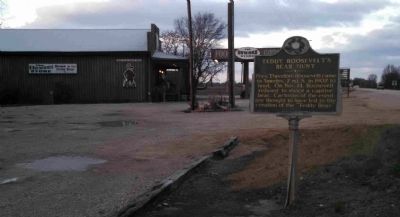
2. Teddy Roosevelt's Bear Hunt Marker
The Onward Store is located near the sign. The store celebrates the history and notoriety that the sign brings it.
Also see . . .
1. Rolling Fork, Mississippi - Chainsaw Teddy Roosevelt Bears. Roadside America website entry (Submitted on January 4, 2015, by Cleo Robertson of Fort Lauderdale, Florida.)
2. Delta National Forest Information. Forest Camping website entry (Submitted on January 4, 2015, by Cleo Robertson of Fort Lauderdale, Florida.)
3. Going on a bear hunt - the Onward Store near Rolling Fork celebrates the Great Bear. Free Library website entry (Submitted on January 4, 2015, by Cleo Robertson of Fort Lauderdale, Florida.)
4. The History of the Teddy Bear: From Wet and Angry to Soft and Cuddly. Smithsonian Magazine website entry (Submitted on June 25, 2024, by Larry Gertner of New York, New York.)
5. The Teddy Bear. Factoids website entry:
Original Swedish article reproduced in English. (Submitted on January 4, 2015, by Cleo Robertson of Fort Lauderdale, Florida.)
Photographed by Cleo Robertson, January 4, 2015
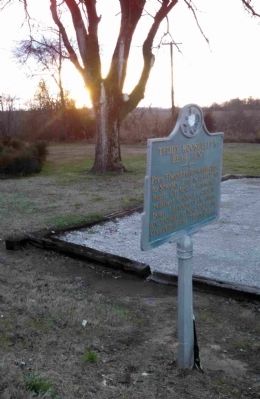
3. Teddy Roosevelt's Bear Hunt Marker
Marker shown with the sun setting in the western sky.
Photographed by Cleo Robertson, January 4, 2015
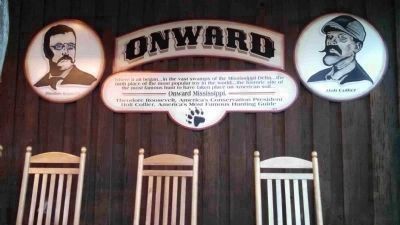
4. Teddy Roosevelt's Bear Hunt & Onward Display
Where it all began...in the vast swamps of the Mississippi Delta...the birth place of the most popular toy in the world...the historic site of the most famous hunt to have taken place on American soil...
-----Onward Mississippi.-----
Theodore Roosevelt, America's Conservation President.
Holt Collier, America's Most Famous Hunting Guide.
November 6, 1902
5. The Birth of the Teddy Bear
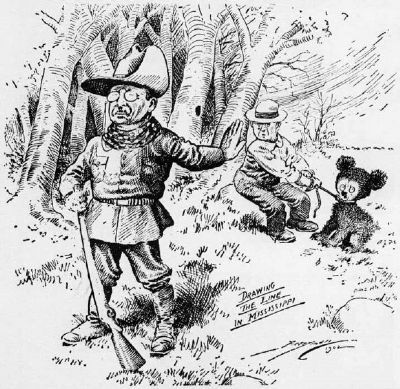
In November 1902, the American President Theodore ‘Teddy’ Roosevelt was relaxing during a trip to settle a border dispute in Mississippi and was taking part in a hunting trip in the state of Mississippi. Having had no luck in finding a bear, members of the presidential hunting party tracked and caught a small black bear which, as the story goes, was a motherless cub. They tied it to a tree and then “invited” the President to shoot it as a trophy of his visit. When the president arrived on the scene he refused to shoot the bear, considering it to be unsportsmanlike. The incident caused Clifford K. Berryman to draw a cartoon titled “Drawing The Line in Mississippi” which linked the incident to the political dispute that had taken President Roosevelt to Mississippi in the first place. (This is the redrawn image of Clifford K. Berryman's first image.)
Photographed by Cleo Robertson, January 4, 2015
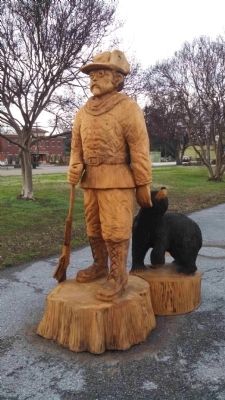
6. Wood Carvings of Teddy Roosevelt & Bear on Display in Rolling Fork
Photographed by Cleo Robertson, January 4, 2015
7. The Onward Store
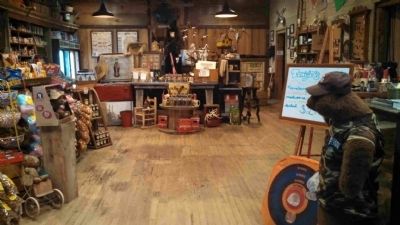
Inside view of the Onward Store, celebrating the folklore of Pres. Theodore Roosevelt's hunting visit to Mississippi Delta in 1902 and the resulting notoriety it's brought this little community.
Photographed by Cleo Robertson, January 4, 2015
8. The Onward Store Wagon
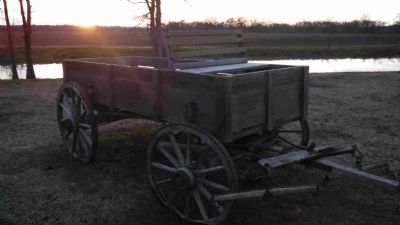
One of the historic pieces of transport from the turn-of-the-century era when Pres. Roosevelt visited the community. Food, clothing and hunting supplies for the president's visit would have been carried in such a wagon.
Photographed by Allen C. Browne, August 9, 2015
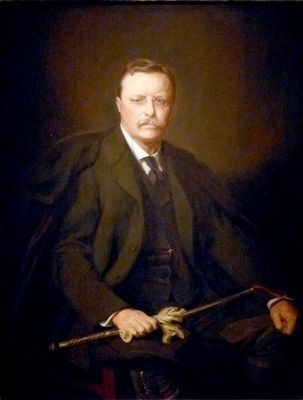
9. Theodore Roosevelt
This 1967 portrait of Theodore Roosevelt by Adrian Lamb after Philip de Lászlo's 1908 original hangs in the National Portrait Gallery in Washington DC.
“No one ever craved the presidency more than Theodore Roosevelt or used its powers more joyously. In early 1901, however, his rise toward that office was suddenly checked. Having gained national prominence as a civil service reformer, Spanish-American War hero, and reform-minded governor of New York, he was now relegated to being William McKinley's vice president. But McKinley's assassination several months later changed everything, and Roosevelt was soon rushing headlong into one of American history's most productive presidencies. By the time he left office in 1909, his accomplishments ranged from implementing landmark efforts to conserve the nation's disappearing natural heritage, to instituting some of the first significant curbs on the excesses of big business, to building the Panama Canal.
When Hungarian-born English artist Philip de Lászlo painted the original version of this portrait, he encouraged Roosevelt to have visitors chat with him during the sittings, apparently thinking that it made for a more animated likeness.” — National Portrait Gallery
“No one ever craved the presidency more than Theodore Roosevelt or used its powers more joyously. In early 1901, however, his rise toward that office was suddenly checked. Having gained national prominence as a civil service reformer, Spanish-American War hero, and reform-minded governor of New York, he was now relegated to being William McKinley's vice president. But McKinley's assassination several months later changed everything, and Roosevelt was soon rushing headlong into one of American history's most productive presidencies. By the time he left office in 1909, his accomplishments ranged from implementing landmark efforts to conserve the nation's disappearing natural heritage, to instituting some of the first significant curbs on the excesses of big business, to building the Panama Canal.
When Hungarian-born English artist Philip de Lászlo painted the original version of this portrait, he encouraged Roosevelt to have visitors chat with him during the sittings, apparently thinking that it made for a more animated likeness.” — National Portrait Gallery
Credits. This page was last revised on August 31, 2026. It was originally submitted on January 4, 2015, by Cleo Robertson of Fort Lauderdale, Florida. This page has been viewed 1,790 times since then and 92 times this year. Photos: 1, 2, 3, 4, 5. submitted on January 4, 2015, by Cleo Robertson of Fort Lauderdale, Florida. 6. submitted on January 5, 2015, by Cleo Robertson of Fort Lauderdale, Florida. 7, 8. submitted on January 4, 2015, by Cleo Robertson of Fort Lauderdale, Florida. 9. submitted on October 24, 2015, by Allen C. Browne of Silver Spring, Maryland. • Bernard Fisher was the editor who published this page.
