Near Berthier-sur-Mer in Chaudière-Appalaches, Québec — Central Canada (French-Canadian)
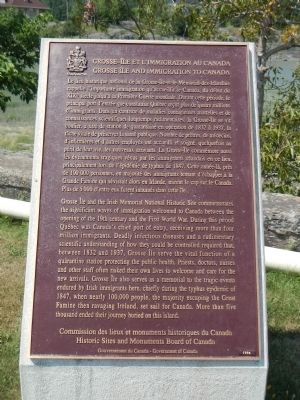
Grosse Île and Immigration to Canada
Grosse-Île et l’immigration au Canada
Photographed by Barry Swackhamer, July 22, 2014
1. Grosse Île and Immigration to Canada Marker

English:
Grosse Île and the Irish Memorial National Historic Site commemorates the significant waves of immigration welcomed to Canada between the opening of the 19th century and the First World War. During this period Québec was Canada's chief port of entry, receiving more than four million immigrants. Deadly infectious diseases and a rudimentary scientific understanding of how they could be controlled required that, between 1832 and 1937, Grosse Île serve the vital function of a quarantine station protecting the public health. Priests, doctors, nurses and other staff often risked their own lives to welcome and care for the new arrivals. Grosse Île also serves as a memorial to the tragic events endured by Irish immigrants here, chiefly during the typhus epidemic of 1847, when nearly 100,000 people, the majority escaping the Great Famine then ravaging Ireland, set sail for Canada. More than five thousand ended their journey buried on this island.
French:
this page online
Erected 1998 by Historic Sites and Monuments Board of Canada.
Topics and series. This historical marker is listed in these topic lists: Cemeteries & Burial Sites • Science & Medicine • Settlements & Settlers.
Photographed by Barry Swackhamer, July 22, 2014
2. Grosse Île and Immigration to Canada Marker
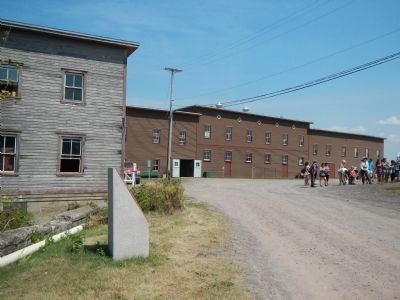
Disinfection building in the background.
Location. 47° 1.236′ N, 70° 40.355′ W. Marker is near Berthier-sur-Mer, Québec, in Chaudière-Appalaches. It is on Rue de la Marina. Touch for map. Marker is in this post office area: Berthier-sur-Mer QC G0R 1E0, Canada. Touch for directions.

Regionally, this marker is in the Québec City Region. It is also in Central Canada. Globally, it is in North America, the Western Hemisphere, and the Western World. Historically, it finds itself in what was once a British colony, the Viceroyalty of New France, the Haudenosaunee (Iroquois) Confederacy, and Rupert’s Land.
Other nearby markers. At least 8 other markers are within 11 kilometers of this marker, measured as the crow flies: Cholera arrives in the Americas (within shouting distance of this marker); Doukhobor Immigrants (approx. 0.2 kilometers away); The Celtic Cross (approx. 0.4 kilometers away); Veterinarians Mark the History of Animal Health in Canada (approx. 0.8 kilometers away); Sir Étienne Paschal Taché (approx. 9.6 kilometers away);
Photographed by Barry Swackhamer, July 22, 2014
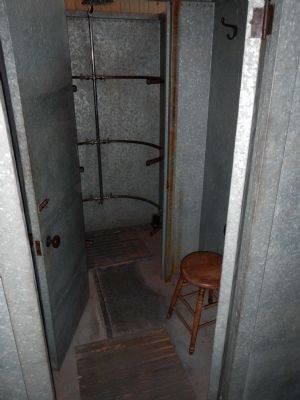
3. Shower
Many immigrants were unfamiliar with showering so these showers were designed so that one could not avoid getting completely wet and disinfected.
More about this marker. Grosse Île and the Irish Memorial National Historic Site of Canada is only accessible by ferry from Berthier-sur-Mer. This marker is located near the Disinfection Building, now the Visitors Centre and Museum.
Also see . . . Grosse Île and the Irish Memorial National Historic Site. "In the 19th century, an increasing stream of people was leaving Europe to rebuild their lives in North America. Around 1830, an average of 30,000 immigrants arrived annually in the City of Québec, the main port of entry to Canada. Approximately two-thirds of these newcomers were from Ireland. This unprecedented immigration on the St. Lawrence River took place at a time when major cholera and smallpox epidemics were sweeping through Europe. In order to help control the spread of the diseases, the quarantine station at Grosse Île, located in the St. Lawrence River downstream from the City of Québec, was established in 1832 and operated until its closure in 1937."
Photographed by Barry Swackhamer, July 22, 2014
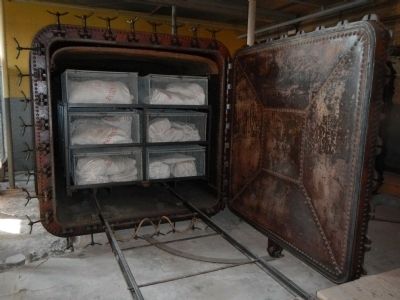
4. Clothing disinfecting 'oven'
Photographed by Barry Swackhamer, July 22, 2014
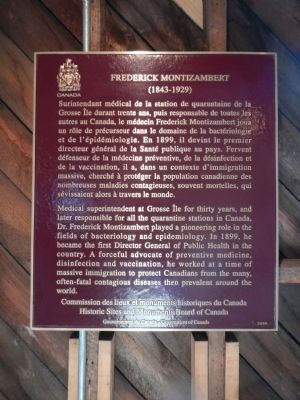
5. Frederick Montizambert plaque, inside the Disinfection Building
English:
Medical superintendent at Grosse Île for thirty years, and later responsible for all the quarantine stations in Canada, Dr. Frederick Montizambert played a pioneering role in the fields of bacteriology and epidemiology. In 1899, he became the first Director General of Public Health in the country. A forceful advocate of preventive medicine, disinfection and vaccination, he worked at a time of massive immigration to protect Canadians from the many, often-fatal contagious diseases then prevalent around the world.br French:
Surintendant médical de la station de quarantaine de la Grosse Île durant trente ans, puis responsable de toutes les autres au Canada, le médecin Frederick Montizambert joua un rôle de précurseur dans le domaine de la bactériologie et de l'épidémiologie. En 1899, il devint le premier directeur général de la Santé publique au pays. Fervent défenseur de la médecine préventive, de la désinfection et de la vaccination, il a, dans un contexte d'immigration massive, cherché à protéger la population canadienne des nombreuses maladies contagieuses, souvent mortelles, qui sévissaient alors à travers le monde.
Photographed by Barry Swackhamer, July 22, 2014
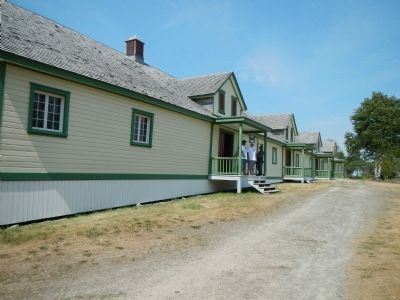
6. Sanatorium
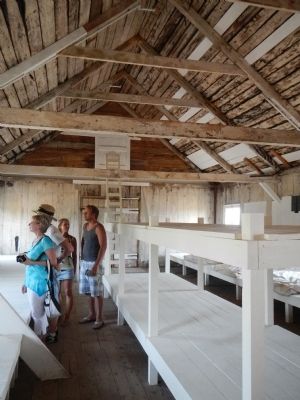
Built to house patients recovering from cholera.
Photographed by Barry Swackhamer, July 22, 2014
7. Sanatorium
Photographed by Barry Swackhamer, July 22, 2014
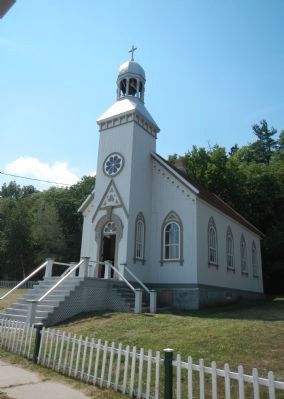
8. Catholic chapel
Photographed by Barry Swackhamer, July 23, 2014
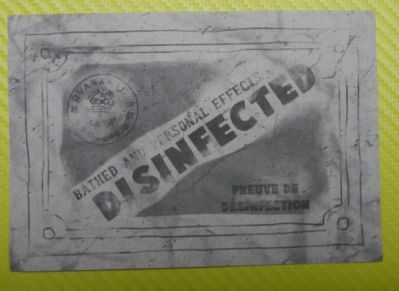
9. Permit to leave the island
Credits. This page was last revised on April 10, 2025. It was originally submitted on February 7, 2015, by Barry Swackhamer of Brentwood, California. This page has been viewed 881 times since then and 87 times this year. Photos: 1, 2, 3, 4, 5, 6, 7, 8, 9. submitted on February 7, 2015, by Barry Swackhamer of Brentwood, California. • Andrew Ruppenstein was the editor who published this page.
