Bellevue in Sarpy County, Nebraska — The American Midwest (Upper Plains)
Big Elk, Bellevue Cemetery
Photographed by Daniel Shurtliff, February 8, 2015
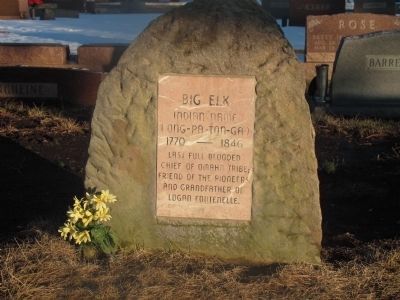
1. Big Elk, Bellevue Cemetery Marker
Big Elk tombstone.
Indian Name
(Ong-Pa-Ton-Ga)
1770 - 1846
Topics. This historical marker is listed in these topic lists: Cemeteries & Burial Sites • Indigenous Peoples and Communities. A significant historical year for this entry is 1770.
Location. 41° 8.982′ N, 95° 53.671′ W. Marker is in Bellevue, Nebraska, in Sarpy County. It is on West Lane in Bellevue Cemetery., on the right when traveling north. Bellevue Cemetery is located at 100-198 W. 13th Avenue. It is about one mile north of Mission / Highway 370. Touch for map. Marker is in this post office area: Bellevue NE 68005, United States of America. Touch for directions.

Regionally, this marker is in Eastern Nebraska and in Greater Omaha. It is also in the American Midwest, in the Lewis & Clark Corridor, in the Corn Belt, and on the prairies. Globally, it is in North America, the Western Hemisphere, the Western World, and the Anglosphere. Historically, it finds itself in what was once the Louisiana Purchase.
Other nearby markers. At least 8 other markers
this page online
More about this marker. The tombstone is located in the northwest quadrant of the cemetery, up the hill. The marker and bench are on the east side of the narrow lane.
Photographed by Daniel Shurtliff, February 8, 2015
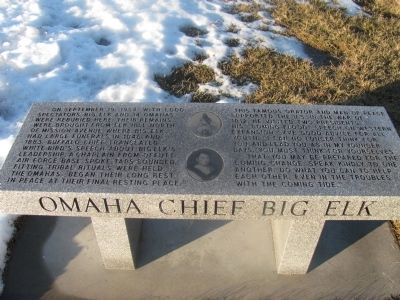
2. Big Elk bench, Bellevue Cemetery.
On September 19, 1954, with 1,000 spectators, Big Elk and 14 Omahas were reburied here. Their remains were brought from Elk Hill north of Mission Avenue where Big Elk had large funerals in 1846 and 1883. Buffalo Chief translated White Bird's speech about Big Elk's leadership. A chaplain from Offutt Air Force Base spoke. Taps sounded. Fitting tribal rituals were held. The Omahas "began their long rest in peace at their final resting place."
This famous orator and man of peace supported the U.S. in the War of 1812. He visited two presidents. His "Coming Flood" speech one western expansion gave good advice for all youth: "I can no longer think for you and lead you as in my younger days. You must think for yourselves... that you may be prepared for the coming change. Speak kindly to one another; Do what you can to help each other, even in the troubles with the coming tide."
Photographed by Daniel Shurtliff,
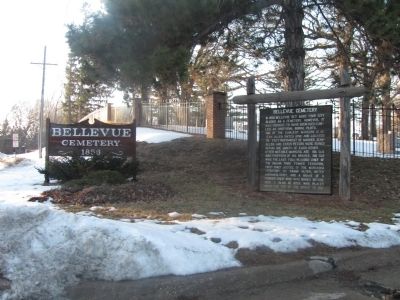
3. Bellevue Cemetery
The entrance to Bellevue Cemetery.
Credits. This page was last revised on June 16, 2016. It was originally submitted on February 11, 2015, by Joan Shurtliff of Seward, Nebraska. This page has been viewed 1,843 times since then and 112 times this year. Photos: 1, 2, 3. submitted on February 11, 2015, by Joan Shurtliff of Seward, Nebraska. • Andrew Ruppenstein was the editor who published this page.
