Hermitage in Davidson County, Tennessee — The American South (East South Central)
Alfred’s Cabin
A Life of Toil
Photographed by Darren Jefferson Clay, November 12, 2022
1. Alfred’s Cabin Marker
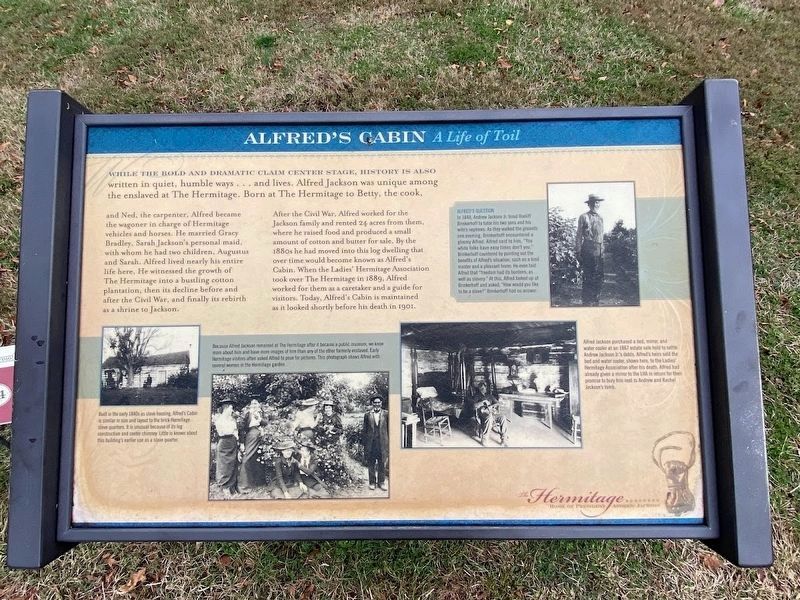
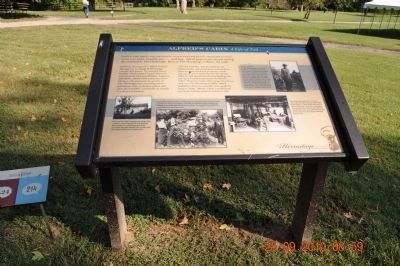
After the Civil War, Alfred worked for the Jackson family and rented 24 acres from them, where he raised food and produced a small amount of cotton and butter for sale. By the 1880s he had moved into this log dwelling that over time would become known as Alfred’s Cabin. When the Ladies’ Hermitage Association took over The Hermitage in 1889, Alfred worked for them as caretaker and a guide for visitors. Today, Alfred’s Cabin is maintained as it looked shortly before his death in 1901.
(sidebar)
Alfred's Question
In
this page online
Topics. This historical marker is listed in these topic lists: African Americans • Agriculture • Animals • Roads & Vehicles • Settlements & Settlers. A significant historical year for this entry is 1889.
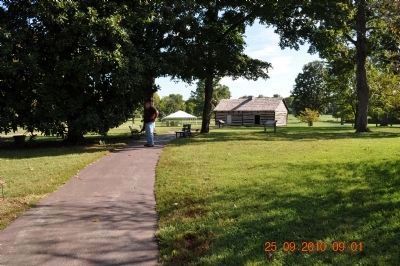
Location. 36° 12.932′ N, 86° 36.768′ W. Marker is in Hermitage, Tennessee, in Davidson County. It can be reached from Rachels Lane 0.3 miles east of Hermitage Road. Marker is located just feet away from Alfred's Cabin behind The Hermitage mansion. Touch for map. Marker is at or near this postal address: 4850 Rachels Lane, Hermitage TN 37076, United States
Photographed by Sandra Hughes, September 25, 2010
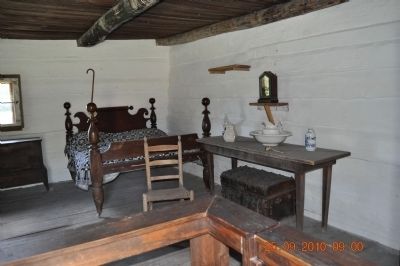
2. Inside Alfred’s Cabin
Alfred Jackson purchased a bed, mirror, and water cooler at an 1867 estate sale held to settle Andrew Jackson Jr.’s debts. Alfred’s heirs said the bed and water cooler, shown here, to the Ladies’ Hermitage Association after his death. Alfred had already given a mirror to the LHA in return for their promise to bury him next to Andrew and Rachel Jackson’s tomb.

Regionally, this marker is in Middle Tennessee and in Greater Nashville. It is also in the American South and specifically in the Upper South. Globally, it is in North America, the Western Hemisphere, the Western World, and the Anglosphere. Historically, it finds itself in what was once the territory of the Mississippian Culture, one of the Confederate States of America, and the Antebellum South.
Other nearby markers. At least 8 other markers are within walking distance of this marker: The Work Yard (a few steps from this marker); A Landscape Of Inequality (within shouting distance of this marker); The Triplex (within shouting distance of this marker); Icehouse (within shouting distance of this marker); Explore The Hermitage Grounds (within shouting distance of this marker); The Hermitage Garden (within shouting distance of this marker); The Garden Privy (within shouting distance of this marker); Property, Family, Humanity (about 300 feet away, measured in a direct line). Touch for a list and map of all markers in Hermitage.
Also see . . .
1. The Hermitage, The Home of President Andrew Jackson.
Photographed by Sandra Hughes, September 25, 2010
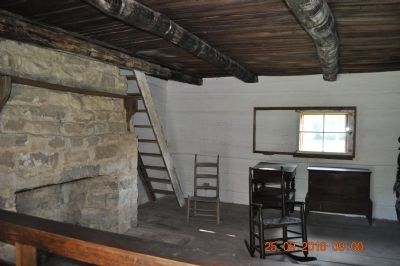
3. Inside Alfred’s Cabin
2. The Hermitage, Alfred's Cabin, 4580 Rachel's Lane, Hermitage, Davidson County, TN. The Historic American Buildings Survey Record for Alfred's Cabin: Significance:Alfred's Cabin is an important part of General Andrew Jackson's plantation, The Hermitage, because it is the only remaining dwelling on the property that can be directly linked to its slaves. Recent dendrochronology studies by Dr. Henri Griss Ino-Mayer, University of Tennessee at Knoxville, show the cabin to be built of eastern red cedar logs in 1843. (Submitted on July 13, 2015.)
Photographed by Sandra Hughes, September 25, 2010
4. Alfred’s Cabin Marker
Photographed by Sandra Hughes, September 25, 2010
5. Alfred’s Cabin Marker
Photographed by Sandra Hughes, September 25, 2010
6. Alfred’s Cabin
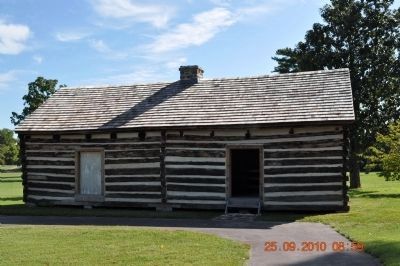
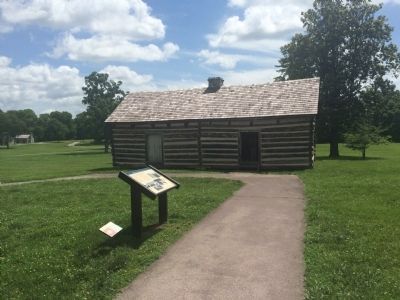
Built in the early 1840s as slave housing, Alfred’s Cabin is similar in size and layout to the brick Hermitage slave quarters. It is unusual because of its log construction and center chimney. Little is known about this building’s earlier use as a slave quarter
Photographed by Sandra Hughes, September 25, 2010
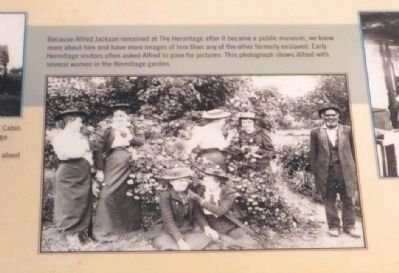
7. Alfred with several women in the Hermitage garden.
Because Alfred Jackson remained at The Hermitage after it became a public museum, we know more about him and have more images of him than any of the other formerly enslaved. Early Hermitage visitors often ask Alfred to pose for pictures. This photograph shows Alfred with several women in the Hermitage garden.
Photographed by Sandra Hughes, September 25, 2010
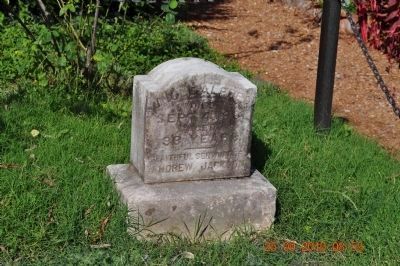
8. Alfred’s grave
Photographed by Sandra Hughes, September 25, 2010
9. Alfred
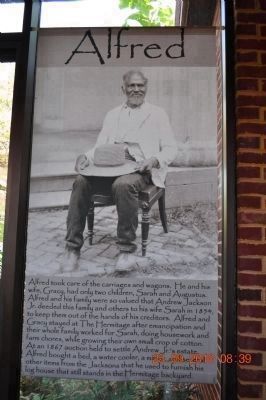
Alfred took care of the carriages and wagons. He and his wife, Gracy, had only two children, Sara and Augustus. Alfred and his family were so valued that Andrew Jackson Jr. deeded this family and others to his wife Sarah in 1854, to keep them out of the hands of his creditors. Alfred and Gracy stayed at The Hermitage after emancipation and their whole family worked for Sarah, doing housework and farm chores, while growing their own small crop of cotton. At an 1867 auction held to settle Andrew Jr.'s estate, Alfred bought a bed, a water cooler, a mirror, and several other items from the Jacksons that he used to furnish his log house that still stands in the Hermitage backyard.
Photographed by J. Makali Bruton, June 14, 2015
10. Wide view of Alfred’s Cabin Marker
Credits. This page was last revised on February 7, 2023. It was originally submitted on February 9, 2012, by Sandra Hughes Tidwell of Killen, Alabama, USA. This page has been viewed 3,028 times since then and 194 times this year. Last updated on March 13, 2015, by J. Makali Bruton of Washington, District of Columbia. Photos: 1. submitted on January 23, 2023, by Darren Jefferson Clay of Duluth, Georgia. 2, 3, 4, 5, 6, 7, 8, 9. submitted on February 9, 2012, by Sandra Hughes Tidwell of Killen, Alabama, USA. 10. submitted on July 12, 2015, by J. Makali Bruton of Washington, District of Columbia. • Bill Pfingsten was the editor who published this page.
