Pulaski in Giles County, Tennessee — The American South (East South Central)
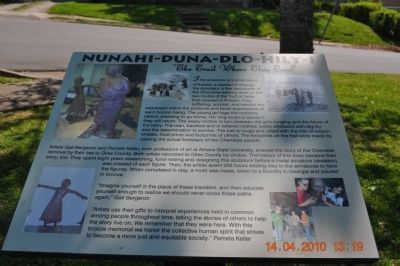
Nunahi-Duna-Dlo-Hily-I
"The Trail Where They Cried"
Photographed by Sandra Hughes, April 14, 2010
1. Nunahi-Duna-Dlo-Hily-I Marker
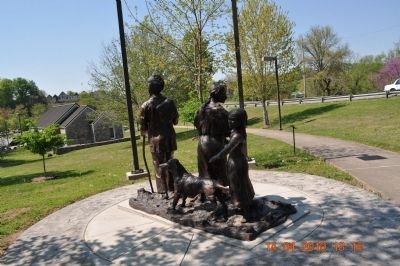
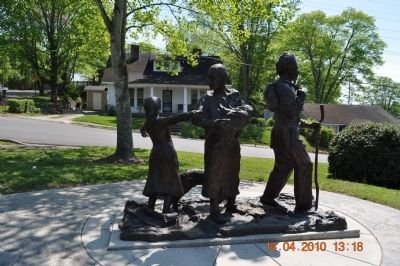
Artist Gail Bergeron and Pamela Keller, both professors of art at Athens State University, entered the story of the Cherokee removal by their ties to Giles County. Both artists relocated to Giles County by choice. The history of this town became their story, too. They spent eight years researching, fund-raising and designing this sculpture before
this page online
"Imagine yourself in the place of these travelers, and then educated yourself enough to realize we should never cross these paths again." Gail Bergeron
"Artist used their gifts to interpret experiences held in common among people throughout time, telling the stories of other to help the story live on. We remember that they were here. With this bronze memorial we honor the collective human spirit that strives to become a more just and equitable society." Pamela Keller
Topics and series. This historical marker is listed in these topic lists: Indigenous Peoples and Communities • Notable Events • Notable Places. In addition, it is included in the Trail of Tears series list.
Location. 35° 11.731′ N, 87° 1.762′ W. Marker is in Pulaski, Tennessee, in Giles County. It is at the intersection of Stadium Street and South Rhodes Street on Stadium Street.
Photographed by Sandra Hughes, April 14, 2010
2. Nunahi-Duna-Dlo-Hily-I Statues

Regionally, this marker is in Middle Tennessee and in the Highland Rim. It is also in the American South and specifically in the Upper South. Globally, it is in North America, the Western Hemisphere, the Western World, and the Anglosphere. Historically, it finds itself in what was once the territory of the Mississippian Culture, one of the Confederate States of America, and the Antebellum South.
Other nearby markers. At least 8 other markers are within walking distance of this marker: Trail of Tears (a few steps from this marker); The Benge Route (within shouting distance of this marker); The Trail of Tears Interpretive Center (within shouting distance of this marker); The Bell Route (within shouting distance of this marker); Giles County Courthouses (within shouting distance of this marker); Count Casimir Pulaski (1747-1779) (within shouting distance of this marker); Native Americans in Giles County (within shouting distance of this marker); Establishment of Pulaski / Giles County
Photographed by Sandra Hughes, April 14, 2010
3. Nunahi-Duna-Dlo-Hily-I Statues
Credits. This page was last revised on June 16, 2016. It was originally submitted on April 15, 2010, by Sandra Hughes Tidwell of Killen, Alabama, USA. This page has been viewed 1,713 times since then and 26 times this year. Last updated on March 15, 2015, by J. Makali Bruton of Washington, District of Columbia. Photos: 1, 2, 3. submitted on April 15, 2010, by Sandra Hughes Tidwell of Killen, Alabama, USA. • Bill Pfingsten was the editor who published this page.
