Old Montreal in Montréal, Québec — Central Canada (French-Canadian)
Kondiaronk and Callière
Kondiaronk et Callière
Photographed by Barry Swackhamer, August 5, 2014
1. Kondiaronk and Callière Marker
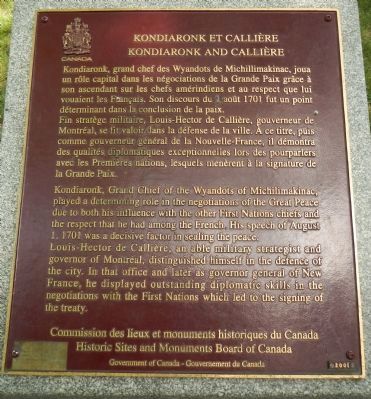
Kondiaronk, Grand Chief of the Wyandots of Michilimakinac, played a determining role in the negotiations of the Great Peace due to both his influence with the other First Nations chiefs and the respect that he had among the French. His speech of August 2, 1701 was a decisive factor in sealing the peace. Louis-Hector de Callière, an able military strategist and governor of Montréal, distinguished himself in the defence of the city. In that office and later as governor general of New France, he displayed outstanding diplomatic skills in the negotiations with the First Nations which led to the signing of the treaty.
French:
Kondiaronk, grand chef des Wyandots de Michillimakinac, joua un rôle capital dans les négociations de la Grande Paix grâce à son ascendant sur les chefs amérindiens et au respect que lui vouaient les Français. Son discours du 2 août 1701 fut un point déterminant dans la conclusion de la paix. Fin stratège militaire, Louis-Hector de Callière, gouverneur de Montréal, se fit valoir dans la défense de la ville. À ce titre, puis comme gouverneur général de la Nouvelle-France, il démontra des qualités
this page online
Erected 2001 by Historic Sites and Monument Board of Canada/Commission de lieux et monuments historique du Canada.
Topics and series. This historical marker is listed in these topic lists: Indigenous Peoples and Communities • Peace • War, French and Indian. In addition, it is included in the Canada, Historic Sites and Monuments Board series list. A significant historical year for this entry is 1701.
Location. 45° 30.097′ N, 73° 33.307′ W. Marker is in Montréal, Québec. It is in Old Montreal. It is on Place d'Youville close to Rue Saint-Nicolas, in the median. Touch for map. Marker is at or near this postal address: 285 Place d'Youville, Montréal QC H2Y 2B3, Canada. Touch for directions.

Regionally, this marker is in Central Canada. Globally, it is in North America, the Western Hemisphere, and the Western World. Historically, it finds itself in what was once a British colony, the Viceroyalty of New France, the Haudenosaunee (Iroquois) Confederacy, and Rupert’s Land.
Other nearby markers. At
Photographed by Barry Swackhamer, August 5, 2014
2. Kondiaronk and Callière Marker
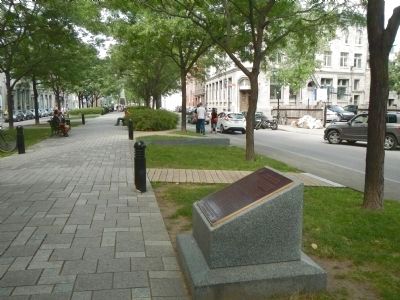
More about this marker. This marker is in Place de la Grande-Paix de Montréal.
Also see . . . The Great Peace of Montreal - Wikipedia. The Great Peace of Montreal was a peace treaty between New France and 40 First Nations of North America. It was signed on August 4, 1701, by Louis-Hector de Callière, governor of New France, and 1300 representatives of 40 aboriginal nations. (Submitted on April 2, 2015, by Barry Swackhamer of Brentwood, California.)
Credits. This page was last revised on February 9, 2023. It was originally submitted on April 2, 2015, by Barry Swackhamer of Brentwood, California. This page has been viewed 921 times since then and 66 times this year. Photos: 1, 2. submitted on April 2, 2015, by Barry Swackhamer of Brentwood, California. • Andrew Ruppenstein was the editor who published this page.
