Araby View in Frederick in Frederick County, Maryland — The American Northeast (Mid-Atlantic)
Retreat
Photographed by Shawn Oliver, April 2, 2015
1. Retreat Marker
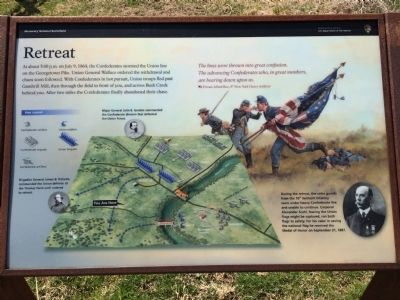
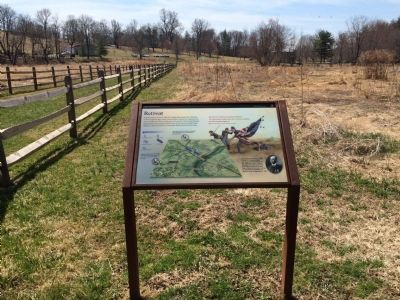
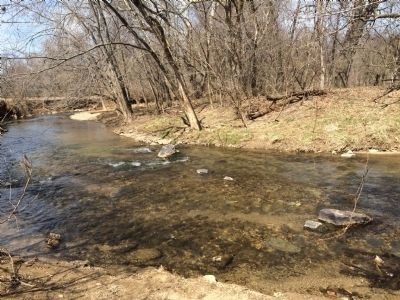
At about 5:00 p.m. on July 9, 1864, the Confederates stormed the Union line on the Georgetown Pike. Union General Wallace ordered the withdrawal and chaos soon followed. With Confederates in hot pursuit, Union troops fled past Gambrill Mill, then through the field in front of you, and across Bush Creek behind you. After two miles the Confederates finally abandoned their chase.
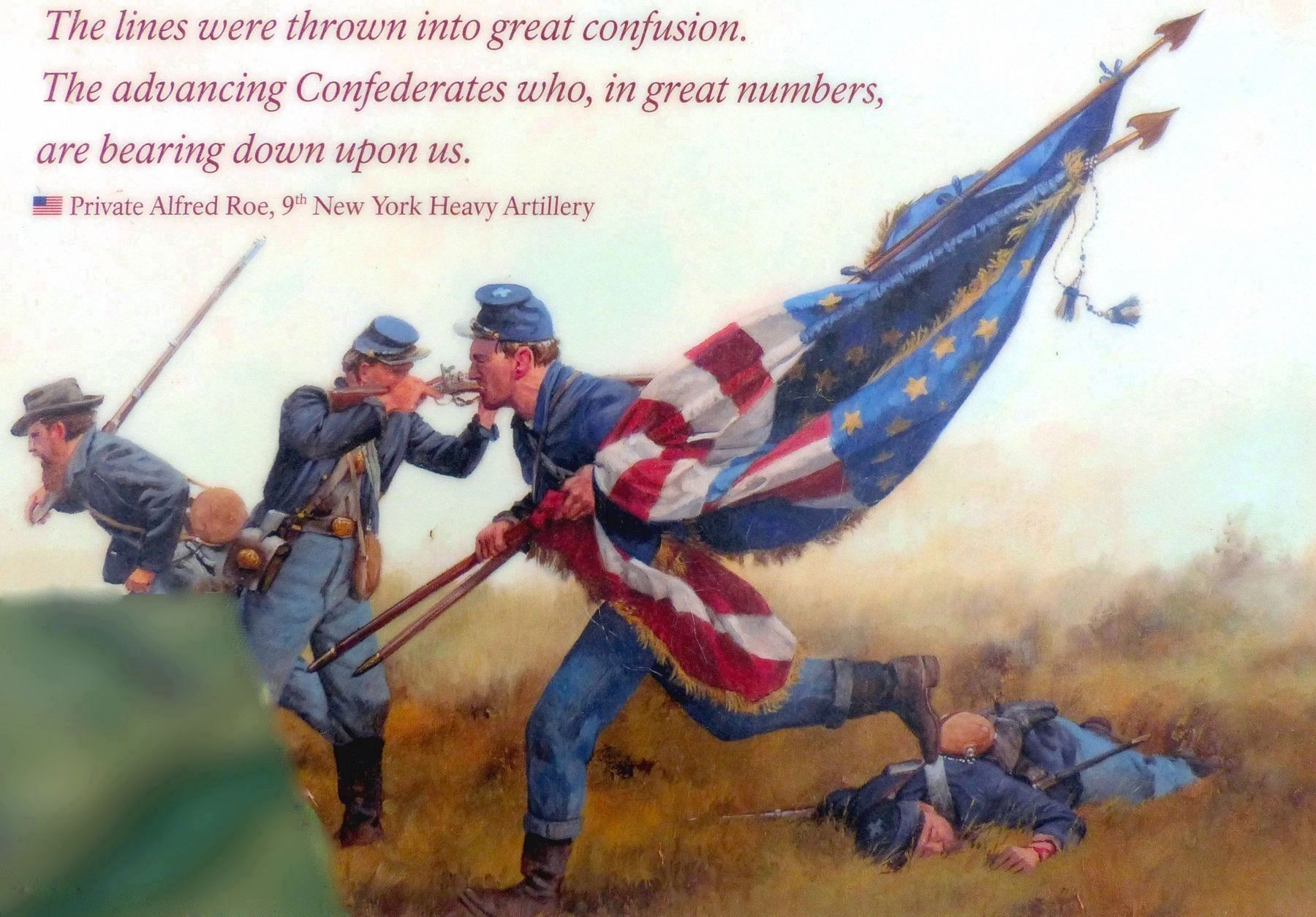
The lines were thrown into great confusion. The advancing Confederates who, in great numbers, are bearing down upon us.
Private Alfred Roe, 9th New York Heavy Artillery
(captions)
(lower left) Brigadier General James B. Ricketts, commanded the Union defense at the Thomas Farm until ordered to retreat.
(lower center) Major General John B. Gordon commanded the Confederate division that defeated the Union forces.
(lower right) During the retreat, the color guards from the 10th Vermont Infantry were under heavy fire and unable to continue. Corporal Alexander Scott, fearing the union flags might be captured, ran both flags to safety. For his valor in saving the national flag he received the Medal of Honor on September 21, 1897.
Erected by Monocacy
this page online
Topics and series. This historical marker is listed in this topic list: War, US Civil. In addition, it is included in the Medal of Honor Recipients series list. A significant historical month for this entry is July 1812.
Location. 39° 22.123′ N, 77° 23.136′ W. Marker is in Frederick, Maryland, in Frederick County. It is in Araby View. It can be reached from the intersection of Urbana Pike (Maryland Route 355) and Araby Church Road, on the right when traveling west. This marker is located along the 0.5-mile Gambrill Mill Trail, located at Stop 5 on the Auto-Tour route. Touch for map. Marker is at or near this postal address: 4823 Urbana Pike, Frederick MD 21704, United States of America. Touch for directions.

Regionally, this marker is in the Washington Metropolitan Area and in Central Maryland. It is also in the American Mid-Atlantic. Globally, it is in North America, the Western Hemisphere, the Western World, and the Anglosphere. Historically, it finds itself in what was once one of the original Thirteen Colonies and also the Antebellum South.
Other nearby markers. At
Photographed by Shawn Oliver
2. Retreat Marker looking toward the Gambrill Mill House
Other markers no longer nearby. Bush Creek Crossing (was a few steps from this marker but has been reported to have been replaced with another marker now near it); Gambrill House (was about 700 feet away, measured in a direct line but has been permanently removed); A Bold Plan (was about 700 feet away but has been replaced with another marker now near it); Monocacy National Battlefield (was about 700 feet away but has been replaced with another marker now near it); a different marker also named Monocacy National Battlefield (was about 700 feet away but has been replaced with another marker now near it); Gambrill Mill (was
Photographed by Shawn Oliver, April 2, 2015
3. Bush Creek
Related marker. Click here for another marker that is related to this marker. HMDb entry on the older wayside at this location titled “Brush Creek Crossing”
Also see . . . Monocacy National Battlefield. National Park Service (Submitted on April 3, 2015.)
Photographed by Allen C. Browne, May 1, 2017
4. Corporal Alexander Scott rescues the flags.
During the retreat, the color guards from the 10th Vermont Infantry were under heavy fire and unable to continue. Corporal Alexander Scott, fearing the union flags might be captured, ran both flags to safety. For his valor in saving the national flag he received the Medal of Honor on September 21, 1897.Close-up of image on marker
Photographed by Allen C. Browne, May 1, 2017
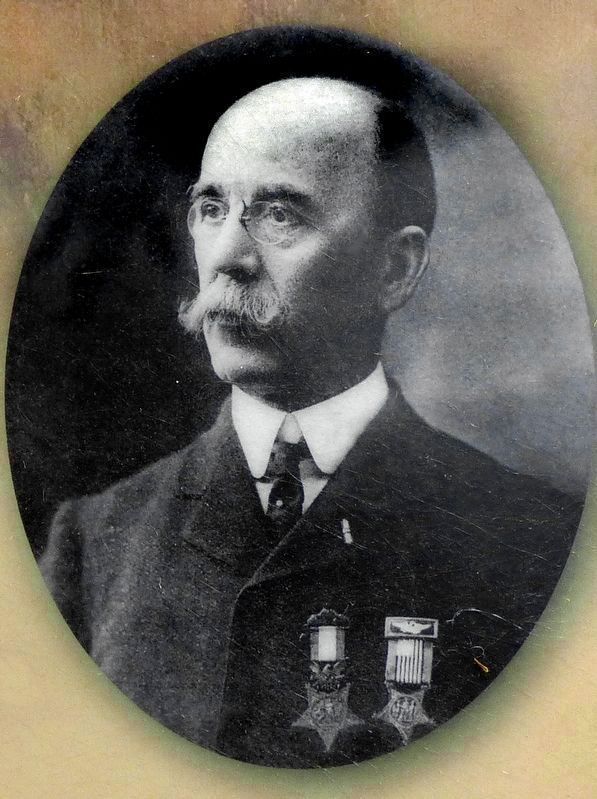
5. Corporal Alexander Scott, of Co. D, 10th Vermont Volunteers
”at Monocacy July 9, 1864 this soldier, a corporal in Co. D, 10th Vermont Volunteers and carrying the State Flag while his regiment was withdrawing under very heavy fire of the enemy saw the color sergeant bearing the national colors fall out of line exhausted and drop to the rear which meant inevitable capture. Corporal Scott then nearly overpowered by the heat and fatigue picked up the national flag and carried both colors during the remainder of the action.” — Medal of Honor Citation.Close-up of photo on marker
Photographed by Tim1965 - Own work, CC BY-SA 3.0 - Wikipedia, September 11, 2011
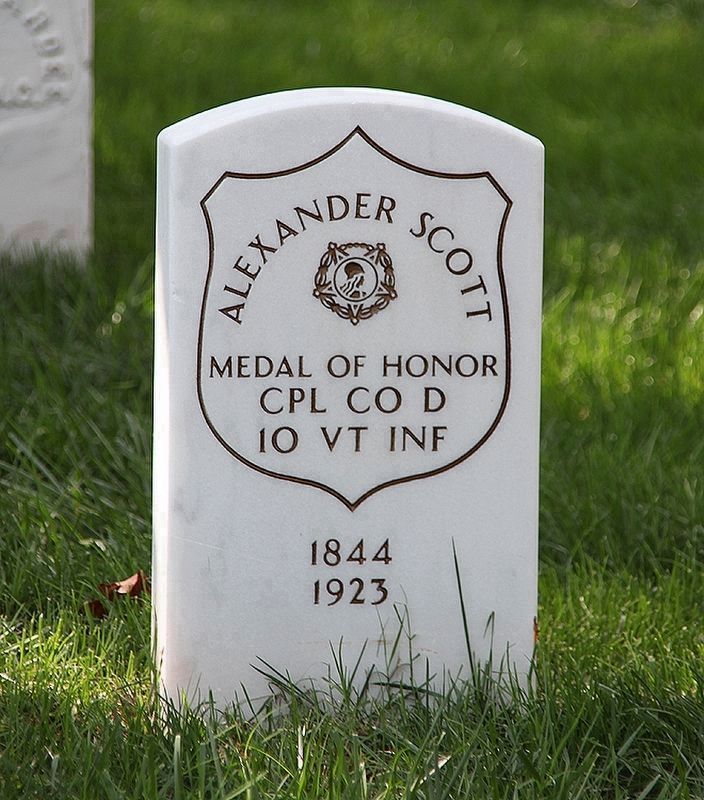
6. Scott's Headstone at Arlington National Cemetery
Medal of Honor
Cpl Co D
10 VT Inf
1844
1923
Credits. This page was last revised on March 20, 2022. It was originally submitted on April 3, 2015, by Shane Oliver of Richmond, Virginia. This page has been viewed 790 times since then and 45 times this year. Photos: 1, 2, 3. submitted on April 3, 2015, by Shane Oliver of Richmond, Virginia. 4, 5, 6. submitted on June 1, 2017, by Allen C. Browne of Silver Spring, Maryland. • Bernard Fisher was the editor who published this page.
