Elk Lick Township near Springs in Somerset County, Pennsylvania — The American Northeast (Mid-Atlantic)
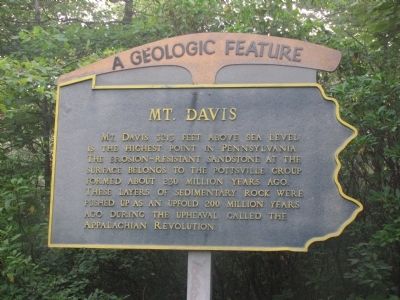
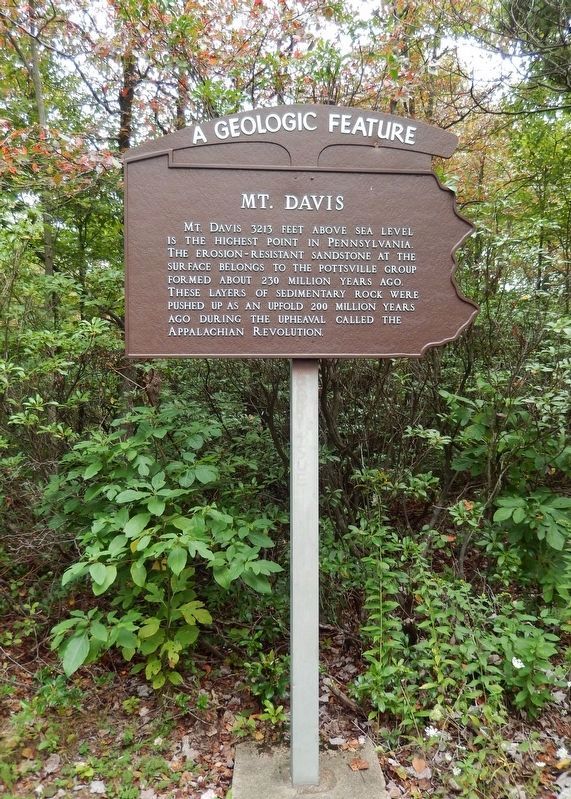
Mt. Davis
A Geologic Feature
Photographed by F. Robby, August 7, 2007
1. Mt. Davis Marker
Topics. This historical marker is listed in this topic list: Natural Features.
Location. 39° 47.156′ N, 79° 10.626′ W. Marker is near Springs, Pennsylvania, in Somerset County. It is in Elk Lick Township. It can be reached from S. Wolf Rock Road 0.6 miles south of Mt. Davis Road when traveling south. Marker is accessible from footpath that is about 300 feet from the parking lot for Mt. Davis. Touch for map. Marker is in this post office area: Fort Hill PA 15540, United States of America. Touch for directions.

Regionally, this marker is in Pennsylvania’s Laurel Highlands. It is also in the American Northeast, in the Mid-Atlantic, in Appalachia, and specifically in Northern Appalachia. Globally, it is in North America, the Western Hemisphere,
this page online
Other nearby markers. At least 8 other markers are within walking distance of this marker: Mount Davis (a few steps from this marker); You are now standing more than fifty feet above the Highest Point (a few steps from this marker); Industry On Negro Mountain (within shouting distance of this marker); John Nelson Davis (within shouting distance of this marker); Tar Kiln (within shouting distance of this marker); The Wild Child (within shouting distance of this marker); Baughman Rocks (within shouting distance of this marker); a different marker also named Baughman Rocks (approx. 0.7 miles away). Touch for a list and map of all markers in Springs.
Photographed by Cosmos Mariner, September 6, 2014
2. Mt. Davis Marker (tall view • repainted)
Photographed by F. Robby, August 7, 2007
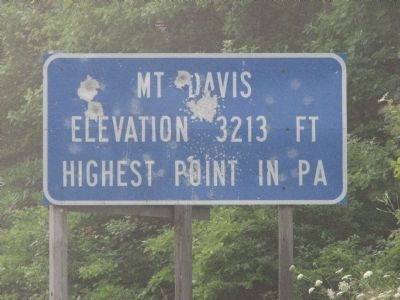
3. Mt. Davis Marker
This marker is near the intersection of Mt. Davis and S. Wolf Rock roads.
Photographed by F. Robby, August 7, 2007
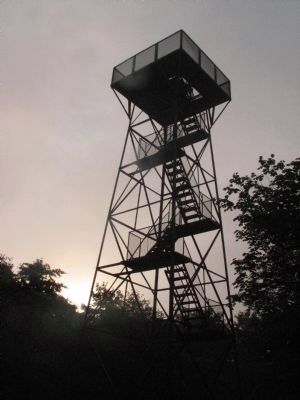
4. Mt. Davis Tower
Tower located about 100 feet from the marker, at the highest point in Pennsylvania.
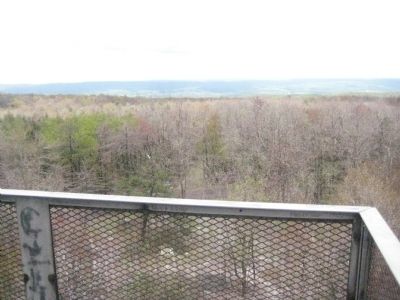
Photographed by F. Robby, May 9, 2008
5. View from Tower
Looking southeast towards Salisbury, PA.
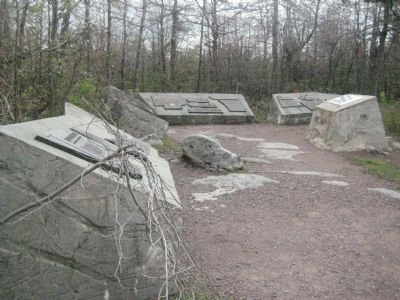
Photographed by F. Robby, May 9, 2008
6. Mt. Davis Markers
Cluster of markers located about 100 feet from the tower structure.
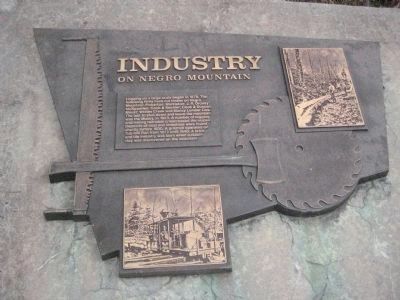
Photographed by F. Robby, May 9, 2008
7. Industry Marker
Inscription: Logging on a large scale began in 1879. The following firms have cut timber on Negro Mountain: Pinkerton; markleton; J.R. Droney; McSpadden; Cook & Sechler; Cook & Duncan; Maust; Whites Creek and Muncy Lumber Co's.. The last to shut down and leave the mountain was the Muncy, in 1923. A number of logging and mining railroads crisscrossed the slopes. Deposits of coal and limestone were found shortly before 1800. A gristmill operated on Tub Mill Run from 1872 until 1940. A brick and tile industry was born when suitable clay was discovered on the mountain.
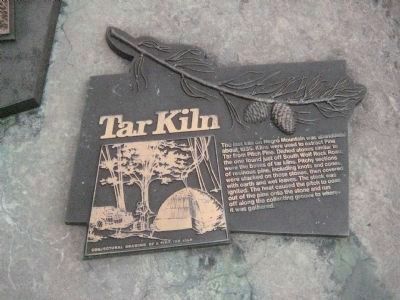
Photographed by F. Robby, May 9, 2008
8. Tar Kiln Marker
The last kiln on Negro Mountain was abandoned about 1835. Kilns were used to extract Pine Tar from Pitch Pine. Dished stones similar to the one found just off South Wolf Rock Road, were the bases of tar kilns. Pitchy sections of resinous pine, including knots and cones, were stacked on these stones, then covered with earth and wet leaves. The stack was ignited. The heat caused the pitch to ooze out of th epine onto the stone and run off along the collecting groove to where it was gathered.
Photographed by F. Robby, May 9, 2008
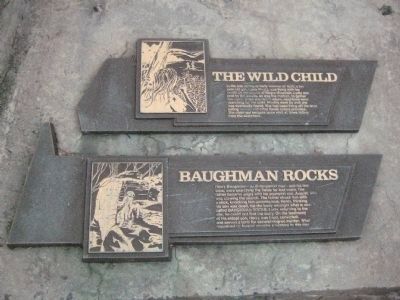
9. Wild Child and Baughman Rocks Markers
The Wild Child inscription: In the late spring or early summer of 1830, a ten year old girl, Lydia Shultz, was living with her family on the slopes of Negro Mountain. Lydia was sent to the woods, as was the custom, to gather the cows. When she didn't return, neighbors went searching for the child. Months went by until she was eventually found. She had been living off the land, eating berries and other foods nature provides. The child had become quite wild, at times hiding from the searchers.
Baughman Rocks inscription: Henry Baughman - an ill-tempered man - and his two sons, were searching the fields for lost cows. The father becaome angry with his youngest son, August, who was slowing the search. The father struck him with a stick, knocking him unconscious. Henry, thinking his son was dead, hid the body amongst what is now called BAUGHMAN ROCKS. Later, returning to the site, he could not find the body. On the testimony of his eldest son, Henry was tried, convicted, and served a term for second-degree murder. What happened to August remains a myster to this day.
Baughman Rocks inscription: Henry Baughman - an ill-tempered man - and his two sons, were searching the fields for lost cows. The father becaome angry with his youngest son, August, who was slowing the search. The father struck him with a stick, knocking him unconscious. Henry, thinking his son was dead, hid the body amongst what is now called BAUGHMAN ROCKS. Later, returning to the site, he could not find the body. On the testimony of his eldest son, Henry was tried, convicted, and served a term for second-degree murder. What happened to August remains a myster to this day.
Credits. This page was last revised on February 7, 2023. It was originally submitted on June 8, 2008, by F. Robby of Baltimore, Maryland. This page has been viewed 2,849 times since then and 47 times this year. Photos: 1. submitted on June 8, 2008, by F. Robby of Baltimore, Maryland. 2. submitted on November 27, 2019, by Cosmos Mariner of Cape Canaveral, Florida. 3, 4, 5, 6, 7, 8, 9. submitted on June 8, 2008, by F. Robby of Baltimore, Maryland.
