Near Birchwood in Meigs County, Tennessee — The American South (East South Central)
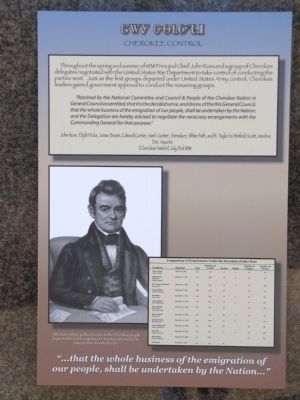
Cherokee Control
Photographed by Lee Hattabaugh, January 2, 2011
1. Cherokee Control Marker
"Resolved by the National Committee and Council & People of the Cherokee Nation in General Council assembled, that it is the decided sense, and desire, of the this General Council, that the whole business of the emigration of our people, shall be undertaken by the Nation: and the Delegation are hereby advised to negotiate the necessary arrangements with the Commanding General for that purpose." - John Ross, Elijah Hicks, James Brown, Edward Gunter, Saml. Gunter, Sitewakee, White Path, and R. Taylor to Winfield Scott, Amohee Dst. Aquohe [Cherokee Nation] July 23, 1838
Topics and series. This historical marker is listed in these topic lists: Government & Politics • Indigenous Peoples and Communities • Wars, US Indian. In addition, it is included in the Trail of Tears series
this page online
Location. 35° 24.423′ N, 85° 0.383′ W. Marker is near Birchwood, Tennessee, in Meigs County. It can be reached from Blythe Ferry Road 2 miles north of Hiwassee Highway (Tennessee Highway 60), on the right when traveling north. Marker is located at the Cherokee Removal Memorial Park. Touch for map. Marker is in this post office area: Birchwood TN 37308, United States of America. Touch for directions.

Regionally, this marker is in East Tennessee. It is also in the American South, specifically in the Upper South, in Appalachia, and specifically in Southern Appalachia. Globally, it is in North America, the Western Hemisphere, the Western World, and the Anglosphere. Historically, it finds itself in what was once the original Cherokee Nation, the territory of the Mississippian Culture, one of the Confederate States of America, and the Antebellum South.
Other nearby markers. At least 8 other markers are within walking distance of this marker: General Winfield Scott (here, next to this marker); "Orders No. 25" (here, next to this marker); "To Learn and not Forget" (here, next
Photographed by Lee Hattabaugh, January 2, 2011
2. John Ross
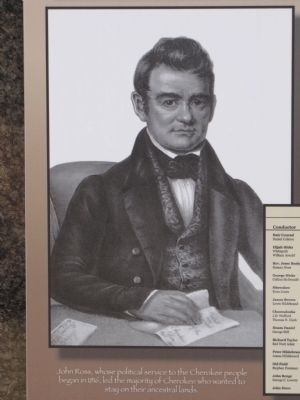
John Ross, whose political service to the Cherokee people began in 1816, led the majority of Cherokee who wanted to stay on their ancestral lands.
Photographed by Lee Hattabaugh, January 2, 2011
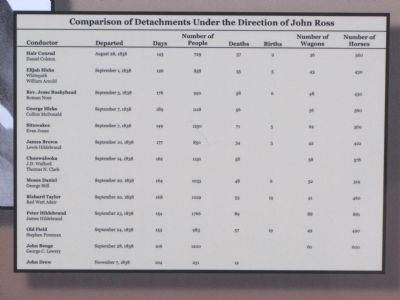
3. Comparison of Detachments under the direction of John Ross
Photographed by Lee Hattabaugh, January 2, 2011
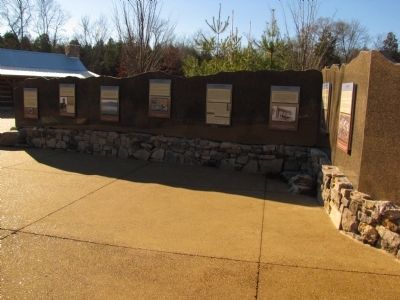
4. Cherokee Control Marker
Second from left in this view.
Photographed by Lee Hattabaugh, January 2, 2011
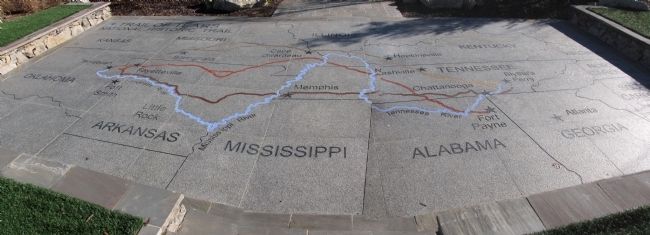
5. The Trail of Tears
Composite image of a large map showing several of the various routes taken by the Cherokee Nation during The Removal.
Photographed by Lee Hattabaugh, January 2, 2011
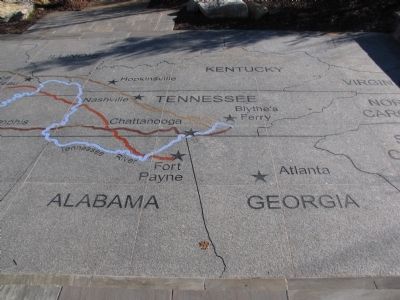
6. The Trail of Tears
Part of a large map depicting the various Removal routes showing the location of Blythe's Ferry on the Tennessee River (the location of the Cherokee Removal Memorial Park).
Photographed by Lee Hattabaugh, January 2, 2011
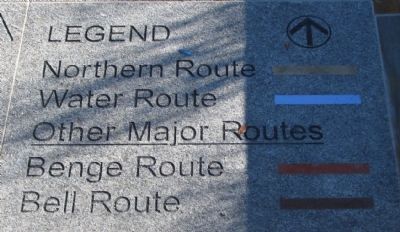
7. The Trail of Tears
Legend for the Trail of Tears route map.
Photographed by Lee Hattabaugh, January 2, 2011
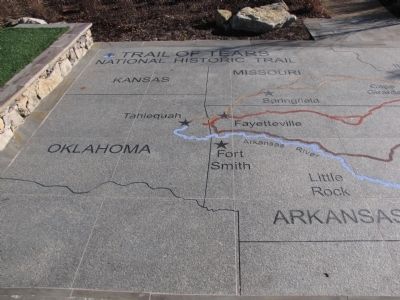
8. The Trail of Tears
A portion of the large map showing the endpoints of the Trail of Tears.
Credits. This page was last revised on June 16, 2016. It was originally submitted on January 7, 2011, by Lee Hattabaugh of Capshaw, Alabama. This page has been viewed 714 times since then and 22 times this year. Last updated on April 8, 2015, by J. Makali Bruton of Washington, District of Columbia. Photos: 1, 2, 3, 4, 5, 6, 7, 8. submitted on January 7, 2011, by Lee Hattabaugh of Capshaw, Alabama. • Bill Pfingsten was the editor who published this page.
