Bristol in Sullivan County, Tennessee — The American South (East South Central)
East Hill Cemetery
Historic Burying Ground
Photographed by Don Morfe, July 31, 2013
1. East Hill Cemetery Marker
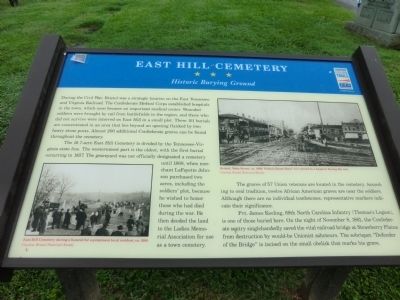
During the Civil War, Bristol was a strategic location on the East Tennessee and Virginia Railroad. The Confederate Medical Corps established hospitals in the town, which soon became an important medical center. Wounded soldiers were brought by rail from battlefields in the region, and those who did not survive were interred on East Hill in a small plot. These 101 burials are concentrated in an area that lies beyond an opening flanked by two heavy stone posts. Almost 200 additional Confederate graves can be found throughout the cemetery.
The 16.7-acre East Hill Cemetery is divided by the Tennessee-Virginia state line. The westernmost part is the oldest, with the first burial occurring in 1857. The graveyard was not officially designated a cemetery until 1868, when merchant LaFayette Johnson purchased two acres, including the soldiers’ plot, because he wished to honor those who had died during the war. He then deeded the land to the Ladies Memorial Association for use as a town cemetery.
The graves of 57 Union veterans are located in the cemetery. According to oral tradition, twelve African American graves are near
this page online
Pvt. James Keeling, 69th North Carolina Infantry (Thomas’s Legion), is one of those buried here. On the night of November 8, 1861, the Confederate sentry singlehandedly saved the vital railroad bridge at Strawberry Plains from destruction by would-be Unionist saboteurs. The sobriquet “Defender of the Bridge” is incised on the small obelisk that marks his grave.
[Captions:]
East Hill Cemetery during a funeral for a prominent local resident, ca. 1900 Courtesy Bristol Historical Society
Bristol, Main Street, ca. 1900. Nichols House Hotel (left) served as a hospital during the war. Courtesy Bristol Historical Society
Erected by Tennessee Civil War Trails.
Topics and series. This historical marker is listed in these topic lists: Cemeteries & Burial Sites • War, US Civil. In addition, it is included in the Tennessee Civil War Trails series list. A significant historical date for this entry is November 8, 1927.
Location. 36° 35.625′ N, 82° 10.225′ W. Marker is in Bristol, Tennessee, in Sullivan County. It is on East Hill Cemetery
Photographed by Don Morfe, July 31, 2013
2. East Hill Cemetery Marker

Regionally, this marker is in East Tennessee and in the Tri-Cities Area. It is also in the American South, specifically in the Upper South, in Appalachia, and specifically in Southern Appalachia. Globally, it is in North America, the Western Hemisphere, the Western World, and the Anglosphere. Historically, it finds itself in what was once the original Cherokee Nation, the territory of the Mississippian Culture, one of the Confederate States of America, the State of Franklin, and the Antebellum South.
Other nearby markers. At least 8 other markers are within walking distance of this marker: A different marker also named East Hill Cemetery (a few steps from this marker); Founder of Bristol (about 600 feet away, measured in a direct line); City Historian (approx. 0.2 miles away in Virginia); First Burial in East Hill Cemetery (approx. 0.2 miles away in Virginia); Slave Section of East Hill Cemetery (approx. 0.2 miles away in Virginia); East Hill Cemetery Confederate Veterans Monument (approx. ¼ mile away in Virginia); Parlett House (approx. 0.4 miles away); Evan Shelby (approx. 0.4 miles away). Touch for a list and map of all markers in Bristol.
Credits. This page was last revised on April 24, 2026. It was originally submitted on August 3, 2013, by Don Morfe of Baltimore, Maryland. This page has been viewed 1,632 times since then and 92 times this year. Last updated on May 5, 2015, by J. Makali Bruton of Washington, District of Columbia. Photos: 1, 2. submitted on August 3, 2013, by Don Morfe of Baltimore, Maryland. • Andrew Ruppenstein was the editor who published this page.
