Near Forest Home in Butler County, Alabama — The American South (East South Central)
The Butler Massacre
⎯⎯⎯
Fort Bibb
Photographed by Mark Hilton, August 27, 2013
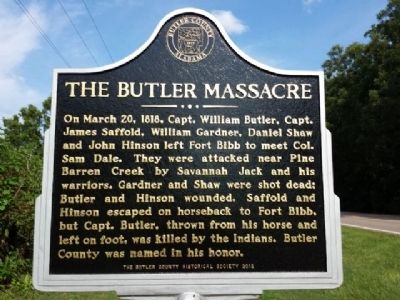
1. The Butler Massacre Marker
The Butler Massacre. On March 20, 1818, Capt. William Butler, Capt. James Saffold, William Gardener, Daniel Shaw and John Hinson left Fort Bibb to meet Col. Sam Dale. They were attacked near Pine Barren Creek by Savannah Jack and his warriors. Gardener and Shaw were shot dead; Butler and Hinson wounded. Saffold and Hinson escaped on horseback to Fort Bibb, but Capt. Butler, thrown from his horse and left on foot, was killed by the Indians. Butler County was named in his honor.
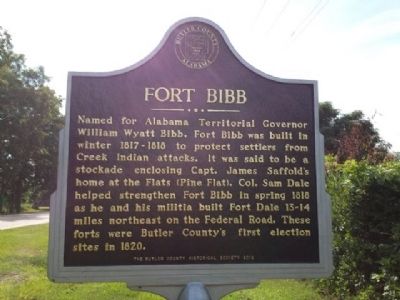
Fort Bibb. Named for Alabama Territorial Governor William Wyatt Bibb, Fort Bibb was built in winter 1817-1818 to protect settlers from Creek Indian attacks. It was said to be a stockade enclosing Capt. James Saffold's home at the Flats (Pine Flats). Col. Sam Dale helped strengthen Fort Bibb in spring 1818 as he and his militia built Fort Dale 13-14 miles northeast on the Federal Road. These forts were Butler County's first election sites in 1820.
Erected 2012 by Butler County Historical Society.
Topics. This historical marker is listed in these topic lists: Forts and Castles • Indigenous Peoples and Communities • Wars, US Indian. A significant historical month for this entry is March 1871.
Location. 31° 50.308′ N,
this page online

Regionally, this marker is in the American South, specifically in the Deep South, and in the Black Belt. Globally, it is in North America, a Gulf of Mexico state, the Western Hemisphere, the Western World, and the Anglosphere. Historically, it finds itself in what was once New Spain, the territory of the Mississippian Culture, one of the Confederate States of America, and the Antebellum South.
Other nearby markers. At least 8 other markers are within 9 miles of this marker, measured as the crow flies: Old Federal Road (approx. 6.2 miles away); Pine Apple Historic District (approx. 6.3 miles away); Moore Academy (approx. 6.6 miles away); Downtown Pine Apple (approx. 6.7 miles away); a different marker also named Pine Apple Historic District (approx. 7.1 miles away); Coleman-Crenshaw House
Photographed by Mark Hilton, August 27, 2013
2. Fort Bibb Marker
More about this marker. This is a replacement marker. Previously these were two separate markers in different locations, one for the Butler Massacre & one for Fort Bibb. Both went missing in 2010. The original Butler Massacre marker was stolen on May 8th, 2011 and later found in pieces at a local recycling center. The thieves received $22.00 for the @ $2,000 marker.
The Butler Massacre marker, erected in 1953, read:
Butler Massacre
March 20, 1818
Creek Indians, led by Savannah Jack, attacked a well-armed party of settlers carrying dispatches to Fort Dale.
After this second massacre in 7 days settlers sought refuge in forts and stockades.
The Site of Fort Bibb marker, erected in 1953, read:
Site of
Fort Bibb
Built in 1818 by settlers as refuge from marauding Creek Indians who resented loss of land by Treaty of Fort Jackson in 1814.
Also see . . . Fort Bibb. Wikipedia entry (Submitted on June 6, 2024, by Larry Gertner of New York, New York.)
Photographed by Mark Hilton, August 27, 2013
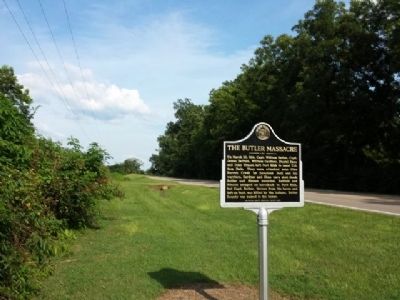
3. The Butler Massacre/Fort Bibb Area
Credits. This page was last revised on June 28, 2025. It was originally submitted on August 28, 2013, by Mark Hilton of Montgomery, Alabama. This page has been viewed 8,645 times since then and 405 times this year. Last updated on May 15, 2015, by J. Makali Bruton of Washington, District of Columbia. Photos: 1, 2, 3. submitted on August 28, 2013, by Mark Hilton of Montgomery, Alabama. • Bill Pfingsten was the editor who published this page.
