Mount Sterling in Montgomery County, Kentucky — The American South (East South Central)
Little Mountain Indian Mound
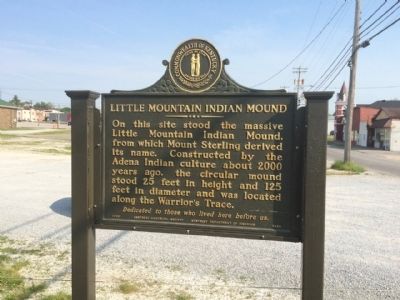
Photographed by Mark Hilton, May 10, 2015
1. Little Mountain Indian Mound Marker (Front)
(Front)
On this site stood the massive Little Mountain Indian Mound, from which Mount Sterling derived its name. Constructed by the Adena Indian culture about 2000 years ago, the circular mound stood 25 feet in height and 125 feet in diameter and was located along the Warrior’s Trace.
(Reverse)
It was a prominent landmark used by William Calk and Enoch Smith to survey land claims in 1775. James Estill and his men camped here on March 21, 1782, the night before the battle of Estill’s Defeat. In 1845, the city removed the mound & extraordinary artifacts of copper, marble, stone, and shell were recovered during the excavation.
Erected 2009 by the Kentucky Historical Society, Kentucky Department of Highways. (Marker Number 2290.)
Topics and series. This historical marker is listed in these topic lists: Indigenous Peoples and Communities • Settlements & Settlers • Wars, US Indian. In addition, it is included in the Kentucky Historical Society series list. A significant historical month for this entry is March 1931.
Location. 38° 3.303′ N, 83° 56.313′ W. Marker is in Mount Sterling, Kentucky, in Montgomery County.
this page online

Regionally, this marker is in Kentucky’s Outer Bluegrass. It is also in the American South and specifically in the Upper South. Globally, it is in North America, the Western Hemisphere, the Western World, and the Anglosphere. Historically, it finds itself in what was once the territory of the Mississippian Culture and also the Antebellum South.
Other nearby markers. At least 8 other markers are within walking distance of this marker: Mt. Sterling, Kentucky (approx. ¼ mile away); Montgomery County Kentucky Vietnam Casualties (approx. ¼ mile away); Montgomery County. 1797 (approx. ¼ mile away); Courthouse Burned (approx. ¼ mile away); Montgomery County World War II Memorial (approx. ¼ mile away); Montgomery County Kentucky World War I Memorial (approx. ¼ mile away); Montgomery County Korean War Memorial (approx.
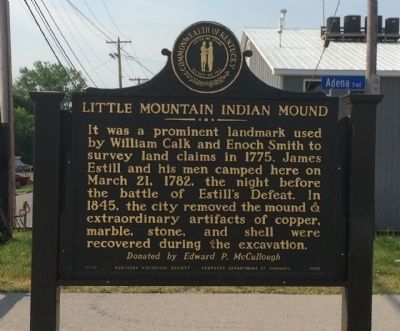
Photographed by Mark Hilton, May 10, 2015
2. Little Mountain Indian Mound Marker (Reverse)
Also see . . . Explore Kentucky History article. (Submitted on June 5, 2015, by Mark Hilton of Montgomery, Alabama.)

Photographed by Mark Hilton, May 10, 2015
3. The Adena Trail near marker.
The trail is named after early Indian tribes that hunted in Montgomery County and built the very distinctive Adena Burial Mounds at the edge of Mt. Sterling.
About 1,800 feet of the former rail line is paved and is enhanced with benches along the trail.
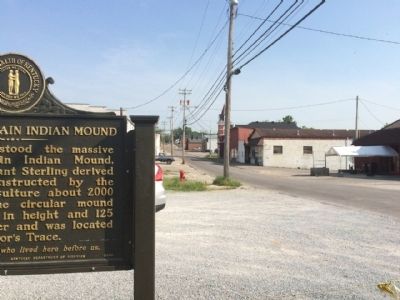
Photographed by Mark Hilton, May 10, 2015
4. View of marker down South Queen Street.

Photographed by Mark Hilton, May 10, 2015
5. Looking north towards Locust Street.
Credits. This page was last revised on June 16, 2016. It was originally submitted on June 5, 2015, by Mark Hilton of Montgomery, Alabama. This page has been viewed 2,367 times since then and 104 times this year. Photos: 1, 2, 3, 4, 5. submitted on June 5, 2015, by Mark Hilton of Montgomery, Alabama.
