Near East Bernstadt in Laurel County, Kentucky — The American South (East South Central)
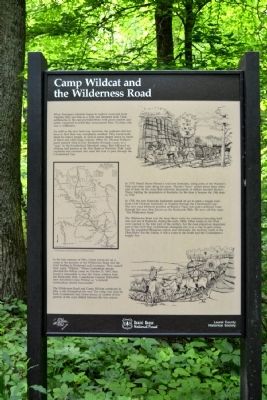
Camp Wildcat and the Wilderness Road
Photographed by Duane Hall, May 23, 2015
1. Camp Wildcat and the Wilderness Road Marker
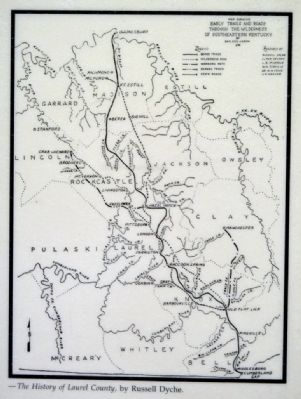
As wild as the new land was, however, the explorers did not have to find their way completely unaided. They found trails made by native people, as well as traces beaten down by herds of bison and other large animals. When Dr. Thomas Walker’s party entered what is now Kentucky through a pass, or a “gap,” in the Cumberland Mountain range, they followed an existing trail known as the War Road or Warriors’ Path. Later explorers and colonists also used this trail to pass through the Cumberland Gap.
In 1775, Daniel Boone blazed a trail into Kentucky, using parts of the Warrior’s Path and other trails along his route. “Boone’s Trace” passes about three miles east of here. In the years that followed, thousands of settlers traveled Boone’s Trace, tripling the population of Kentucky by the time it became the 15th state in 1792.
In 1795, the new Kentucky legislature passed an act to open a wagon road from Crab Orchard, Kentucky, to Virginia through the Cumberland Gap. The new road followed portions of Boone’s Trace, but took a different route through this area, then known as the Rockcastle Hills. We now call this route “The Wilderness Road.”
The Wilderness Road was the most direct route for commerce traveling both into and out of Kentucky during the early 1800s. Other routes to the West were opened in the later part of the century, but the road played an important part in the Civil War. Confederate strategists saw it as a way to gain access into the populated Bluegrass region, and ultimately, the territory north of the Ohio
this page online
In the late summer of 1861, Union forces set up a camp at the junction of the Wilderness Road and the road leading to Richmond and Lexington. They named their camp “Wildcat.” When Confederate troops attacked the hilltop camp on October 21, 1861, they found it impossible to rout the Union soldiers from the Rockcastle Hills. Confederate General Zollicoffer later described Camp Wildcat as “a natural fortification, almost inaccessible.”
The Wilderness Road and Camp Wildcat continued to play a role throughout the war. The camp was used by both Confederate and Union forces, as control of this portion of the road shifted between the two armies.
Erected by Daniel Boone National Forest and Laurel County Historical Society.
Topics. This historical marker is listed in these topic lists: Exploration • Roads & Vehicles • Settlements & Settlers • War, US Civil. A significant historical month for this entry is October 1895.
Location. 37° 15.621′ N, 84° 11.939′ W. Marker is near East Bernstadt, Kentucky, in Laurel County. It is
Photographed by Duane Hall, May 23, 2015
2. Early Trails and Roads Through the Wilderness of Southeastern Kentucky

Regionally, this marker is in Eastern Kentucky and in the Cumberland Plateau. It is also in the American South, specifically in the Upper South, in Appalachia, and specifically in Southern Appalachia. Globally, it is in North America, the Western Hemisphere, the Western World, and the Anglosphere. Historically, it finds itself in what was once the territory of the Mississippian Culture and also the Antebellum South.
Other nearby markers. At least 8 other markers are within 2 miles of this marker, measured as the crow flies: Battle of Camp Wildcat (approx. 0.3 miles away); Kentucky - September 1861 (approx. 0.3 miles away); a different marker also named Battle of Camp Wildcat (approx. 0.3 miles away); Nerve Center for the Union Army (approx.
Photographed by Duane Hall, May 23, 2015
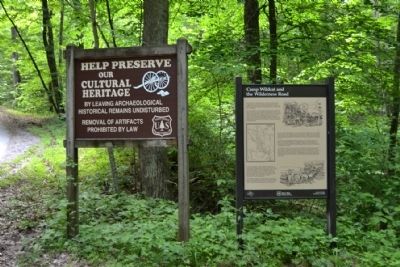
3. Camp Wildcat and the Wilderness Road Marker
More about this marker. There is an identical marker located on N. Laurel Road (US 25) approx. three miles south of this marker.
Also see . . .
1. Wilderness Road - Wikipedia entry. (Submitted on June 11, 2015.)
2. Battle of Camp Wildcat - Wikipedia entry. (Submitted on June 11, 2015.)
Photographed by Duane Hall, May 23, 2015
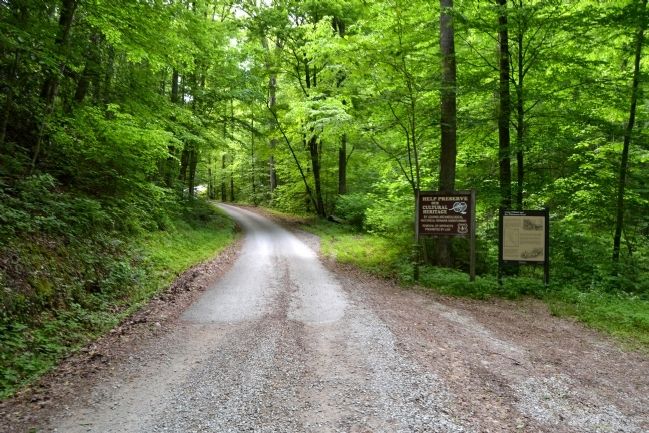
4. Marker on Old Wilderness Road to the Camp Wildcat Battlefield
Credits. This page was last revised on June 16, 2016. It was originally submitted on June 11, 2015, by Duane Hall of Abilene, Texas. This page has been viewed 931 times since then and 62 times this year. Photos: 1, 2, 3, 4. submitted on June 11, 2015, by Duane Hall of Abilene, Texas.
