Near Manassas in Prince William County, Virginia — The American South (Mid-Atlantic)
Stone House
Battlefield Landmark
Photographed by Tom Fuchs, June 10, 2006
1. Stone House Marker
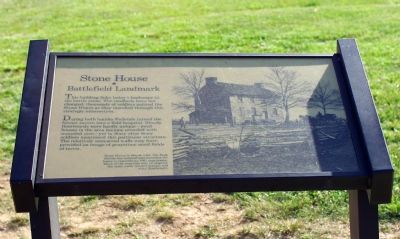
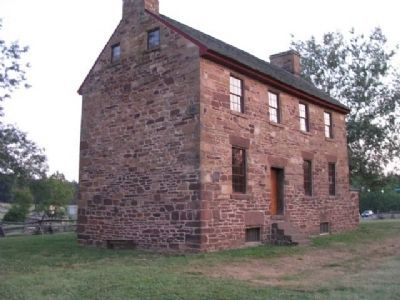
This building links today’s landscape to the battlefield scene. The roadbeds have not changed; thousands of soldiers noticed the Stone House as they marched through this strategic intersection.
During both battles Federals turned the former tavern into a field hospital. Bloody floorboards were hardly unique—most houses in the area became crowded with wounded men—yet in diary after diary soldiers mentioned this particular structure. The relatively unscarred walls may have provided an image of peacetime amid fields of terror.
(Photo Caption) Stone House in March 1862. The Park Service has restored and furnished the house to resemble its 1861 appearance. Much of the structure may be original: the stone walls, window frames, and some floorboards.
Erected by National Park Service, U.S. Department of the Interior.
Topics and series. This historical marker is listed in this topic list: War, US Civil.
this page online
Location. This marker has been replaced by another marker nearby. It was located near 38° 49.14′ N, 77° 31.555′ W. Marker was near Manassas, Virginia, in Prince William County. It could be reached from the intersection of Lee Highway (U.S. 29) and Sudley Road (Virginia Route 234), on the right when traveling west. It is in the Manassas National Battlefield Park. There is a fee per person per day to enter the park. Touch for map. Marker was at or near this postal address: 12521 Lee Hwy, Manassas VA 20109, United States of America. Touch for directions.

Regionally, this marker was in the Washington Metropolitan Area, in Northern Virginia, and in the Piedmont. It was also in the American South, specifically in the Upper South, in the Mid-Atlantic, and on the Eastern Seaboard. Globally, it was in
Photographed by Tom Fuchs, June 10, 2006
2. Stone House Marker
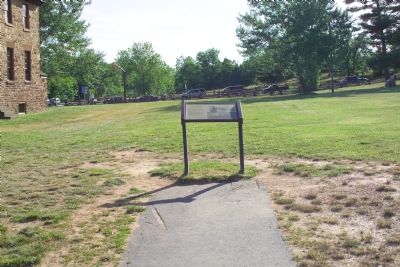
Walkway from parking lot leads to marker. The nearby "Battlefield of Bull Run or First Manassas" marker can be seen in the distance right.
Other nearby markers. At least 10 other markers are within walking distance of this location: Stone House: Witness to War (here, next to this marker); a different marker also named Stone House (within shouting distance of this marker); Battlefield of Bull Run or First Manassas (within shouting distance of this marker); First Battle of Manassas (about 300 feet away, measured in a direct line); Henry House (about 300 feet away); a different marker also named First Battle of Manassas (about 300 feet away); Visions of Victory (about 400 feet away); Pope's Headquarters (about 500 feet away); James Robinson House (approx. 0.2 miles away);
Photographed by Tom Fuchs, June 10, 2006
3. The Stone House
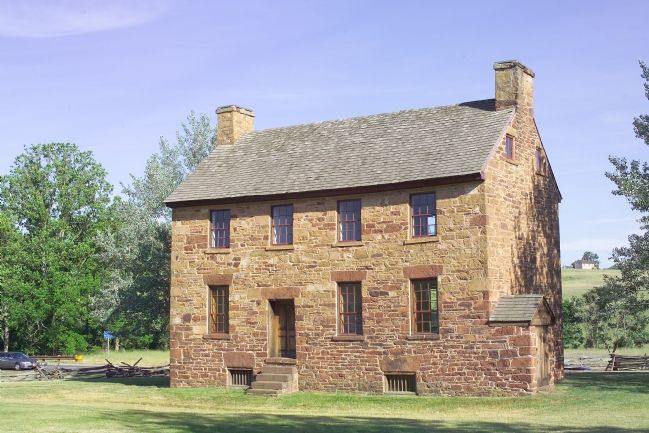
Notice the Henry House in the distance on Henry Hill to the right of the Stone House.
Related marker. Click here for another marker that is related to this marker. This marker has been replaced by the linked marker.
Photographed by J. J. Prats, June 10, 2006
4. The Stone House - View from Henry Hill
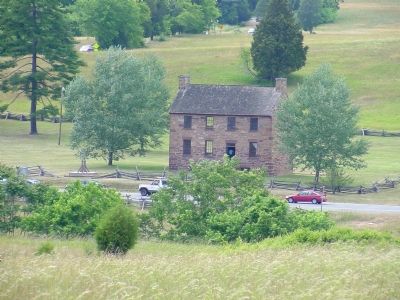
The Warrenton Turnpike, now Lee Highway, runs east-west in front of the house. Sudley Road heads north in the distance.
Photographed by Denise Boose, July 6, 2012
5. Stone House – Battlefield Landmark
The side that faces the battlefield.
Photographed by Denise Boose, July 6, 2012
6. Stone House – Battlefield Landmark
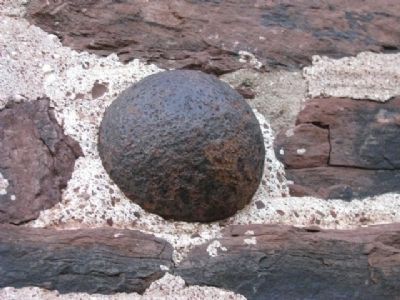
Cannon ball embedded into the wall. The cannon ball was placed in the house after the war as a curiosity piece.
Photographed by Denise Boose, July 6, 2012
7. Stone House – Battlefield Landmark
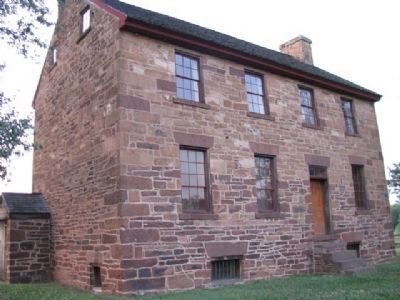
The side of the house facing the street. Cannon ball is to the right of the door.
Photographed by Denise Boose, July 6, 2012
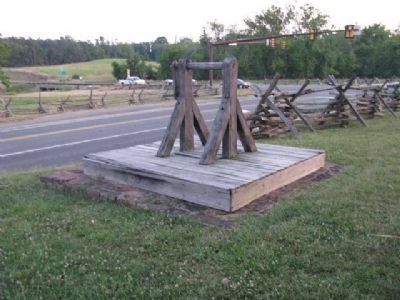
8. Stone House Well – Battlefield Landmark
Photographed by Brandon Fletcher, July 19, 2007
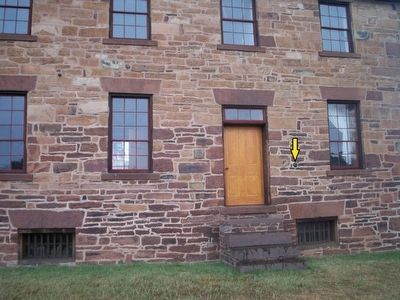
9. Stone House –cannon ball location
(yellow arrow) showing location of the cannon ball embedded to right of front door.
Photographed by J. Makali Bruton, September 4, 2015
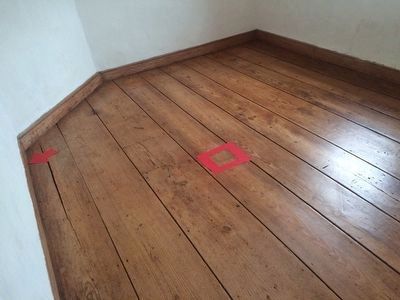
10. Stone House upstairs soldiers' grafitti
During its use as a field hospital, at least two Union soldiers scratched their names into the floor.
Photographed by Mike Stroud, 1985
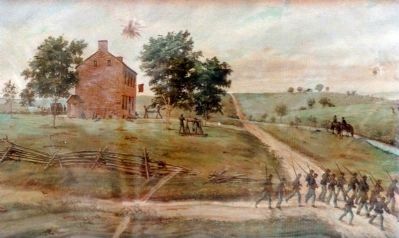
11. Artist Concept ; Action around the Stone House
Photographed by Mike Stroud, 1985
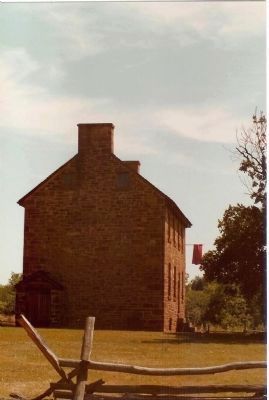
12. Stone House
Credits. This page was last revised on July 8, 2020. It was originally submitted on February 5, 2007, by Tom Fuchs of Greenbelt, Maryland. This page has been viewed 3,544 times since then and 75 times this year. Photos: 1, 2, 3. submitted on February 5, 2007, by Tom Fuchs of Greenbelt, Maryland. 4. submitted on February 27, 2007, by J. J. Prats of Powell, Ohio. 5, 6, 7, 8. submitted on July 22, 2012, by Denise Boose of Tehachapi, California. 9. submitted on August 15, 2015, by Brandon Fletcher of Chattanooga, Tennessee. 10. submitted on September 11, 2015, by J. Makali Bruton of Washington, District of Columbia. 11, 12. submitted on November 22, 2008, by Mike Stroud of Bluffton, South Carolina. • J. J. Prats was the editor who published this page.
