
Key West in Monroe County, Florida — The American South (South Atlantic)
African Cemetery at Higgs Beach
Photographed by Marsha A. Matson, May 28, 2015
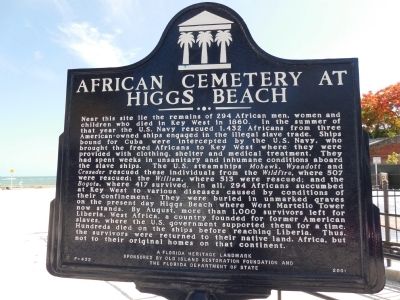
1. African Cemetery at Higgs Beach Marker
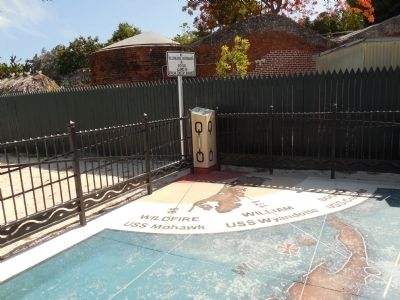
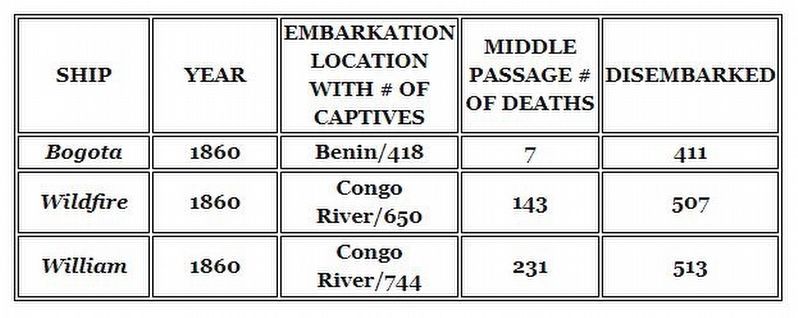
Near this site lie the remains of 294 African men, women and children who died in Key West in 1860. In the summer of that year the U.S. Navy rescued 1,432 Africans from three American-owned ships engaged in the illegal slave trade. Ships bound for Cuba were intercepted by the U.S. Navy, who brought the freed Africans to Key West where they were provided with clothing, shelter and medical treatment. They had spent weeks in unsanitary and inhumane conditions aboard the slave ships. The U.S. steamships Mohawk, Wyandott and Crusader rescued these individuals from the Wildfire, where 507 were rescued; the William, where 513 were rescued; and the Bogota, where 417 survived. In all, 294 Africans succumbed at Key West to various diseases caused by conditions of their confinement. They were buried in unmarked graves on the present day Higgs Beach where West Martello Tower now stands. By August, more than 1,000 survivors left for Liberia, West Africa, a country founded for former American slaves, where the U.S. government supported them for a time. Hundreds died on the ships before reaching Liberia. Thus, the survivors were returned
this page online
Erected 2001 by Old Island Restoration Foundation and the Florida Department of State. (Marker Number F-432.)
Topics. This historical marker is listed in these topic lists: African Americans • Cemeteries & Burial Sites • Waterways & Vessels. A significant historical year for this entry is 1860.
Location. 24° 32.845′ N, 81° 47.129′ W. Marker is in Key West, Florida, in Monroe County. It is at the intersection of Atlantic Boulevard and White Street, on the right when traveling east on Atlantic Boulevard. Touch for map. Marker is in this post office area: Key West FL 33040, United States of America. Touch for directions.

Regionally, this marker is on the Florida Keys. It is also in the American South and on the Gulf Coast. Globally, it is in the North Atlantic Region, North America, a Gulf of Mexico state, the Western Hemisphere, the Western World, and the Anglosphere. Historically, it finds itself in what was once New Spain, the territory of the Mississippian Culture, one of the Confederate States of America, and the Antebellum
Photographed by Marsha A. Matson, May 28, 2015
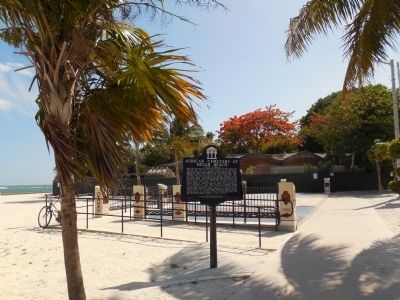
2. African Cemetery at Higgs Beach Marker
Other nearby markers. At least 8 other markers are within walking distance of this marker: West Martello (within shouting distance of this marker); Key West Roosters (about 500 feet away, measured in a direct line); "Rambler" Wheel (approx. 0.3 miles away); La Brisa House (approx. 0.4 miles away); Josephine Parker City Hall (approx. 0.4 miles away); Key West City Hall (approx. 0.4 miles away); 1846 "Havana" Hurricane (approx. half a mile away); 1909 & 1910 Hurricanes (approx. half a mile away). Touch for a list and map of all markers in Key West.
Also see . . . Middle Passage Ceremonies and Port Markers Project (MPCPMP). Organization homepage. (Submitted on January 21, 2020.)
Additional commentary.
1. Middle Passage Key West
As the nation’s southern-most location, Key West was used by the U.S. Navy as a delivery point for ships intercepted with illegal “cargo” after the Constitutional ban on importation of Africans. These particular vessels transported primarily children and women, many who died after arrival as a result of conditions on board during the Middle Passage, and were buried in
Photographed by Marsha A. Matson, May 28, 2015
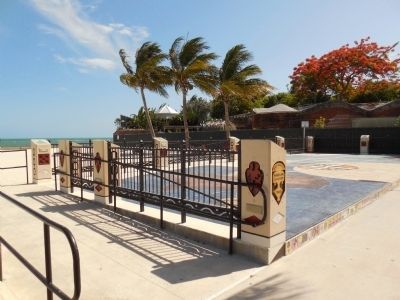
3. African Cemetery at Higgs Beach
— Submitted January 18, 2020, by John Bloomfield of Palm Coast, Florida.
Additional keywords. Middle Passage Ceremonies and Port Markers Project, Middle Passage; human trafficking; Trans-Atlantic Trade; UNESCO Routes of Enslaved Peoples (Slave Route Project); UNESCO Site of Memory; International Coalition Site of Conscience
Photographed by Marsha A. Matson, May 28, 2015
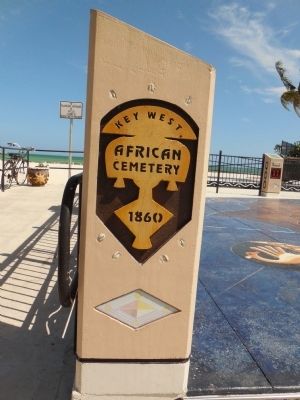
4. African Cemetery at Higgs Beach
African Cemetery
1860
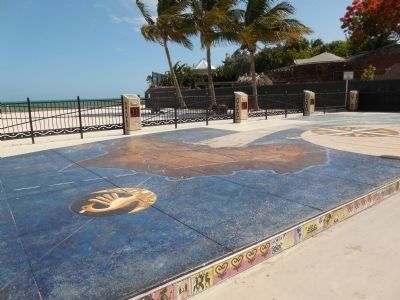
Photographed by Marsha A. Matson, May 28, 2015
5. African Cemetery at Higgs Beach
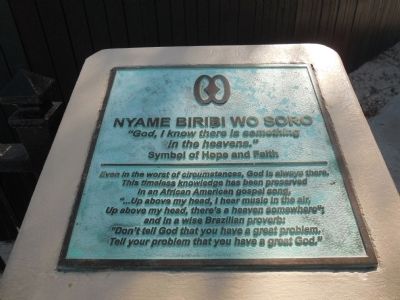
Photographed by Marsha A. Matson, May 28, 2015
6. African Cemetery at Higgs Beach
“God, I know there is something in the heavens.”
Symbol of Hope and Faith
Even in the worst of circumstances, God is always there. This timeless knowledge has been preserved in an African American gospel song,
"Up above my head, I hear music in the air,
Up above my head, there's a heaven somewhere”:
and in a wise Brazilian proverb:
"Don't tell God that you have a great problem,
Tell your problem that you have a great God.”
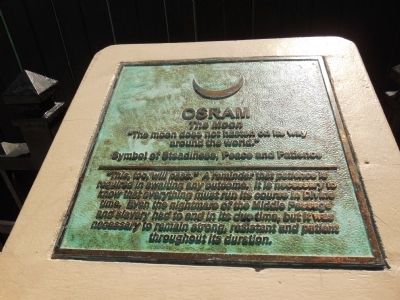
Photographed by Marsha A. Matson, May 28, 2015
7. African Cemetery at Higgs Beach
The Moon
“The moon does not hasten on its way around the world.”
Symbol of Steadiness, Peace and Patience
“This, too, will pass.” A reminder that patience is required in awaiting any outcome. It is necessary to know that everything must run its course in Divine time. Even the nightmare of the Middle Passage and slavery had to end in its due time, but it was necessary to remain strong, resistant and patient throughout its duration.
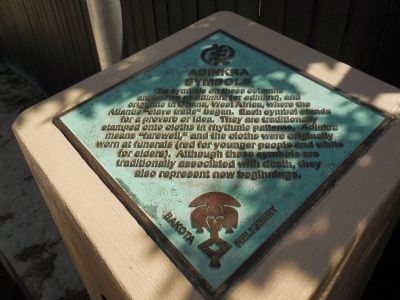
Photographed by Marsha A. Matson, May 28, 2015
8. African Cemetery at Higgs Beach
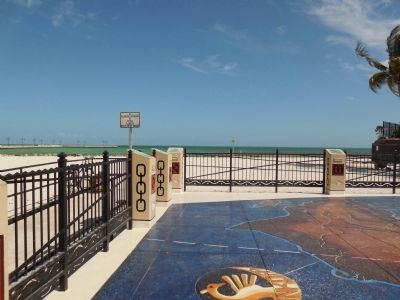
The symbols on these columns are known as adinkra (or edinkra), and originate in Ghana, West Africa, where the Atlantic “slave trade” began. Each symbol stands for a proverb or idea. They are traditionally stamped onto cloths in rhythmic patterns. Adinkra means “farewell”, and the cloths were originally worn at funerals (red for younger people and white for elders). Although these symbols are traditionally associated with death, they also represent new beginnings.
Bakota Reliquary
Photographed by Marsha A. Matson, May 28, 2015
9. African Cemetery at Higgs Beach
Photographed by Marsha A. Matson, May 28, 2015
10. African Cemetery at Higgs Beach
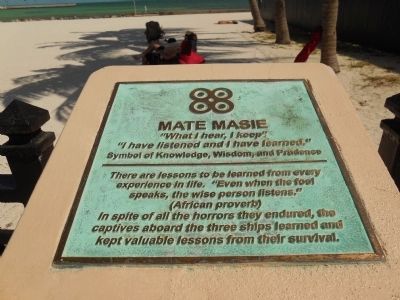
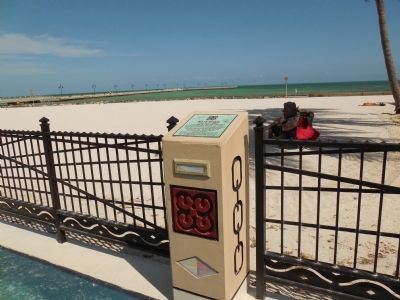
“What I hear, I keep”
“I have listened and I have learned.”
Symbol of Knowledge, Wisdom, and Prudence
There are lessons to be learned from every experience in life. “Even when the fool speaks, the wise person listens.”
(African proverb)
In spite of all the horrors they endured, the captives aboard the three ships learned and kept valuable lessons from their survival.
Photographed by Marsha A. Matson, May 28, 2015
11. African Cemetery at Higgs Beach
Photographed by Marsha A. Matson, May 28, 2015
12. African Cemetery at Higgs Beach
Photographed by John Bloomfield, January 21, 2020
13. Table Courtesy of Middle Passage Ceremonies and Port Markers Project
Credits. This page was last revised on April 24, 2026. It was originally submitted on June 25, 2015, by Marsha A. Matson of Palmetto Bay, Florida. This page has been viewed 1,770 times since then and 106 times this year. Last updated on April 24, 2026, by Kaycee Hailey of Charlotte, North Carolina. Photos: 1, 2, 3, 4, 5, 6, 7, 8, 9, 10, 11, 12. submitted on June 25, 2015, by Marsha A. Matson of Palmetto Bay, Florida. 13. submitted on January 18, 2020, by John Bloomfield of Palm Coast, Florida. • Devry Becker Jones was the editor who published this page.
