Hermitage in Davidson County, Tennessee — The American South (East South Central)
The Hermitage Garden
An Ever Changing Delight
Photographed by Sandra Hughes, September 25, 2010
1. The Hermitage Garden Marker
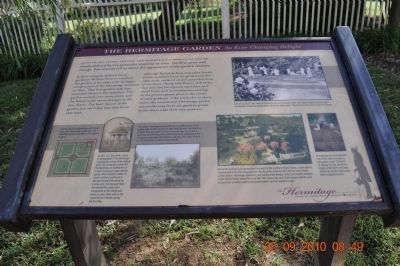
Although Rachel Jackson and other female family members loved the garden and did light work, enslaved workers provided most of the labor. Along with flowers and herbs, they may also have grown vegetables and small fruits such as strawberries and figs in the present grassy plots in the center of each quadrant. Like much else in those times, the ornamental Hermitage garden was worlds away from the gardens grown by the slave near their own quarters.
Topics and series. This historical marker is listed in these topic lists: African Americans • Agriculture •
this page online
Location. 36° 12.903′ N, 86° 36.765′ W. Marker is in Hermitage, Tennessee, in Davidson County. It can be reached from Rachels Lane 0.3 miles east of Hermitage Road. Marker is located in The Hermitage Garden. Touch for map. Marker is at or near this postal address: 4580 Rachels Lane, Hermitage TN 37076, United States of America. Touch for directions.

Regionally, this marker is in Middle Tennessee and in Greater Nashville. It is also in the American South and specifically in the Upper South. Globally, it is in North America, the Western Hemisphere, the Western World, and the Anglosphere. Historically, it finds itself in what was once the territory of the Mississippian Culture, one of the Confederate States of America, and the Antebellum South.
Other nearby markers. At least 8 other markers are within walking distance of this marker: Explore The Hermitage Grounds (a few steps from this marker); A Landscape Of Inequality
Photographed by Sandra Hughes, September 25, 2010
2. The Hermitage Garden
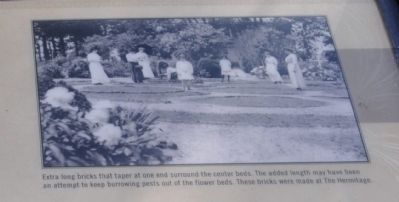
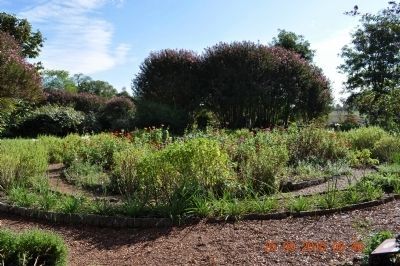
Extra long bricks that taper at one end surround the center beds. The added length may have been an attempt to keep burrowing pest out of the flowerbeds. These bricks were made at The Hermitage.
Also see . . . The Hermitage, The Home of President Andrew Jackson. (Submitted on February 9, 2012, by Bernard Fisher of Richmond, Virginia.)
Photographed by Sandra Hughes, September 25, 2010
3. The Hermitage Garden
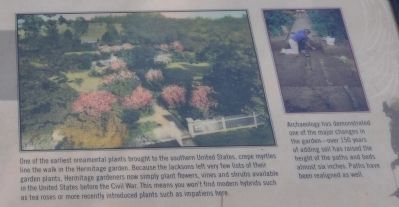
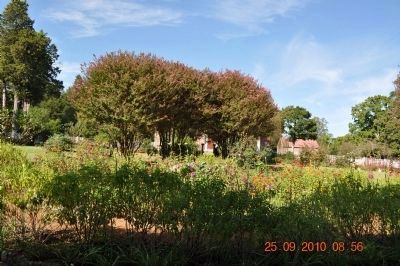
One of the earliest ornamental plants brought to the southern United States, crepe myrtles line the walk in the Hermitage garden. Because the Jackson’s left very few list of their garden plants, Hermitage gardeners now simply plant flowers, vines and shrubs available in the United State before the Civil War. This means you won't find modern hybrids such as tea roses or more recently introduced plants such as impatiens here.
Archeology had demonstrated one of the major changes in the garden-over 150 years of adding soil has raised the height of the paths and beds almost six inches. Paths have been realigned as well.
Archeology had demonstrated one of the major changes in the garden-over 150 years of adding soil has raised the height of the paths and beds almost six inches. Paths have been realigned as well.
Photographed by Sandra Hughes, September 25, 2010
4. Repair of The Hermitage Garden
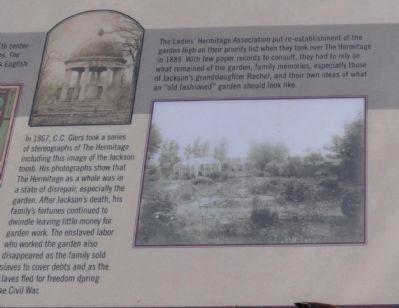
In 1867, C.C. Giers took series of stereographs of the Hermitage including this image of the Jackson tomb. His photographs show that The Hermitage as a whole was in a state of disrepair, especially the garden. After Jackson's death, his family's fortunes continued to dwindle leaving little money for garden work. The enslaved labor who worked the garden also disappeared as the family sold slaves to cover debts and as the slave fled for freedom during the Civil War.
The Ladies' Hermitage Association put re-establishment of the garden high on their priority list when they took over The Heritage in 1889. With few paper records to consult, they had to rely on what remained of the garden, family memories, especially those of Jackson's granddaughter Rachel, and their own ideas of what an "old fashioned" garden should look like.
The Ladies' Hermitage Association put re-establishment of the garden high on their priority list when they took over The Heritage in 1889. With few paper records to consult, they had to rely on what remained of the garden, family memories, especially those of Jackson's granddaughter Rachel, and their own ideas of what an "old fashioned" garden should look like.
Photographed by Sandra Hughes, September 25, 2010
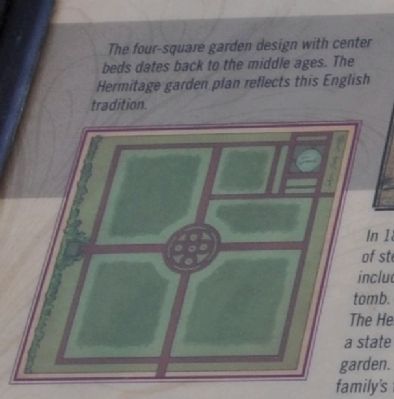
5. The Hermitage Garden ~Four Square
The foursquare garden design with center beds date back to the middle ages. The Hermitage garden plan reflects this English tradition
Photographed by Sandra Hughes, September 25, 2010
6. The Hermitage Garden
Photographed by Sandra Hughes, September 25, 2010
7. The Hermitage Garden Marker/Crepe Myrtles
Photographed by Sandra Hughes, September 25, 2010
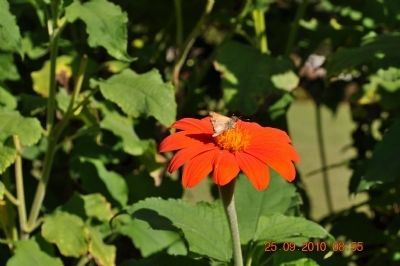
8. The Hermitage Garden
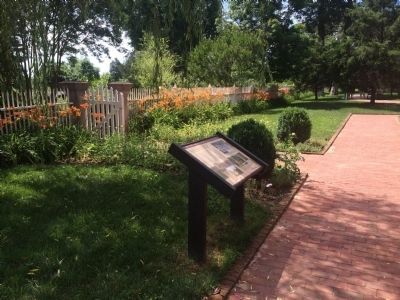
Photographed by J. Makali Bruton, June 14, 2015
9. Wide view of The Hermitage Garden Marker
Credits. This page was last revised on February 7, 2023. It was originally submitted on February 8, 2012, by Sandra Hughes Tidwell of Killen, Alabama, USA. This page has been viewed 887 times since then and 32 times this year. Last updated on July 12, 2015, by J. Makali Bruton of Washington, District of Columbia. Photos: 1, 2, 3, 4, 5, 6, 7, 8. submitted on February 8, 2012, by Sandra Hughes Tidwell of Killen, Alabama, USA. 9. submitted on July 12, 2015, by J. Makali Bruton of Washington, District of Columbia. • Bill Pfingsten was the editor who published this page.
