Hermitage in Davidson County, Tennessee — The American South (East South Central)
Ginning and Pressing "King Cotton"
Wealth Created by Enslaved Hands
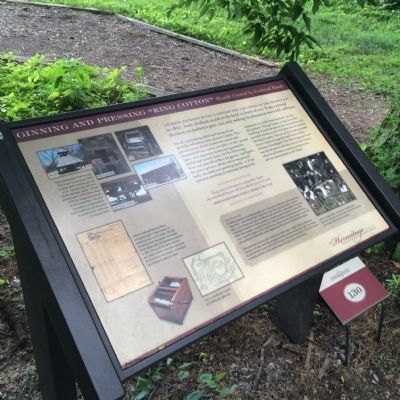
Photographed by J. Makali Bruton, June 14, 2015
1. Ginning and Pressing "King Cotton" Marker
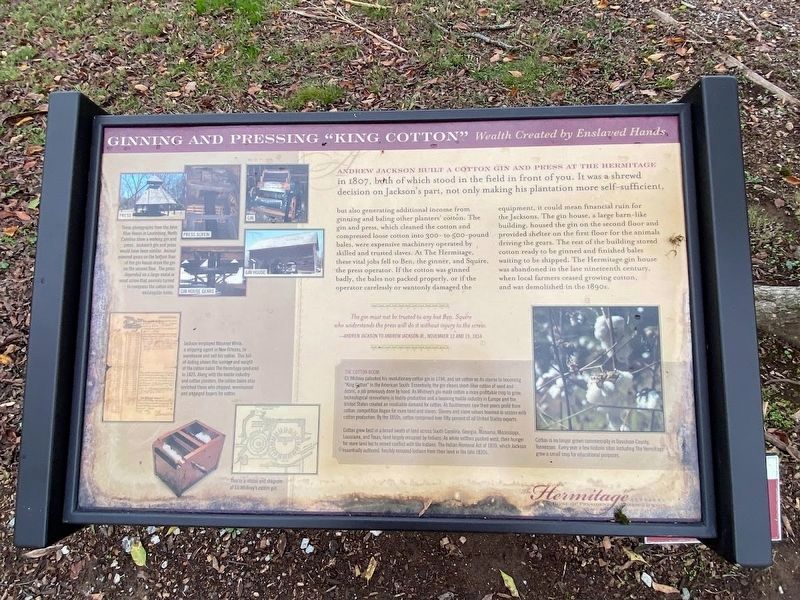
The gin must not be trusted to any but Ben. Squire who understands the press will do it without any injury to the screw.
this page online
The Cotton Boom
Eli Whitney patented his revolutionary cotton gin in 1794, and set cotton on its course to becoming “King Cotton” in the American South. Essentially, the gin cleans short-fiber cotton of seed and debris, a job previously done by hand. As Whitney's gin made cotton a more profitable crop to grow, technological innovations in textile production and a booming textile industry in Europe and the United States created an insatiable demand for cotton. As Southerners saw their peers profit from cotton, competition began for more land and slaves. Slavery and slave values boomed in unison with cotton production. By the 1850s, cotton comprised over fifty percent of all United States exports.
Cotton grew best in a broad swath of land across South Carolina, Georgia, Alabama, Mississippi, Louisiana, and Texas, land largely occupied by Indians. As white settlers pushed west, their hunger for more land led to armed conflict with the Indians. The Indian Removal Act of 1830, which Jackson essentially authored, forcibly removed Indians from their land in the late
Photographed by Darren Jefferson Clay
2. Ginning and Pressing "King Cotton" Marker
Captions:
These photographs from the John Blue House in Laurinburg, North Carolina show a working gin and press. Jackson's gin and press would have been similar. Animal powered gears on the bottom floor of the gin house drove the gin on the second floor. The press depended on a large metal or wood screw that animals turned to compress the cotton into rectangular bales. (Press, Press Screw, Gin, Gin House, Gin House Gears)
Jackson employed Maunsel White, a shipping agent in New Orleans, to warehouse and sell his cotton. This bill-of-lading shows the number and weight of the cotton bales The Hermitage produced in 1825. Along with the textile industry and cotton planters, the cotton boom also enriched those who shipped, warehoused and arranged buyers for cotton.
This is a model and diagram of Eli Whitney's cotton gin.
Cotton is no longer grown commercially in Davidson County, Tennessee. Every year a few historic sites including The Hermitage grow a small crop for educational purposes.
Erected by The Hermitage Foundation.
Topics and series. This historical marker is listed in these topic lists: African Americans
Photographed by J. Makali Bruton, June 14, 2015
3. Ginning and Pressing "King Cotton" Marker
Location. 36° 13.052′ N, 86° 36.649′ W. Marker is in Hermitage, Tennessee, in Davidson County. It is on Field Quarter Trail. The marker is on The Field Quarter at The Hermitage. Touch for map. Marker is in this post office area: Hermitage TN 37076, United States of America. Touch for directions.

Regionally, this marker is in Middle Tennessee and in Greater Nashville. It is also in the American South and specifically in the Upper South. Globally, it is in North America, the Western Hemisphere, the Western World, and the Anglosphere. Historically, it finds itself in what was once the territory of the Mississippian Culture, one of the Confederate States of America, and the Antebellum South.
Other nearby markers. At least 8 other markers are within walking distance of this marker: The North Cabin (here, next to this marker); Field Quarter Trail (within shouting distance of this marker); The Belted Galloway (within shouting distance of this marker); Abandonment and Preservation (within shouting distance of this marker); The Hermitage Landscape (within shouting distance of this marker); A home for Jackson’s Slaves (within shouting distance of this marker); The Hermitage Overseer (about 300 feet away, measured in a direct line); A Future President's Home (about 300 feet away). Touch for a list and map of all markers in Hermitage.
Credits. This page was last revised on February 7, 2023. It was originally submitted on July 14, 2015, by J. Makali Bruton of Washington, District of Columbia. This page has been viewed 835 times since then and 40 times this year. Photos: 1. submitted on July 14, 2015, by J. Makali Bruton of Washington, District of Columbia. 2. submitted on January 23, 2023, by Darren Jefferson Clay of Duluth, Georgia. 3. submitted on July 14, 2015, by J. Makali Bruton of Washington, District of Columbia. • Bill Pfingsten was the editor who published this page.
