Avon in Stearns County, Minnesota — The American Midwest (Upper Plains)
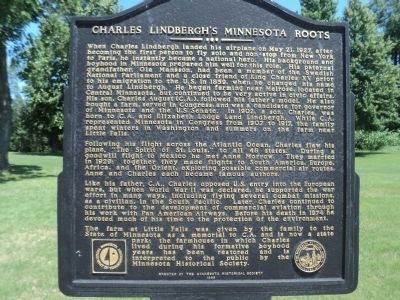
Charles Lindbergh’s Minnesota Roots
Photographed by Bill Coughlin, July 19, 2015
1. Charles Lindbergh’s Minnesota Roots Marker
Following his flight across the Atlantic Ocean, Charles flew his plane, “The Spirit of St. Louis,” to all 48 states. During a goodwill flight to Mexico
this page online
Like his father, C.A., Charles opposed U.S. entry into the European wars, but when World War II was declared, he supported the war effort in many ways, including flying several combat missions, as a civilian, in the South Pacific. Later, Charles continued to contribute to the development of commercial aviation through his work with Pan American Airways. Before his death in 1974 he devoted much of his time to the protection of the environment.
The farm at Little Falls was given by the family to the State of Minnesota as a memorial to C.A. and is now a state park; the farmhouse in which Charles lived during his formative boyhood years has been restored and is interpreted to the public by the Minnesota Historical Society.
Erected 1998 by Minnesota Historical Society.
Topics and series. This historical marker is listed in these topic lists: Agriculture • Air & Space • Parks & Recreational Areas • Settlements & Settlers
Photographed by Bill Coughlin, July 19, 2015
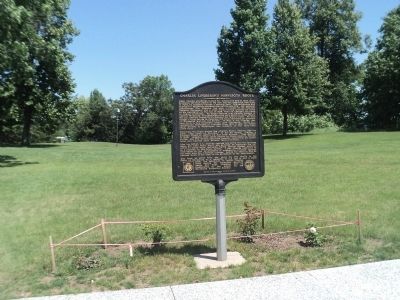
2. Charles Lindbergh’s Minnesota Roots Marker
Location. 45° 36.249′ N, 94° 28.57′ W. Marker is in Avon, Minnesota, in Stearns County. It can be reached from Interstate 94, on the right when traveling north. Marker is located in the Middle Spunk rest area on the northbound side of I-94 N. Touch for map. Marker is in this post office area: Avon MN 56310, United States of America. Touch for directions.

Regionally, this marker is in Central Minnesota. It is also in the American Midwest and in the Corn Belt. Globally, it is in North America, the Western Hemisphere, the Western World, and the Anglosphere. Historically, it finds itself in what was once Rupert’s Land, the territory of the Mississippian Culture, and the Louisiana Purchase.
Other nearby markers. At least 7 other markers are within 11 miles of this marker, measured as the crow flies: The Benedictines in Minnesota (approx. 0.3 miles away); St. John's Abbey and University (approx. 4.1 miles away); St. John's Abbey and University Old Church and Quadrangle (approx. 4.4 miles
Photographed by Bill Coughlin, July 19, 2015
3. Charles Lindbergh’s Minnesota Roots Marker
Related marker. Click here for another marker that is related to this marker.
Credits. This page was last revised on November 23, 2019. It was originally submitted on July 19, 2015, by Bill Coughlin of Woodland Park, New Jersey. This page has been viewed 756 times since then and 21 times this year. Photos: 1, 2, 3. submitted on July 19, 2015, by Bill Coughlin of Woodland Park, New Jersey.
