Susquehanna Township near Harrisburg in Dauphin County, Pennsylvania — The American Northeast (Mid-Atlantic)
Pennsylvania Slavery
Photographed by Don Morfe, July 6, 2015
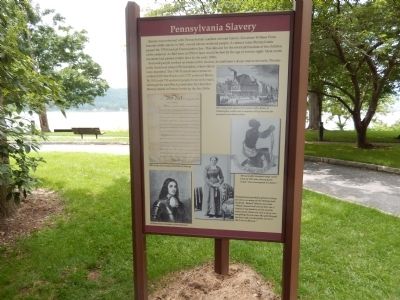
1. Pennsylvania Slavery Marker
Slavery was entwined with Pennsylvania’s earliest colonial history. Governor William Penn, founder of the colony in 1681, owned eleven enslaved people. A century later, Pennsylvania passed the 1780 Gradual Emancipation law. This allowed for the eventual freedom of the children of the enslaved. A child born in 1780 or later would be free by the age of twenty-eight. Most northern states had passed similar laws by the early 1800s.
Enslaved people worked on farm and in taverns, in craftsmen’s shops and as servants. The majority lived in or around Philadelphia, where slaves were imported. The 1790 census recorded 6,537 free Blacks and 3,737 enslaved Blacks. By 1810 on 795 enslaved people lived in the state, although the total Black population had doubled. Slavery ended in Pennsylvania by the late 1840s.
[Captions:]
1780 Act for the Gradual Abolition of Slavery
William Penn, Governor of Pennsylvania
This lithograph depicts the London Coffee House in Philadelphia, which was a common selling location for merchants and slave traders.
This powerful woodcut image comes from an 1837 anti-slavery poem titled, “Our Countrymen in Chains.”
Pennsylvania provided a glimmer of home for slaves escaping via the Underground Railroad. Harriet Tubman once said, “When I found I had crossed that line, I looked at my hands to see if I was the same person. There was such a glory over everything the sun came like gold through the trees, and over the fields, and I felt like I was in Heaven.”
Erected by Dauphin
this page online
Topics. This historical marker is listed in these topic lists: Abolition & Underground RR • African Americans • Agriculture • Industry & Commerce. A significant historical year for this entry is 1681.
Location. 40° 20.506′ N, 76° 54.572′ W. Marker is near Harrisburg, Pennsylvania, in Dauphin County. It is in Susquehanna Township. It is on River Road. The marker is located on the grounds of Fort Hunter Park. Touch for map. Marker is at or near this postal address: 35 N Front St, Harrisburg PA 17110, United States of America. Touch for directions.

Regionally, this marker is in South-Central Pennsylvania, specifically in Pennsylvania Dutch Country, and in the Susquehanna Valley. It is also in the American Northeast and in the Mid-Atlantic. Globally, it is in North America, the Western Hemisphere, the Western World, and the Anglosphere. Historically, it finds itself in what was once the Haudenosaunee (Iroquois) Confederacy and also one of the original Thirteen Colonies.
Other nearby markers. At least 8 other markers are within walking distance of this marker: United States Slavery (here,
Photographed by Don Morfe, July 6, 2015
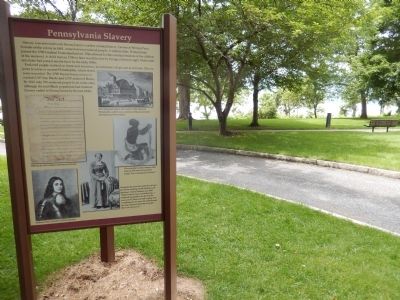
2. Pennsylvania Slavery Marker
Another marker is no longer nearby. Fort Hunter (was within shouting distance of this marker but has been replaced with another marker now near it).
Photographed by Don Morfe, July 6, 2015
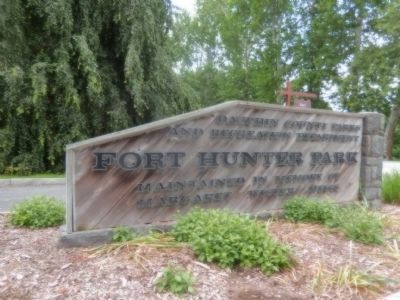
3. Sign at the entrance to Fort Hunter Park
Credits. This page was last revised on August 4, 2024. It was originally submitted on July 23, 2015, by Don Morfe of Baltimore, Maryland. This page has been viewed 644 times since then and 30 times this year. Photos: 1, 2, 3. submitted on July 23, 2015, by Don Morfe of Baltimore, Maryland. • Bill Pfingsten was the editor who published this page.
