Old Town in Alexandria, Virginia — The American South (Mid-Atlantic)
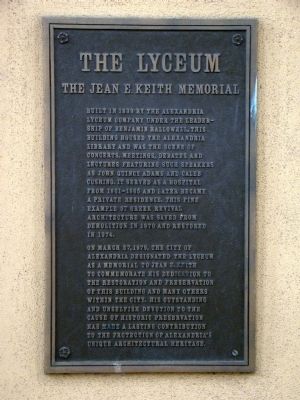
The Lyceum
The Jean E. Keith Memorial
Photographed by J. J. Prats, June 28, 2008
1. The Lyceum Marker
Built in 1839 by the Alexandria Lyceum Company under the leadership of Benjamin Hallowell, this building housed the Alexandria Library and was the scene of concerts, meetings, debates and lectures featuring such speakers as John Quincy Adams and Caleb Cushing. It served as a hospital from 1861–1865 and later became a private residence. This fine example of Greek Revival architecture was saved from demolition in 1970 and restored in 1974.
On March 27, 1979, the City of Alexandria designated the Lyceum as a memorial to Jean E. Keith to commemorate his dedication to the restoration and preservation of this building and many others within the city. His outstanding and unselfish devotion to the cause of historic preservation has made a lasting contribution to the protection of Alexandria’s unique architectural heritage.
Topics and series. This historical marker is listed in these topic lists: Architecture • Arts, Letters, Music • Charity & Public Work • Education • Entertainment • Industry & Commerce • Science & Medicine • War, US Civil. In addition, it is included in the Former U.S. Presidents: #06 John Quincy Adams
this page online
Location. 38° 48.224′ N, 77° 2.848′ W. Marker is in Alexandria, Virginia. It is in Old Town. It is on South Washington Street (Virginia Route 400) south of Prince Street, on the right when traveling south. Marker is on the wall at the entrance doors. Touch for map. Marker is at or near this postal address: 201 S Washington St, Alexandria VA 22314, United States of America. Touch for directions.

Regionally, this marker is in the Washington Metropolitan Area and in Northern Virginia. It is also in the American South, specifically in the Upper South, in the Mid-Atlantic, and on the Eastern Seaboard. Globally, it is in the North Atlantic Region, North America, the Western Hemisphere, the Western World, and the Anglosphere. Historically, it finds itself in what was once the territory of the Mississippian Culture, one of the original Thirteen Colonies, one of the Confederate States of America, and the Antebellum South.
Other nearby markers. At least 8 other markers are within walking distance of this marker: The Historic Lyceum (here, next to this marker); The Patton-Fowle House
Photographed by J. J. Prats, June 28, 2008
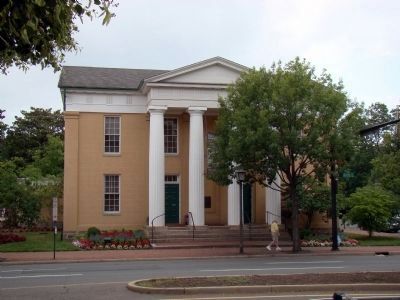
2. The Lyceum and Marker
Marker can be seen behind the second column from the left.
Other markers no longer nearby. The Confederate Statue (was within shouting distance of this marker but has been permanently removed); Swann-Daingerfield House (was within shouting distance of this marker but has been permanently removed).
Regarding The Lyceum. Caleb Cushing (1800–1879), mentioned on this marker, was an American statesman and diplomat who served as a U.S. Congressman from Massachusetts and Attorney General under President Franklin Pierce.
Also see . . . What is a ‘Lyceum’. “By 1839, the popularity of these programs had grown so that The Alexandria Lyceum sought to construct a new hall which
Photographed by J. J. Prats, June 28, 2008
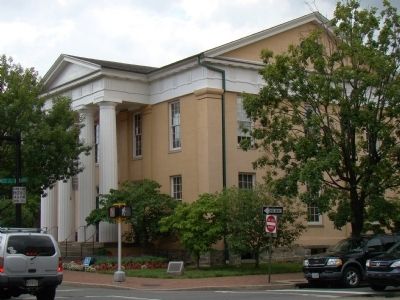
3. The Lyceum
Credits. This page was last revised on January 28, 2023. It was originally submitted on June 28, 2008, by J. J. Prats of Powell, Ohio. This page has been viewed 2,348 times since then and 29 times this year. Photos: 1, 2, 3. submitted on June 28, 2008, by J. J. Prats of Powell, Ohio.
