Volcano in Amador County, California — The American West (Pacific Coastal)
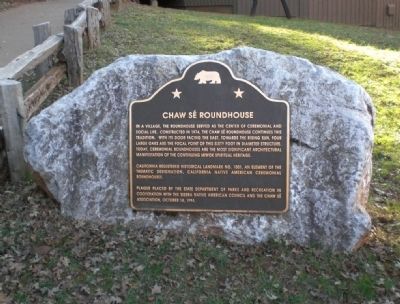
Chaw Sé Roundhouse
Photographed by Andrew Ruppenstein, November 22, 2007
1. Chaw Sé Roundhouse Marker
California Registered Historical Landmark No. 1001, an element of the thematic designation, California Native American Ceremonial Roundhouses.
Plaque placed by the State Department of Parks and Recreation in cooperation with the Sierra Native American Council and the Chaw Sé Association, October 14, 1974.
Erected 1994 by California State Department of Parks and Recreation. (Marker Number 1001.)
Topics and series. This historical marker is listed in these topic lists: Anthropology & Archaeology • Architecture • Indigenous Peoples and Communities • Settlements & Settlers. In addition, it is included in the California Historical Landmarks series list. A significant historical date for this entry is October 14, 1974.
Location. 38° 25.489′ N,
this page online

Regionally, this marker is in the Sierra Nevada. It is also in the American Mountain West. Globally, it is in North America, on the Pacific Rim, in the Western Hemisphere, in the Western World, and in the Anglosphere. Historically, it finds itself in what was once New Spain and also Mexico’s Alta California.
Other nearby markers. At least 8 other markers are within 2 miles of this marker, measured as the crow flies: Petroglyphs (Rock Carvings) (about 400 feet away, measured in a direct line); Chaw'se (about 400 feet away); Hun'ge (about 700 feet away); Pine Grove (approx. 1.2 miles away); Volcano Masonic Cave (approx. 1.2 miles away); Moose Milk (approx. 1.3 miles away); St. George Hotel (approx. 1.3 miles away); General Store (approx. 1.3 miles away). Touch for a list and map
Photographed by Andrew Ruppenstein, November 22, 2007
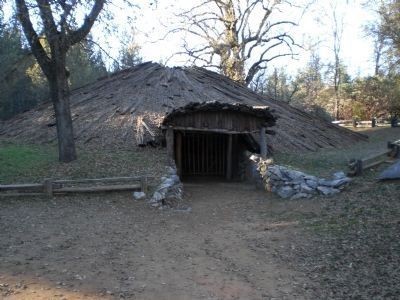
2. Chaw Se Roundhouse
The roundhouse is constructed of cedar poles secured with grapevine, and topped with cedar bark. Inside is a fire pit. The roof is supported oak pillars. A fire exit was added in the rear of the structure in 1993, per state fire regulations. The door faces the east to catch the sunrise.
The roundhouse is still used today, on occasion, for ceremonial dances.
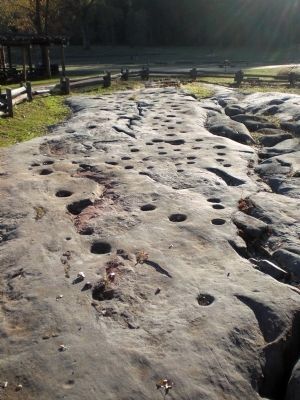
More about this marker. Indian Grinding Rock State Historic Park preserves 135 acres of meadows and Valley Oak lands. The highlight of the park is a large limestone outcropping, containing 1,185 mortar holes, as well as some petroglyphs. In addition to this grinding rock, the park also contains a roundhouse, a regional Native American museum, and reproductions of Native American bark houses.
Also see . . . The Rock and the People. The California Department of Parks and Recreation's web page for the grinding rock. (Submitted on June 30, 2008, by Andrew Ruppenstein of Lamorinda, California.)
Photographed by Andrew Ruppenstein, November 22, 2007
3. Chaw Se - The main grinding rock
Chaw Sé, or alternatively, Chaw'Se, is the Miwok word for grinding rock. These mortar holes were used to grind acorns into meal.
Photographed by Andrew Ruppenstein, November 22, 2007
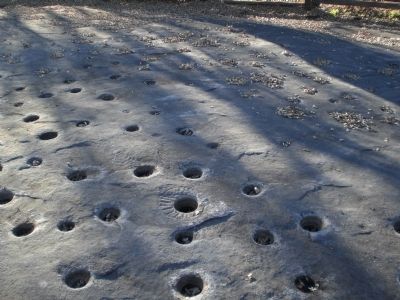
4. Chaw Se - Grinding Rock
Another view of the grinding rock. Note the faint presence of a number of petroglyphs. A number of these are thought to be 2,000 - 3,000 years old.
Credits. This page was last revised on January 8, 2025. It was originally submitted on June 30, 2008, by Andrew Ruppenstein of Lamorinda, California. This page has been viewed 3,220 times since then and 54 times this year. Last updated on July 2, 2008, by Andrew Ruppenstein of Lamorinda, California. Photos: 1, 2, 3, 4. submitted on June 30, 2008, by Andrew Ruppenstein of Lamorinda, California. • Kevin W. was the editor who published this page.
