
West Chillisquaque Township near Milton in Northumberland County, Pennsylvania — The American Northeast (Mid-Atlantic)
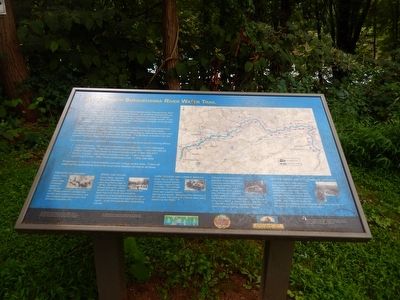
West Branch Susquehanna River Water Trail
Photographed by Beverly Pfingsten, August 22, 2015
1. West Branch Susquehanna River Water Trail Marker
A journey down the West Branch tells the tale of lumbering in Pennsylvania, from the early lumber mills to today's sustainable forests. As you float downstream you will see the legacy of lumber; the "rafting points" used by river pilots to navigate the dangerous waters, abandoned railroads, and miles of renewable forest, If you listen carefully enough you may hear elk bugle, bald eagles screech, or the ghosts of log drivers and rafters calling to each other.
To safely assist you in your journey, consult the West Branch Susquehanna River Trail Map and Guide book. The Guide includes safety and route information, along with detailed maps showing the historic rafting points, natural resources, and recreational opportunities in each of the sections. The Guide is available from the Lumber Heritage Region at www.lumberheritage.org.
For more recreation and visitor information contact the local county tourism offices:
• Indiana County - http://www.visitindianacountypa.org/ -1-877-7INDIANA
• Clearfield County - http://www.visitclearfieldcounty.org/ - 1-866-GOWILDS
• Clinton County - http://www.clintoncountyinfo.com/ - 1-888-388-6991
•
this page online
• Lycoming County - http://www.vacationpa.com/ - 1-800-358-9900
Remember, rivers are unpredictable and can change at any time. Follow all water safety precautions and wear a personal flotation devise at all times.
Pioneers of Logging
In the 1780s the first small scale lumbering began in Pennsylvania. These sawmills operated seasonally and supplied local neds, but also shipped wood down rivers and streams as lumber rafts.
Spars and Sticks
In the 1830s, sawmills along the West Branch were supplied by logs or "sticks", that were cut and floated downriver - either as part of a raft or as scattered logs in a "drive" that would be captured by a boom placed across the river. The straightest stock were used as masts, or "spars", in the Chesapeake Bay shipbuilding industry.
Bark Peelers and Lumber Barons
From 1864 to 1941 the logging railroad was the principal means of hauling timber. The railroads hauled mostly hemlock, which was used for leather tanning and lumber. Because of the efficiency of the railroads, Pennsylvania's forests were nearly cleared by the 1930s.
Forest Conservation
Decades
Photographed by Beverly Pfingsten, August 22, 2015
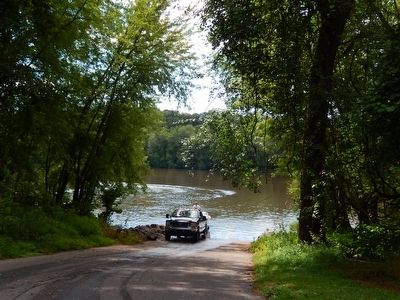
2. West Branch Susquehanna River
Second Forest and a Sustainable Approach
After World War II, Pennsylvania's "new" hardwood forests replaced the white pine and hemlock forests, and sustainable forestry practices emerged. Sustainable management keeps land in forest use, fosters cleaner rivers and more wildlife, and makes Pennsylvania the nation's leading producer of hardwoods, while over half of the state (17 million acres) remains forested.
Erected by PA DCNR, PA Lumber Heritage Region, and Chesapeake Bay Gateways Network.
Topics. This historical marker is listed in these topic lists: Environment • Horticulture & Forestry • Industry & Commerce • Waterways & Vessels. A significant historical year for this entry is 1830.
Location. 40° 56.503′ N, 76° 51.918′ W. Marker is near Milton, Pennsylvania, in Northumberland County. It is in West Chillisquaque Township. It can be reached from Pennsylvania Route 405. Marker is .1 mile from PA 405 at a public boat landing. Touch for map. Marker is in this post office area: Milton PA 17847, United States of America. Touch for directions.

Regionally, this marker is in Pennsylvania’s Anthracite Coal Region and in the Susquehanna Valley. It is also in the American Northeast, in the Mid-Atlantic, in Appalachia, and specifically in Northern Appalachia. Globally, it is in North America, the Western Hemisphere, the Western World, and the Anglosphere. Historically, it finds itself in what was once the Haudenosaunee (Iroquois) Confederacy and also one of the original Thirteen Colonies.
Other nearby markers. At least 8 other markers are within 2 miles of this marker, measured as the crow flies: Site of The College Inn (approx. 1.3 miles away); Bucknell University (approx. 1.4 miles away); Christopher Mathewson (approx. 1.4 miles away); Christy Mathewson Memorial Gateway (approx. 1.4 miles away); Bucknell University World War I Memorial (approx. 1.4 miles away); Robert Lowry (approx. 1.4 miles away); War Against Terrorism Memorial (approx. 1½ miles away); 2nd/Lt. George H. Ramer, U.S.M.C.R. (approx. 1½ miles away).
Related marker. Click here for another marker that is related to this marker.
Credits. This page was last revised on December 16, 2024. It was originally submitted on August 24, 2015, by Bill Pfingsten of Bel Air, Maryland. This page has been viewed 549 times since then and 18 times this year. Photos: 1, 2. submitted on August 24, 2015, by Bill Pfingsten of Bel Air, Maryland.
