Near Manassas in Prince William County, Virginia — The American South (Mid-Atlantic)
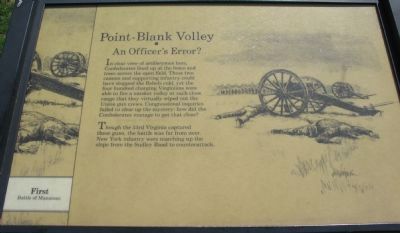
Point-Blank Volley
An Officer’s Error?
| — | First Battle of Manassas | — |
Photographed by Craig Swain, May 4, 2008
1. Point-Blank Volley Marker
Though the 33rd Virginia captured these guns, the battle was far from over. New York infantry were marching up from Sudley Road to counterattack.
Topics. This historical marker is listed in this topic list: War, US Civil.
Location. This marker has been replaced by another marker nearby. 38° 48.736′ N, 77° 31.233′ W. Marker is near Manassas, Virginia, in Prince William County. It can be reached from Sudley Road (Virginia Route 234) 0.6 miles south of Lee Highway (U.S. 29), on the right when traveling north. The marker is one of the waysides along the Henry House Hill trail, which starts at the Manassas National Battlefield Park visitor center. Touch for map.
this page online

Regionally, this marker is in the Washington Metropolitan Area, in Northern Virginia, and in the Piedmont. It is also in the American South, specifically in the Upper South, in the Mid-Atlantic, and on the Eastern Seaboard. Globally, it is in the North Atlantic Region, North America, the Western Hemisphere, the Western World, and the Anglosphere. Historically, it finds itself in what was once the territory of the Mississippian Culture, one of the original Thirteen Colonies, one of the Confederate States of America, and the Antebellum South.
Other nearby markers. At least 10 other markers are within walking distance of this location: Point Blank Volley (here, next to this marker); Lieutenant William P. Mangum (about 300 feet away, measured in a direct line); Colonel Thomas (about 300 feet away); Final Struggle (about 300 feet away); Defeat and Disarray (about 300 feet away); Counterattack (about 300 feet away); Charge on Griffin’s Guns (about 400 feet away); Turning the Tide (about 400 feet away); General Barnard Elliott Bee
Photographed by Tom Fuchs, June 10, 2006
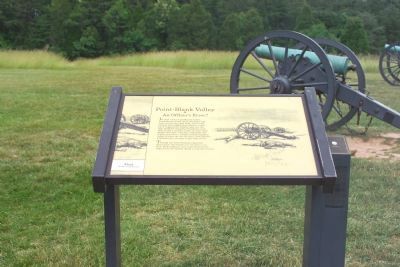
2. Point-Blank Volley Marker
More about this marker. On the right side of the marker is a depiction of the overrun battery.
This marker was replaced by a new one also named Point-Blank Volley (see nearby markers).
Regarding Point-Blank Volley. “First Bull Run was a first battle—a major engagement after a prolonged period of peace. For some it constitutes a metaphor of the price paid for military unpreparedness.” —John S. Brown, Brigadier General, USA, 2003.
Also see . . .
1. Civil War Artillery Equipment. (Submitted on March 4, 2007.)
2. First Bull Run, An Overview. From the 2004 Battle of First Bull Run by Ted Ballard, Center of Military History, United States Army. (Submitted on March 4, 2007, by Tom Fuchs of Greenbelt, Maryland.)
Additional commentary.
1. Griffin's Guns
The two guns located at this point of the battlefield were a section of Battery D, 5th U.S. Artillery, commanded by Captain Charles Griffin. Also known as "The West Point Battery, it was armed with four 10-pdr (2.9-inch)
Photographed by Tom Fuchs, June 10, 2006
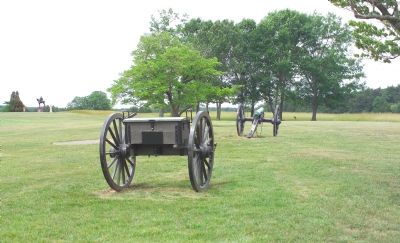
3. Union Cannon Face Tree Line on Henry Hill
Today two 12-pounder Model 1841 Field Howitzers mark the location of this section on the battlefield. The two cannon were both cast by Cyrus Alger, in Boston.
— Submitted June 8, 2008, by Craig Swain of Leesburg, Virginia.
Additional keywords. First Battle of Bull Run. 1st Bull Run. 1st Manassas. Ricketts’ cannon, Rickett's cannon, Ricketts' cannon, Captain J. B. Ricketts, Battery D, 5th U.S. Artillery, commanded by Capt. Charles Griffin. Confederate Col. Arthur C. Cummings, 33rd Virginia.
Photographed by Tom Fuchs, June 10, 2006
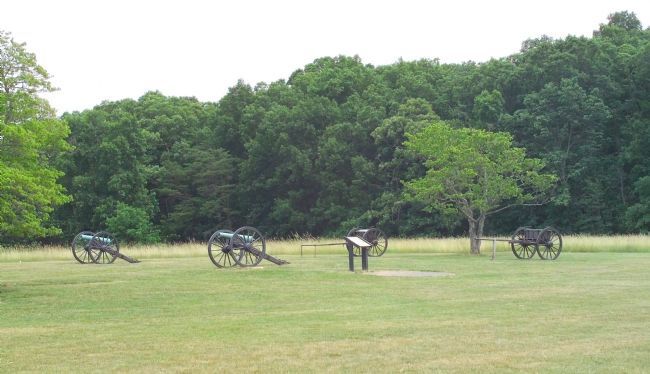
4. Two Cannon, Two Limbers, and the Marker
Limbers are two-wheeled ammunition carriages. During transport they are hooked to the two-wheeled carriage holding the cannon, forming a four-wheel cart that pivots between the axles, with the cannoneers using the ammunition chest as a seat. Limbers can also haul caissons (not shown) instead of cannon. Caissons hold additional ammunition chests.
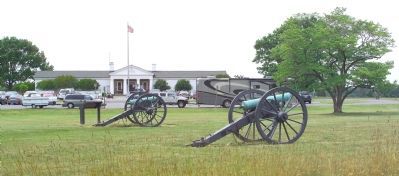
Photographed by Tom Fuchs, June 10, 2006
5. The Manassas National Battlefield Park Visitors Center North of Manassas
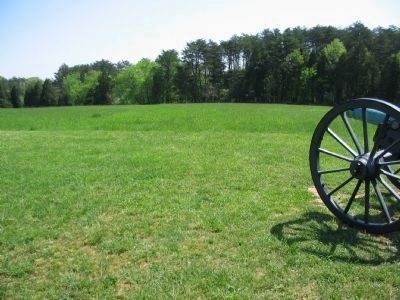
Photographed by Craig Swain, May 4, 2008
6. 33rd Virginia Attack
The 33rd Virginia approached the guns from the low ground in front of the battery (the background here).
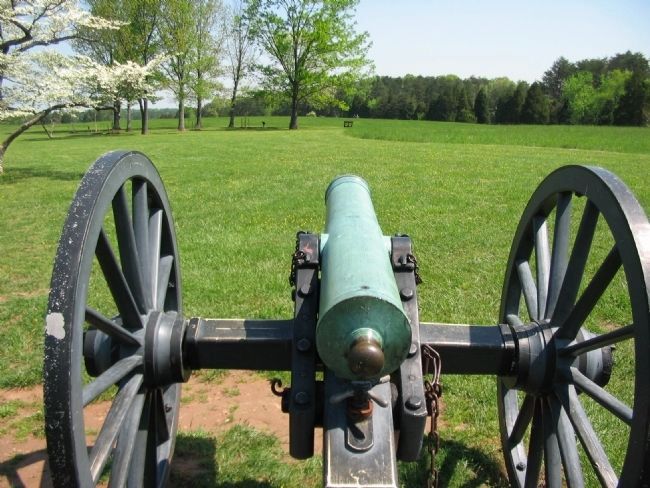
Photographed by Craig Swain, May 4, 2008
7. View from Griffin's Guns
Looking down one of the 12-pounder Howitzers. The Confederate batteries and infantry that Battery D, 5th U.S. Artillery was engaged stood on the far side of the field, near the distant tree line. The 33rd Virginia attacked from the right of this view.
Credits. This page was last revised on June 16, 2016. It was originally submitted on March 4, 2007, by Tom Fuchs of Greenbelt, Maryland. This page has been viewed 2,967 times since then and 31 times this year. Photos: 1. submitted on June 8, 2008, by Craig Swain of Leesburg, Virginia. 2, 3, 4, 5. submitted on March 4, 2007, by Tom Fuchs of Greenbelt, Maryland. 6, 7. submitted on June 8, 2008, by Craig Swain of Leesburg, Virginia. • J. J. Prats was the editor who published this page.
