Mill Springs National Cemetery
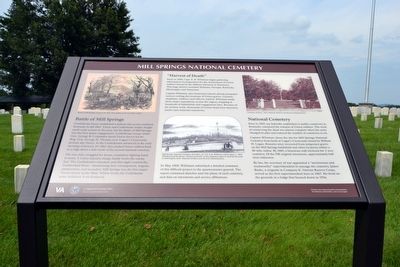
Battle of Mill Springs
Confederate forces established a defense line across southern Kentucky in fall 1861. Union and Confederate armies fought small-scale actions in the area, but the Battle of Mill Springs was the first major engagement. Confederate troops under Gen. George B. Crittenden faced Union forces led by Brig. Gen. George H. Thomas near Logan’s Crossroads, present-day Nancy. As the Confederates advanced in the early morning of January 19, 1862, they pushed Union soldiers back to a ridge about a mile south of the current national cemetery.
The two sides struggled for hours, sometimes fighting hand to hand. A Union bayonet charge finally broke the enemy line. The Confederates retreated, and that night crossed the Cumberland River—abandoning their encampment, wagons, ammunition, and wounded. Mill Springs was the first major Union victory in the West. Within weeks the Confederate army withdrew from Kentucky.
“Harvest of Death”
Early in 1866, Capt. E.B. Whitman began gathering information in preparation of the reinterment of Union soldiers buried in the Military Division of Tennessee. This
this page online
Captain Whitman, later lieutenant colonel, placed newspaper notices seeking the locations of Union graves. Citizens, chaplains, soldiers, and officers replied. Whitman made three major expeditions across the region, stopping at hundreds of battlefields and engagement sites. Because of his tireless work, thousands of Union dead were moved to twelve new national cemeteries.
In May 1869, Whitman submitted a detailed summary of this difficult project to the quartermaster general. The report contained sketches and site plans for each cemetery, and date on interments and service affiliations.
National Cemetery
Prior to 1869, ten federally established or public cemeteries in Kentucky contained the remains of Union soldiers. The work of reinterring the dead was almost complete when the army changed its plan and reduced the number of cemeteries to six.
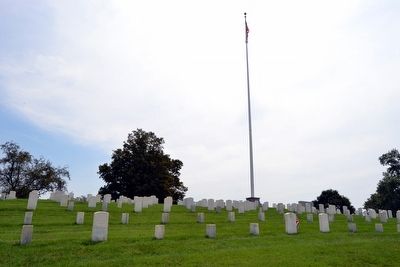
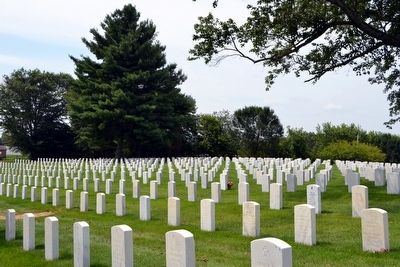
Captain Whitman chose the site for Mill Springs National Cemetery from lands at Logan’s Crossroads owned by William H. Logan. Remains were recovered from temporary graves on the Mill Springs battlefield
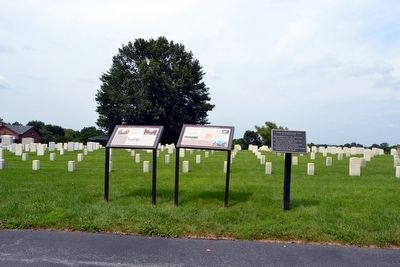
A National Cemetery System (R) Markers
By law, the secretary of war appointed a “meritorious and trustworthy” superintendent to manage the cemetery. James Burke, a sergeant in Company K, Veteran Reserve Corps, served as the first superintendent here in 1867. He lived on the grounds in a lodge that burned down in 1916.
[Captions:]
Battle of Mill Springs, January 19, 1862. Our Soldier in the Civil War (1886).
Mill Springs National Cemetery, from Brvt. Lt. Col. E.B. Whitman's final report, c. 1869. Whitman used the phrase "Harvest of Death" in his exhaustive report to describe the work of collecting the dead. National Archives and Records Administration.
Cemetery entrance, 1904. National Archives and Records Administration.
Erected by National Cemetery Administration, U.S. Department of Veterans Affairs.
Topics and series. This historical marker is listed in these topic lists: Cemeteries & Burial Sites • War, US Civil. In addition, it is included in the National Cemeteries
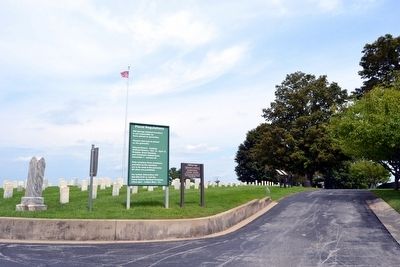
Location. 37° 4.106′ N, 84° 44.249′ W. Marker is in Nancy, Kentucky, in Pulaski County. It can be reached from State Highway 80 0.2 miles east of State Highway 235, on the left when traveling east. Marker is located in the Mill Springs National Cemetery 100 feet east of the main entrance. Touch for map. Marker is at or near this postal address: 9044 Kentucky 80, Nancy KY 42544, United States of America. Touch for directions.

Regionally, this marker is in the Lake Cumberland Region. It is also in the American South, specifically in the Upper South, in Appalachia, and specifically in Southern Appalachia. Globally, it is in North America, the Western Hemisphere, the Western World, and the Anglosphere. Historically, it finds itself in what was once the territory of the Mississippian Culture and also the Antebellum South.
Other nearby markers. At least 8 other markers are within walking distance of this marker: A National Cemetery System (here, next to this marker); a different marker also named A Hard March (about 500 feet away, measured in a direct line); Confederate Defense Line / The Forces Move In / Battle of Mill Springs / Aftermath
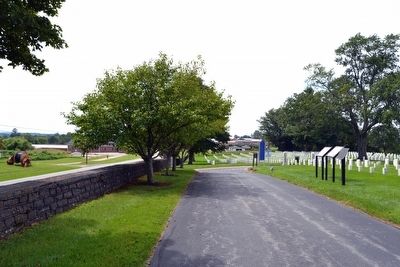
Other markers no longer nearby. "A Hard March" (was within shouting distance of this marker but has been replaced with another marker now near it); a different marker also named "Battle on a Sabbath Morn" (was approx. 0.8 miles away but has been replaced with another marker now near it); The Union Line at the Fence (was approx. 0.8 miles away but has been reported to have been replaced with another marker now near it); Fix Bayonets - Charge! (was approx. 0.8 miles away but has been reported to have been replaced with another marker now near it).
Credits. This page was last revised on January 28, 2021. It was originally submitted on September 10, 2015, by Duane Hall of Abilene, Texas. This page has been viewed 737 times since then and 35 times this year. Photos: 1, 2, 3, 4, 5, 6. submitted on September 10, 2015, by Duane Hall of Abilene, Texas. 7. submitted on January 27, 2021, by Bradley Owen of Morgantown, West Virginia.
