Araby View near Frederick in Frederick County, Maryland — The American Northeast (Mid-Atlantic)
Gordon’s Decisive Attack
3:00-4:30 p.m. July 9, 1864
| — | Monocacy National Battlefield, National Park Service, U.S. Department of the Interior | — |
Photographed by Craig Swain, September 9, 2007
1. Gordon's Decisive Attack Marker
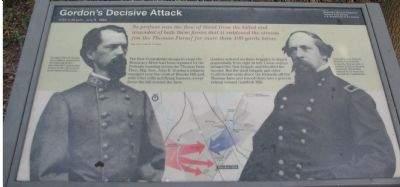
So profuse was the flow of blood from the killed and wounded of both sides of these forces that it reddened the stream [on the Thomas Farm] for more than 100 yards below.
Maj. Gen. John B. Gordon
The first Confederate troops to cross the Monocacy River had been repulsed by the Federals massing across the Thomas farm. Then Maj. Gen. John B. Gordon's infantry emerged over the crest of Brooks Hill and with rebel yells and flying banners, swept down the hill toward the farm.
Gordon ordered his three brigades to attack sequentially from right to left. Union volleys ravaged the first brigade and bloodied the second. But the third brigade and other Confederate units drove the Federals off the Thomas farm and forced them into a general retreat toward Gambrill Mill.
Erected by National Park Service, U.S. Department of the Interior.
Topics. This historical marker is listed in this topic list: War, US Civil. A significant historical month for this entry is July 1863.
Location. Marker has been reported missing. It was located near 39° 21.287′ N, 77° 23.681′ W. Marker was near Frederick, Maryland, in Frederick County. It was in Araby
this page online

Regionally, this marker was in the Washington Metropolitan Area and in Central Maryland. It was also in the American Mid-Atlantic. Globally, it was in North America, the Western Hemisphere, the Western World, and the Anglosphere. Historically, it found itself in what was once one of the original Thirteen Colonies and also the Antebellum South.
Other nearby markers. At least 8 other markers are within walking distance of this location: A Bold Plan (approx. ¼ mile away); Final Attack (approx. ¼ mile away); Civilians Under Siege (approx. ¼ mile away); History of the Monocacy River Valley (approx. 0.4 miles away); Clustered Spires of Frederick (approx. 0.4 miles away); The Battle That Saved Washington
Photographed by Bill Coughlin, April 12, 2011
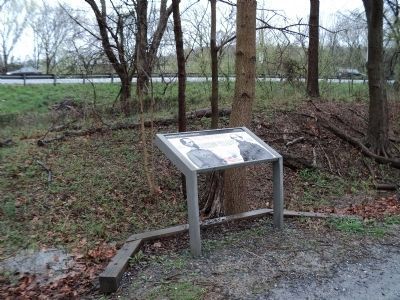
2. Gordon’s Decisive Attack Marker
This photo looks east in the direction of the Thomas Farm and Gordon's advance. The view of the farm is blocked by I-270, which bisects the Monocacy Battlefield.
Other markers no longer nearby. Thick of the Battle (was approx. ¼ mile away but has been confirmed missing); Thomas Farm (was approx. ¼ mile away but has been permanently removed); Federal Retreat (was approx. ¼ mile away but has been permanently removed); Goodloe Edgar Byron (was approx. half a mile away but has been permanently removed).
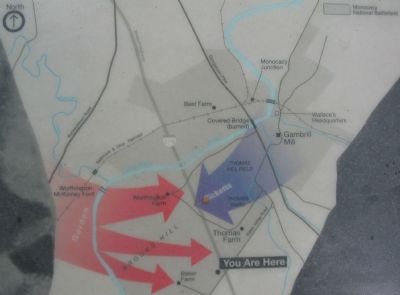
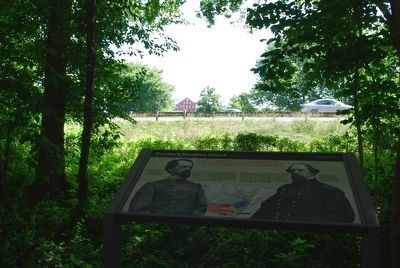
More about this marker. On the left is a portrait of "Georgia's John B. Gordon" who "was a gallant, determined, and inspiring leader - just what the Confederates needed at the critical point in the Battle of Monocacy." On the right is a portrait of "Union Brig. Gen. James B. Rickets," who "moved quickly across the Thomas farm to confront Gordon's flanking movement. His division suffered heavy losses but did stall the Confederates." Between the portraits is a tactical battle map.
Regarding Gordon’s Decisive Attack. The Monocacy Battlefield, while otherwise rather pristine compared to
Photographed by Craig Swain, September 9, 2007
3. Battle Map
Note how modern I-270 bisects the battlefield at this point.
Related markers. Click here for a list of markers that are related to this marker. This marker is among several describing the battle of Monocacy, to "tour" the battlefield using the related HMBd markers sites.
Also see . . . Battle of Monocacy. National Park Service site. (Submitted on November 4, 2007, by Craig Swain of Leesburg, Virginia.)
Photographed by Craig Swain, September 9, 2007
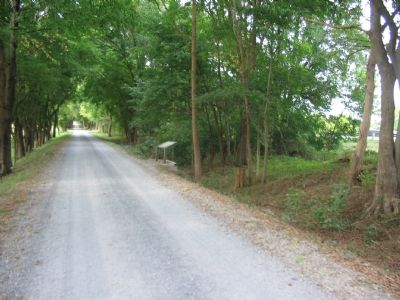
4. Marker along the Service Road
Note the guard rail for the interstate on the right. At the time of the battle of course neither the interstate or the tree line existed. This section of the battlefield was open, rolling farm land.
Photographed by Brandon Fletcher, June 25, 2009
5. Gordon’s Decisive Attack Marker
Photographed by Craig Swain, May 26, 2007
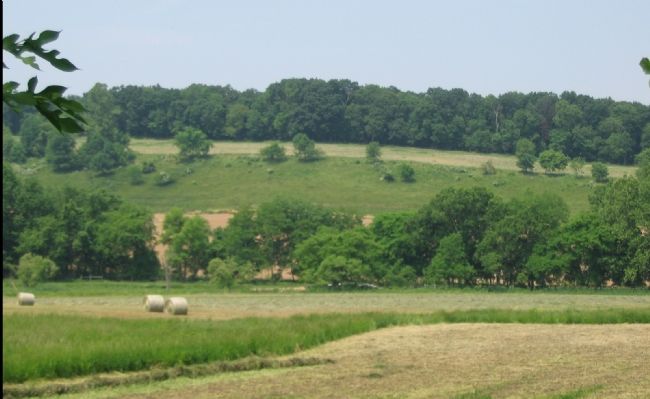
6. Brooks Hill and Gordon's Advance
Gordon's division moved up this valley at the foot of Brooks Hill to attack the Federal lines. The valley is named for Baker's Farm which stood just at the base of Brooks Hill.
Credits. This page was last revised on April 25, 2024. It was originally submitted on November 4, 2007, by Craig Swain of Leesburg, Virginia. This page has been viewed 2,137 times since then and 125 times this year. Last updated on October 1, 2015, by Shane Oliver of Richmond, Virginia. Photos: 1. submitted on November 4, 2007, by Craig Swain of Leesburg, Virginia. 2. submitted on April 23, 2011, by Bill Coughlin of Woodland Park, New Jersey. 3, 4. submitted on November 4, 2007, by Craig Swain of Leesburg, Virginia. 5. submitted on August 9, 2015, by Brandon Fletcher of Chattanooga, Tennessee. 6. submitted on November 4, 2007, by Craig Swain of Leesburg, Virginia. • Andrew Ruppenstein was the editor who published this page.
