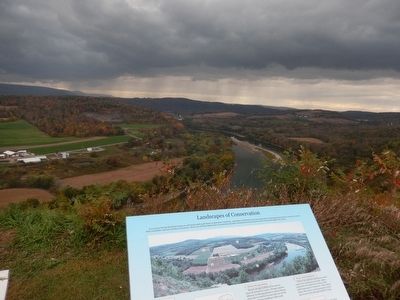
Landscapes of Conservation
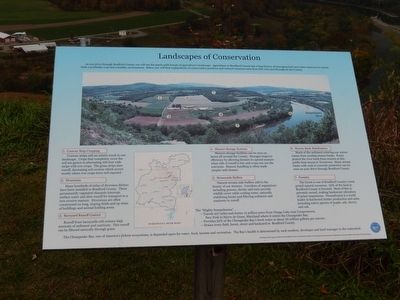
1. Contour Strip Cropping
Contour strips add an artistic touch to our landscape. Crops that completely cover the soil are grown in alternating 100 foot wide strips with row crops. The grass strips slow runoff, decreasing soil erosion which occurs mostly where row crops leave soil exposed.
2. Diversions
Many hundreds of miles of diversion ditches have been installed in Bradford County. These permanently vegetated channels intercept surface water and slow runoff for transport in a non-erosive manner. Diversions are often constructed on long, sloping fields and up slope of building and animal holding area.
3. Barnyard Runoff Control
Runoff from barnyards will contain high amounts of sediment and nutrients. This runoff can be filters naturally through
this page online
4. Manure Storage Systems
Manure storage facilities can be seen on farms all around the County. Storages improve efficiency by allowing farmers to spread manure when risk of runoff is low and crops can use the nutrients. Manure handling is often made simpler and cleaner.
5. Stream Buffers
Natural stream-side buffers add to the beauty of our streams. Corridors of vegetation including grasses, shrubs and trees provide wildlife cove while cooling water, naturally stabilizing banks and filtering sediment and nutrients in runoff.
6. Stream Bank Stabilization
Much of the sediment entering our waters comes from eroding stream banks. Rocks protect the river bank from erosion at his public boat access in Terrytown. Many stream banks with rock or concrete protection can be seen on your drive through Bradford County.
7. Forestry
The forest is one of Bradford County’s most prized natural resources. 50% of the land in Bradford County is forested. Most of this is privately owned, making landowner education of prime importance. Pennsylvania is a world leader in hardwood timber production and sales including native species of maple, ash, cherry,
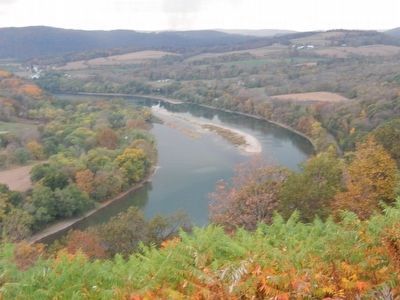
The “Mighty Susquehanna”…*Travels 447 miles and drains 13 million acres of Otsego Lake near Cooperstown, New York to Harve de Grace, Maryland, where it enters the Chesapeake Bay. *Provides 50% of the Chesapeake Bay’s fresh water at about 20 million gallons per minute. *Drains every field, forest, street and backyard in Bradford County.
The Chesapeake Bay, one of America’s richest ecosystems, is depended upon for water, income and recreation. The Bay’s health is determined by each resident, developer and land manager in the watershed.
Erected by Bradford County Conservation District, the Pennsylvania Department of Agriculture and the Endless Mountain Heritage Region.
Topics. This historical marker is listed in these topic lists: Agriculture • Environment.
Location. 41° 41.502′ N, 76° 16.358′ W. Marker is in Wyalusing, Pennsylvania, in Bradford County. It is on Grand Army of the Republic Hwy (US 6). Touch for map. Marker is in this post office area: Wyalusing PA 18853, United States of America. Touch for directions.
Regionally, this marker is in the
Other nearby markers. At least 8 other markers are within 2 miles of this marker, measured as the crow flies: Communities Connected by Water (here, next to this marker); Warriors Path (within shouting distance of this marker); Wyalusing (approx. 1½ miles away); Raymond W. Baker (approx. 1.7 miles away); Wyalusing Borough Historic District (approx. 1.8 miles away); Veterans Memorial (approx. 1.8 miles away); Wyalusing's Lodge Hall (approx. 1.8 miles away); a different marker also named Wyalusing (approx. 1.9 miles away). Touch for a list and map of all markers in Wyalusing.
Credits. This page was last revised on June 16, 2016. It was originally submitted on November 12, 2015, by Don Morfe of Baltimore, Maryland. This page has been viewed 363 times since then and 11 times this year. Photos: 1, 2, 3. submitted on November 12, 2015, by Don Morfe of Baltimore, Maryland. • Bill Pfingsten was the editor who published this page.
