Southwest Quadrant in Alexandria, Virginia — The American South (Mid-Atlantic)
Alexandria National Cemetery
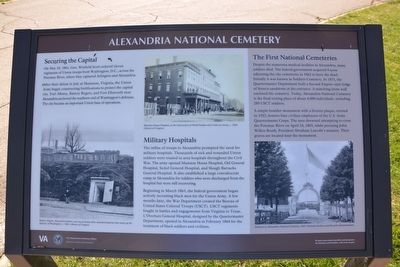
Photographed by A. Taylor, January 4, 2016
1. Alexandria National Cemetery Marker
Securing the Capital
On May 24, 1861, Gen. Winfield Scott ordered eleven regiments of Union troops from Washington, D.C., across the Potomac River, where they captured Arlington and Alexandria.
After their defeat in July at Manassas, Virginia, the Union Army began constructing fortifications to protect the capital city. Fort Albany, Battery Rogers, and Fort Ellsworth near Alexandria anchored the southern end of Washington's defenses. The city became an important Union base of operations.
Military Hospitals
The influx of troops to Alexandria prompted the need for military hospitals. Thousands of sick and wounded Union soldiers were treated in area hospitals throughout the Civil War. The army opened Madison House Hospital, Old General Hospital, Sickel General Hospital, and Slough Barracks General Hospital. It also established a large convalescent camp in Alexandria for soldiers who were discharged from the hospital but were still recovering.
Beginning if March 1863, the federal government began actively recruiting black men for the Union Army. A few months later, the War Department created the Bureau of United
this page online
(sidebar)
The First National Cemeteries
Despite the numerous medical facilities in Alexandria, many soldiers died. The federal government acquired 4 acres adjoining the city cemeteries in 1862 to bury the dead. Initially it was known as Soldiers Cemetery. In 1871, the Quartermaster Department built a Second Empire-style lodge of Seneca sandstone at the entrance. A matching stone wall enclosed the cemetery. Today, Alexandria National Cemetery is the final resting place of about 4,000 individuals, including 280 USCT soldiers.
A simple boulder monument with a bronze plaque, erected in 1922, honors four civilian employees of the U.S. Army Quartermaster Corp. The men drowned attempting to cross the Potomac River on April 24, 1865, while pursuing John Wilkes Booth, President Abraham Lincoln's assassin. Their graves are located near the monument.
Erected 2015 by U.S.
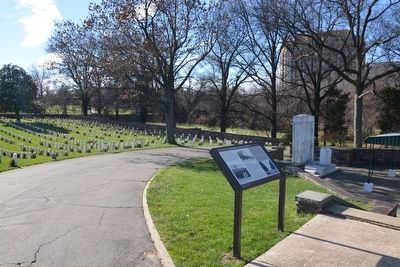
Photographed by A. Taylor, January 4, 2016
2. Alexandria National Cemetery Marker
Topics and series. This historical marker is listed in these topic lists: African Americans • Cemeteries & Burial Sites • War, US Civil. In addition, it is included in the Defenses of Washington, and the National Cemeteries series lists. A significant historical date for this entry is May 24, 1861.
Location. 38° 48.098′ N, 77° 3.492′ W. Marker is in Alexandria, Virginia. It is in the Southwest Quadrant. It can be reached from Wilkes Street west of Hamilton Avenue when traveling west. Marker is inside the Alexandria National Cemetery. Touch for map. Marker is at or near this postal address: 1450 Wilkes St, Alexandria VA 22314, United States of America. Touch for directions.

Regionally, this marker is in the Washington Metropolitan Area and in Northern Virginia. It is also in the American South, specifically in the Upper South, in the Mid-Atlantic, and on the Eastern Seaboard. Globally, it is in the North Atlantic Region, North America, the Western Hemisphere, the Western World, and the Anglosphere. Historically, it finds itself in what was once the territory
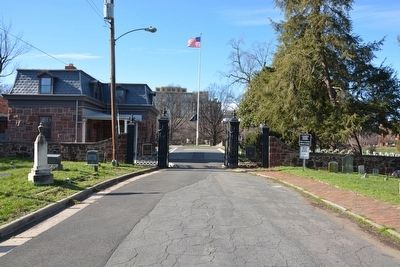
Photographed by A. Taylor, January 4, 2016
3. Current day entrance to Alexandria National Cemetery
Other nearby markers. At least 8 other markers are within walking distance of this marker: "Pursuers of Booth the Assassin" (a few steps from this marker); In Honor of Those Who Gave the Ultimate Sacrifice (a few steps from this marker); A National Cemetery System (within shouting distance of this marker); Civil Rights (about 300 feet away, measured in a direct line); Freedom (about 400 feet away); Remembrance (about 400 feet away); Hooff's Run Bridge (about 500 feet away); African American Heritage Park (about 500 feet away). Touch for a list and map of all markers in Alexandria.
Also see . . . U.S. Department of Veterans Affairs, National Cemetery Administration. (Submitted on January 10, 2016.)

Photographed by Devry Becker Jones (CC0), December 16, 2025
4. Plaque on the building in the cemetery
National Military Cemetery
Alexandria
Established 1862.
Interments 3570.
Known 3467.
Unknown 103.

Photographed by Devry Becker Jones (CC0), December 16, 2025
5. Virginia Historic Landmark plaque for the cemetery
Cemetery
has been registered as a
Virginia
Historic
Landmark
pursuant to the authority vested in the
Virginia Board of Historic Resources

Photographed by Devry Becker Jones (CC0), December 16, 2025
6. Gettysburg Address plaque in the cemetery
Several identical plaques can be found throughout the National Cemetery system.

Historic American Landscapes Survey (courtesy Library of Congress)
7. Alexandria National Cemetery, 1450 Wilkes Street, Alexandria, Alexandria (Independent City), VA
Detail of cemetery entrance gate, with lodge building at left background. View to Southwest. - Alexandria National Cemetery, 1450 Wilkes Street, Alexandria, Alexandria (Independent City), VA Photos from Survey HALS VA-2
Click for more information.
Click for more information.
Credits. This page was last revised on December 16, 2025. It was originally submitted on January 8, 2016, by A. Taylor of Laurel, Maryland. This page has been viewed 895 times since then and 28 times this year. Photos: 1, 2, 3. submitted on January 8, 2016, by A. Taylor of Laurel, Maryland. 4, 5, 6. submitted on December 16, 2025, by Devry Becker Jones of Washington, District of Columbia. 7. submitted on December 16, 2025. • Bernard Fisher was the editor who published this page.
