William Penn Annex East in Philadelphia in Philadelphia County, Pennsylvania — The American Northeast (Mid-Atlantic)
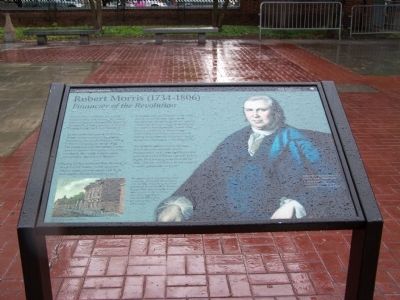
Robert Morris (1734 - 1806)
Financier of the Revolution
| — | Independence National Historical Park, National Park Service, U.S. Department of the Interior | — |
Photographed by Beverly Pfingsten, July 5, 2008
1. Robert Morris (1734 - 1806) Marker
Robert Morris risked his life, wealth, and reputation to help create the United States of America. A patriot, he signed the Declaration of Independence, Articles of Confederation, and U.S. Constitution.
An immigrant orphaned at 16, Robert Morris became a partner in a leading Philadelphia mercantile firm, the Willing & Morris Company, by the age of 22. The company traded throughout Europe, America, and the West Indies. Like many merchants, their cargo included grain, animal hides, and enslaved Americans.
During the Revolutionary War, Morris used his genius for finance and his maritime trading connections to secure vital funds and supplies for the Continental Army.
As Superintendent of Finance (1781-1784), Morris rescued the new nation from financial ruin. He stabilized the economy by creating the first national bank, a model for our modern banking system. As one of the first U.S. senators from Pennsylvania (1789-1795), Morris was instrumental in making Philadelphia the temporary capital during the construction of Washington, D.C.
One of the wealthiest men in America, Morris speculated heavily in land. Overextended,
this page online
[Caption:]
Philadelphia was the capital of the United States from 1790 to 1800. Robert Morris made his large, elegant home near Sixth and Market Streets available to President George Washington. From this house, which served as both residence and office, the president directed the affairs of the executive branch of the United States.
Robert Morris, from a 1782 portrait by artist Charles Willson Peale featured in the "People of Independence" exhibit in the Second Bank of the United States.
Erected by National Park Service, U.S. Department of the Interior.
Topics and series. This historical marker is listed in these topic lists: African Americans • Colonial Era • Government & Politics • Industry & Commerce • Patriots & Patriotism • Settlements & Settlers • War, US Revolutionary • Waterways & Vessels. In addition, it is included in the Signers of the Declaration of Independence series list. A significant historical year for this entry is 1806.
Location. 39° 56.868′ N,
Photographed by Bill Coughlin, July 25, 2017
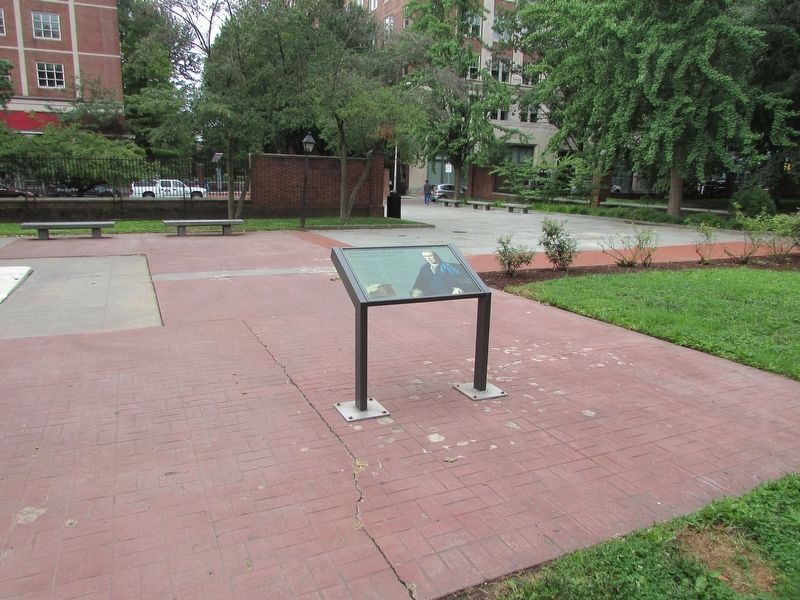
2. Robert Morris (1734 - 1806) Marker

Regionally, this marker is in Southeast Pennsylvania. It is also in the American Northeast and in the Mid-Atlantic. Globally, it is in North America, the Western Hemisphere, the Western World, and the Anglosphere. Historically, it finds itself in what was once the Haudenosaunee (Iroquois) Confederacy, New Netherland, and one of the original Thirteen Colonies.
Other nearby markers. At least 8 other markers are within walking distance of this marker: Robert Morris (a few steps from this marker); Secretary of the Navy’s Office Site (within shouting distance of this marker); Rose Garden (within shouting distance of this marker); Surgeons’ Hall Site (within shouting distance of this marker); Portrait Gallery in the Second Bank of the United States (within shouting
Photographed by Bill Coughlin, July 25, 2017
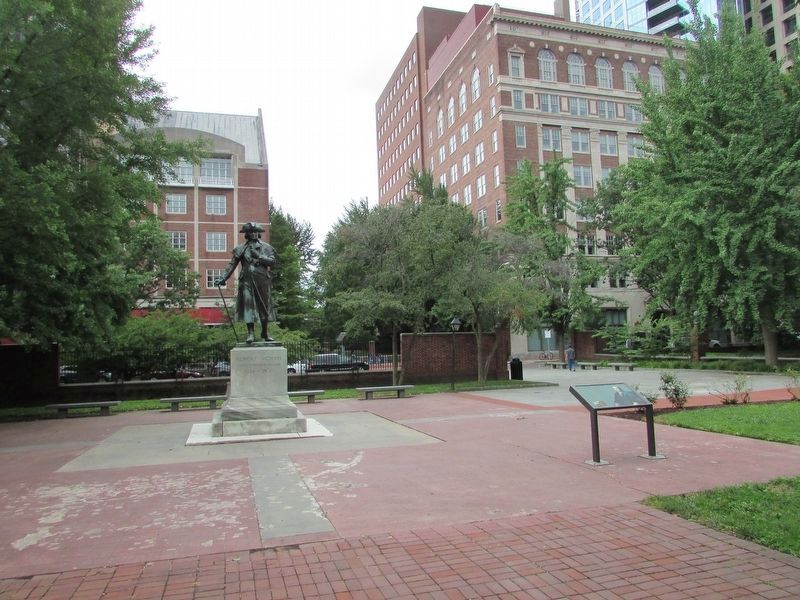
3. Robert Morris (1734 - 1806) Marker
A statue of Robert Morris can be seen near the marker.
Also see . . . Robert Morris at FindAGrave.com. (Submitted on July 21, 2011, by Mike Wintermantel of Pittsburgh, Pennsylvania.)
Additional keywords. human trafficking
Photographed by Allen C. Browne, January 18, 2014
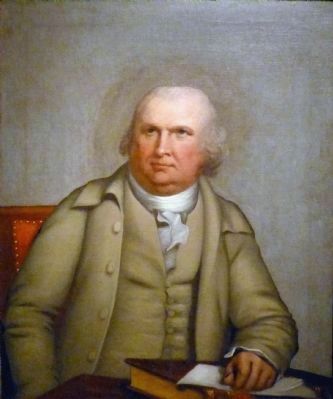
4. Robert Morris
This c. 1785 portrait of Robert Morris by Robert Edge Pine hangs in the National Portrait Gallery in Washington, DC.
“As the Second Continental Congress moved toward a vote for independence, Robert Morris, one of America's leading merchants, thought that the country was not ready for it. In the interest of colonial unity, Morris absented himself from the Pennsylvania delegation when the vote was taken on July 2, but added his signature to the embossed copy of the Declaration of Independence on August 2. ‘I am not one of those politicians that run testy when my own plans are not adopted,’ Morris said.‘I think it is the duty of a good citizen to follow when he cannot lead.’
During the Revolutionary War, Morris did yeoman service, championing the formation of the American navy, striving to keep Washington's army fed and supplied, and, as superintendent of finance, pledging his personal credit as a substitute ‘for that which the Country had lost.’” — National Portrait Gallery
“As the Second Continental Congress moved toward a vote for independence, Robert Morris, one of America's leading merchants, thought that the country was not ready for it. In the interest of colonial unity, Morris absented himself from the Pennsylvania delegation when the vote was taken on July 2, but added his signature to the embossed copy of the Declaration of Independence on August 2. ‘I am not one of those politicians that run testy when my own plans are not adopted,’ Morris said.‘I think it is the duty of a good citizen to follow when he cannot lead.’
During the Revolutionary War, Morris did yeoman service, championing the formation of the American navy, striving to keep Washington's army fed and supplied, and, as superintendent of finance, pledging his personal credit as a substitute ‘for that which the Country had lost.’” — National Portrait Gallery
Credits. This page was last revised on February 2, 2023. It was originally submitted on July 16, 2008, by Bill Pfingsten of Bel Air, Maryland. This page has been viewed 1,990 times since then and 67 times this year. Photos: 1. submitted on July 16, 2008, by Bill Pfingsten of Bel Air, Maryland. 2, 3. submitted on July 25, 2017, by Bill Coughlin of Woodland Park, New Jersey. 4. submitted on June 16, 2015, by Allen C. Browne of Silver Spring, Maryland.
