The Mormon Pioneer Trail
⎯⎯⎯
A Road and River, Well Traveled
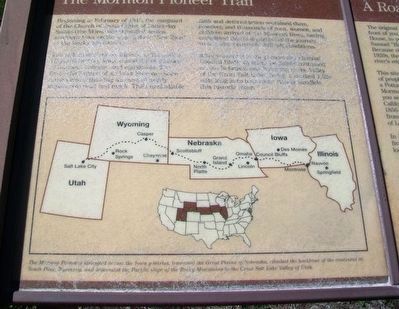
Beginning in February of 1846, the vanguard of the Church of Jesus Christ of Latter-day Saints (the Mormons) struggled across southern Iowa on the way to their "New Zion" in the Rocky Mountains.
The trek from Nauvoo, Illinois, to Kanesville (Council Bluffs), Iowa, tested the endurance of humans, animals, and equipment. The frozen landscape of an Iowa February soon turned into a thawing mixture of nearly impassable mud and muck. Their unshakable faith and determination sustained them, however, and thousands of men, women, and children arrived at the Missouri River, having completed this first portion of the journey west under extremely difficult conditions.
After wintering in the present-day Omaha/Council Bluffs district, the Saints continued across Nebraska and Wyoming to the Valley of the Great Salt Lake. Today, a marked 1,624 mile long auto tour route closely parallels this historic route.
The Mormon Pioneers struggled across the Iowa prairies, traversed the Great Plains of Nebraska, climbed the backbone of the continent at South Pass, Wyoming, and descended the Pacific slope of the Rocky Mountains to the Great Salt
this page online
————————————
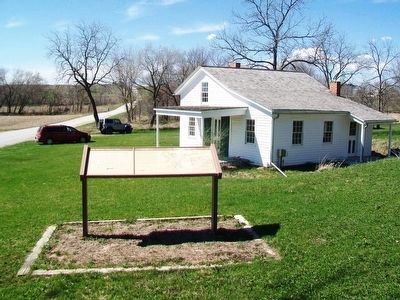
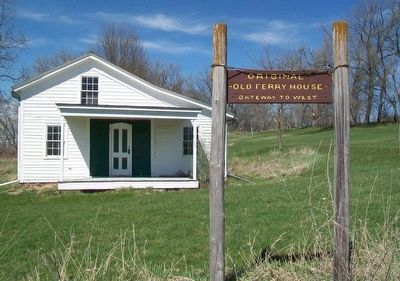
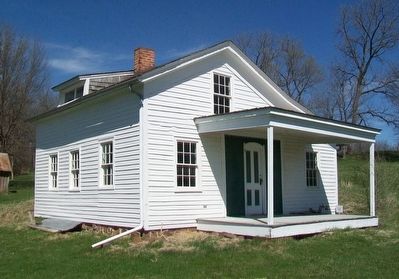
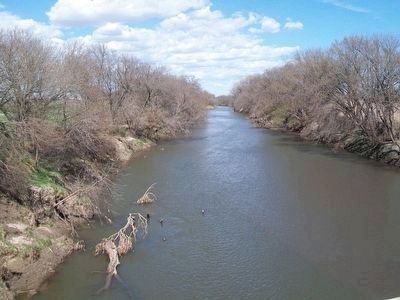
The original Nishnabotna River bed, which lies in front of you, was crossed by a ferry. The Ferry House, to your right, was occupied by ferry operator Samuel "Harlow" Tefft and his family in the 1850's. Because of the straightening of the river in the 1920s, the Ferry House no longer stands at the river's edge.
This site saw the passing of many different groups of people. The road past the Ferry House had been a Pottawattamie Indian Trail in the 1830's. The Mormon Pioneer Trail of 1846 followed the ridge you see in the distance to your left. In 1849, California gold seekers passed this way, and in 1856-57, Mormon handcart companies, pushing west from Iowa City, joined this road just east of the town of Lewis.
In 1851, the road was surveyed as the state road from Des Moines to Indiantown, which was then located a short distance across the Nishnabotna.
The Mormon handcarts were generally six or seven feet long and were made entirely out of wood. They carried about 500 pounds of flour, bedding, [illegible], clothing, cooking utensils,
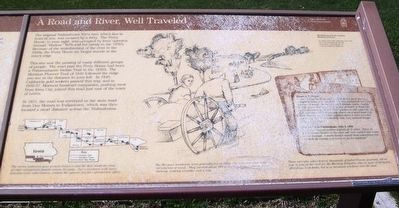
These excerpts, selected from thousands of faded Pioneer journals, tell us how it was on the trail for the Mormon Pioneers, who in spite of daily toil, hardships, and death, left us a thousand windows into the past.
Hiram [Illegible]
[Most of entry illegible]
Patrick Twiss Bermingham, July 3, 1856
[Illegible] long and tedious journey of 25 miles. Some of brethren fainted on the road and were carried into camp in the ox team. I nearly fainted myself from exhaustion, but plucked up courage and never let go the handcart."
Marching song of the Mormon Handcart Pioneers
For some must push and some must pull
As we go marching up the hill,
As merrily on the way we go
Until we reach the Valley, oh.
Erected by Iowa Mormon Trails Association.
Topics and series. This historical marker is listed in these topic lists: Roads & Vehicles • Settlements & Settlers • Waterways & Vessels. In addition, it is included in the Mormon Pioneer Trail series list. A significant historical month for this entry is February 1846.
Location. 41° 18.495′ N, 95° 5.624′ W. Marker is in Lewis, Iowa, in Cass County. It is on Minnesota Street / Nishna

Regionally, this marker is in Western Iowa. It is also in the American Midwest and in the Corn Belt. Globally, it is in North America, the Western Hemisphere, the Western World, and the Anglosphere. Historically, it finds itself in what was once the territory of the Mississippian Culture and also the Louisiana Purchase.
Other nearby markers. At least 8 other markers are within 6 miles of this marker, measured as the crow flies: Memorial Building (approx. 0.3 miles away); The Mormon Trail (approx. 0.3 miles away); World Wars Memorial (approx. 0.3 miles away); Fighting Slavery – Aiding Runaways (approx. 0.6 miles away); Rev. George B. Hitchcock House (approx. 0.6 miles away); The Mormon Pioneer Trail / A Warm Welcome on the Nishnabotna (approx. 0.6 miles away); Lewis Freedom Rock Veterans Memorial (approx. 0.8 miles away); Veterans Memorial (approx. 5.7 miles away). Touch for a list and map
Also see . . . Mormon Pioneer National Historic Trail. (Submitted on April 11, 2016, by William Fischer, Jr. of Reynoldsburg, Ohio.)
Credits. This page was last revised on October 22, 2020. It was originally submitted on April 11, 2016, by William Fischer, Jr. of Reynoldsburg, Ohio. This page has been viewed 1,215 times since then and 64 times this year. Photos: 1, 2, 3, 4, 5. submitted on April 11, 2016, by William Fischer, Jr. of Reynoldsburg, Ohio. 6. submitted on April 13, 2016, by William Fischer, Jr. of Reynoldsburg, Ohio.
