Near Charles City in Charles City County, Virginia — The American South (Mid-Atlantic)
Sherwood Forest
President John Tyler's Home
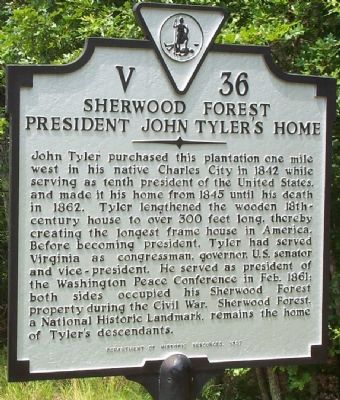
Photographed by Kathy Walker, August 11, 2007
1. Sherwood Forest Marker
Erected 1997 by Department of Historic Resources. (Marker Number V-36.)
Topics and series. This historical marker is listed in these topic lists: Agriculture • Settlements & Settlers • War, US Civil. In addition, it is included in the Former U.S. Presidents: #10 John Tyler, the National Historic Landmarks, and the Virginia Department of Historic Resources (DHR) series lists. A significant historical month for this entry is February 1861.
Location. 37° 19.556′ N, 76° 59.704′ W.
this page online

Regionally, this marker is in Coastal Virginia. It is also in the American South, specifically in the Upper South, in the Tidewater, and on the Eastern Seaboard. Globally, it is in the North Atlantic Region, North America, the Western Hemisphere, the Western World, and the Anglosphere. Historically, it finds itself in what was once the territory of the Mississippian Culture, one of the original Thirteen Colonies, one of the Confederate States of America, and the Antebellum South.
Other nearby markers. At least 8 other markers are within 4 miles of this marker, measured as the crow flies: Sturgeon Point & Kennons (here, next to this marker); Kennon's Landing (here, next to this marker); Fort Pocahontas (a few steps from this marker); a different
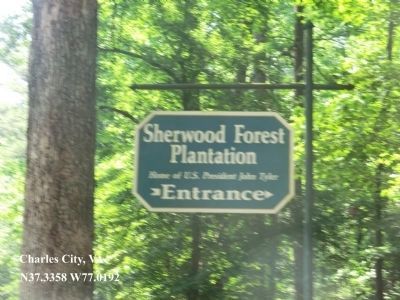
Photographed by Don Morfe, June 23, 2012
2. Sherwood Forest Marker
Another marker is no longer nearby. Binns Hall (was approx. 3 miles away but has been confirmed missing).
Also see . . . Sherwood Forest Plantation. Home of President John Tyler (Submitted on December 9, 2009, by Bernard Fisher of Richmond, Virginia.)
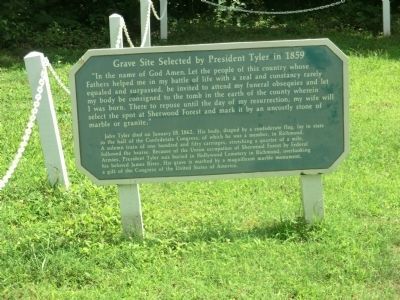
Photographed by Don Morfe, June 23, 2012
3. Sherwood Forest Marker
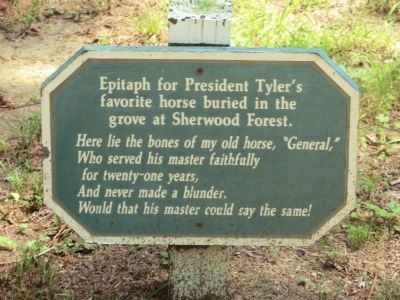
Photographed by Don Morfe, June 23, 2012
4. Sherwood Forest Marker
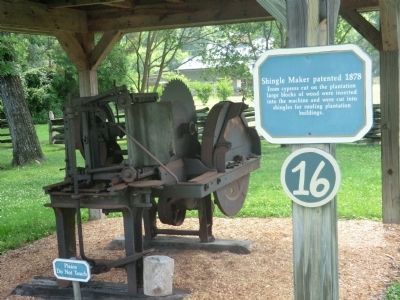
Photographed by Don Morfe, June 23, 2012
5. Sherwood Forest Marker
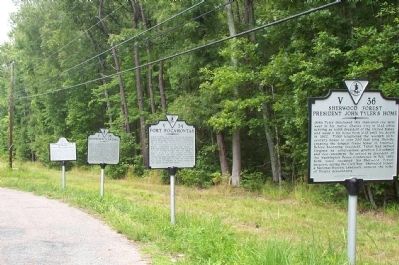
Photographed by Kathy Walker, August 11, 2007
6. Sherwood Forest Marker
Shown with markers Fort Pocahontas (V 34), Kennon's Landing (V 35) and Sturgeon Point and Kennons.
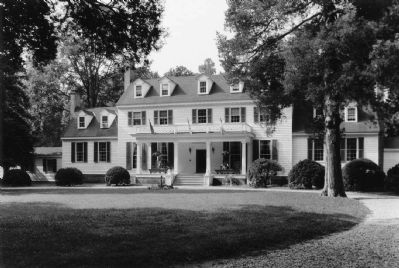
National Register of Historic Places
7. President John Tyler's Home (Sherwood Forest)
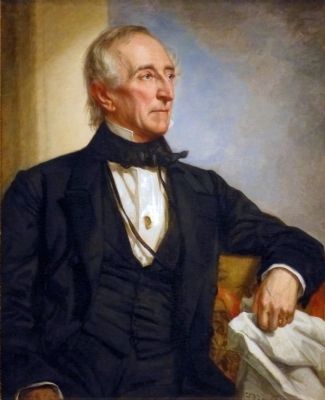
Photographed by Allen C. Browne, February 16, 2015
8. John Tyler
This 1859 portrait of John Tyler by George P. A. Healy hangs in the National Portrait Gallery in Washington, DC.
“In rallying to the cry of ‘Tippecanoe and Tyler, too’ in 1840, voters had their eyes fixed on the Whig Party's White House contender referred to in the first half of that catchy slogan William Henry Harrison, hero of the Battle of Tippecanoe. For most, his vice-presidential running mate, John Tyler, represented merely an afterthought. Within a month of his inauguration, however, Harrison was dead, and Tyler became the first vice president to be made president upon the death of his predecessor.
Tyler claimed the full powers of the presidency on taking office and thereby set a valuable precedent for future vice presidents who faced his situation. But Tyler's White House tenure was tempestuous. When his belief in the limited powers of federal government led him to veto his fellow Whigs' measure for reestablishing a national bank, he found himself deserted by his cabinet, formally read out of his party, and branded ‘His Accidency’ by former allies.” — National Portrait Gallery
“In rallying to the cry of ‘Tippecanoe and Tyler, too’ in 1840, voters had their eyes fixed on the Whig Party's White House contender referred to in the first half of that catchy slogan William Henry Harrison, hero of the Battle of Tippecanoe. For most, his vice-presidential running mate, John Tyler, represented merely an afterthought. Within a month of his inauguration, however, Harrison was dead, and Tyler became the first vice president to be made president upon the death of his predecessor.
Tyler claimed the full powers of the presidency on taking office and thereby set a valuable precedent for future vice presidents who faced his situation. But Tyler's White House tenure was tempestuous. When his belief in the limited powers of federal government led him to veto his fellow Whigs' measure for reestablishing a national bank, he found himself deserted by his cabinet, formally read out of his party, and branded ‘His Accidency’ by former allies.” — National Portrait Gallery
Credits. This page was last revised on February 3, 2020. It was originally submitted on July 25, 2008, by Kathy Walker of Stafford, Virginia. This page has been viewed 2,489 times since then and 81 times this year. Photos: 1. submitted on July 25, 2008, by Kathy Walker of Stafford, Virginia. 2, 3, 4, 5. submitted on September 19, 2012, by Don Morfe of Baltimore, Maryland. 6. submitted on July 25, 2008, by Kathy Walker of Stafford, Virginia. 7. submitted on December 9, 2009, by Bernard Fisher of Richmond, Virginia. 8. submitted on July 17, 2015, by Allen C. Browne of Silver Spring, Maryland. • Craig Swain was the editor who published this page.
