Spotted Horse in Campbell County, Wyoming — The American West (Mountains)
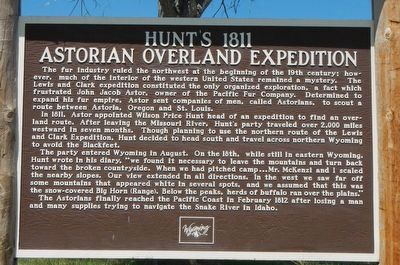
Hunt's 1811 Astorian Overland Expedition
Photographed by Barry Swackhamer, June 5, 2016
1. Hunt's 1811 Astorian Overland Expedition Marker
The fur industry ruled the northwest at the beginning of the 19th century; however, much of the interior of the western United States remained a mystery. The Lewis and Clark expedition constituted the only organized exploration, a fact which frustrated John Jacob Aster, owner of the Pacific Fur Company. Determined to expand his fur empire, Astor sent companies of men, called Astorians, to scout a route between Astoria, Oregon and St. Louis.
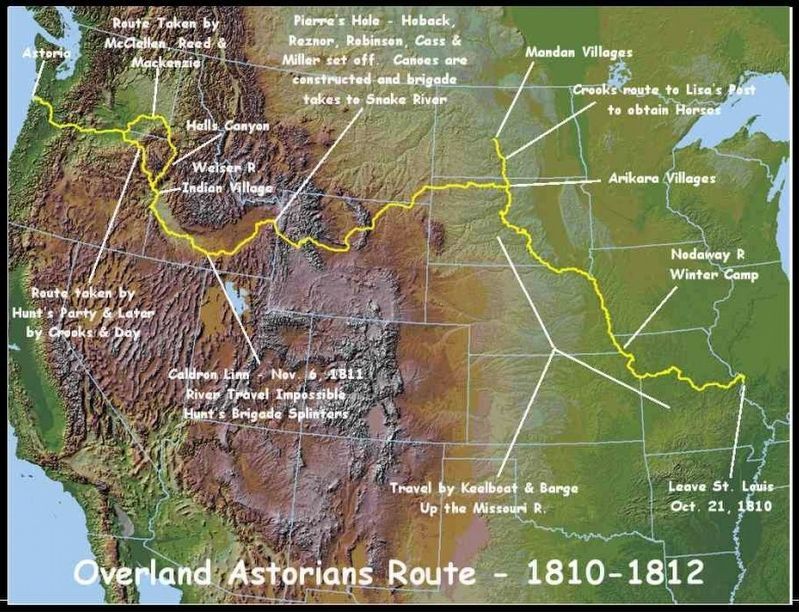
In 1811, Astor appointed Wilson Price Hunt head of an expedition to find an overland route. After leaving Missouri River, Hunt’s party traveled over 2,000 miles westward in seven months. Though planning to use the northern route of the Lewis and Clark Expedition, Hunt decided to head south and travel across northern Wyoming to avoid the Blackfeet.
The party entered Wyoming in August. On the 18th, while still in eastern Wyoming, Hunt wrote in his diary, “we found it necessary to leave the mountains and turn back toward the broken countryside. When we had pitched camp … Mr. McKenzi and I scaled the nearby slopes. Our view extended in all directions. In the west we saw far off
this page online
Erected by Wyoming State Historic Preservation Office.
Topics. This historical marker is listed in these topic lists: Exploration • Indigenous Peoples and Communities • Industry & Commerce • Roads & Vehicles.
Location. 44° 42.505′ N, 105° 50.181′ W. Marker is in Spotted Horse, Wyoming, in Campbell County. It is on U.S. 16 at milepost 70 near Werner Road, on the right when traveling east. Touch for map. Marker is at or near this postal address: 7021 U.S Highway 14/16, Gillette WY 82716, United States of America. Touch for directions.

Regionally, this marker is in Wyoming’s Powder River Basin. It is also in the American Mountain West, on the Great Plains, on the Northern Plains, and specifically on the High Plains. Globally, it is in North
Photographed by Barry Swackhamer, June 5, 2016
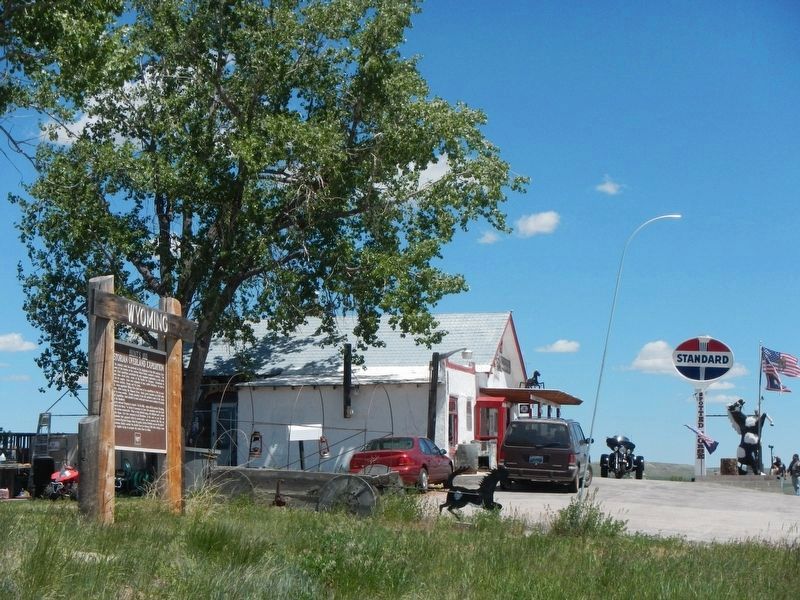
2. Hunt's 1811 Astorian Overland Expedition Marker and the Spotted Horse Bar
More about this marker. This marker is located next to the Spotted Horse Bar, just about the only thing out there.
Also see . . .
1. The Pacific Fur Company - Wikipedia. Consult the "Overland Expedition" section. br As the leader of the expedition Hunt would make a number of decisions which were disastrous. The movement of Hunt's group has been described as "a company of traders forging westward in [a] haphazard fashion." (Submitted on September 19, 2016, by Barry Swackhamer of Brentwood, California.)
2. Marie Dorion and The Astoria Expedition - Historynet. Marie Dorion was the only woman on the 1811-12 overland expedition financed by John Jacob Astor, to establish a fur trading post at the mouth of the Columbia River. That second American crossing of the continent was the result of Astor’s competition with the British Hudson’s Bay Company. Astor, after having made a fortune on the fur resources about the Great Lakes, planned to establish a trading post on the coast of Oregon, to control the fur trade with the Orient.
Photographed by Http://www.mman.us/mapwestboundastorians.htm
3. Map Showing Route of Overland Astorians 1810-1813
Credits. This page was last revised on December 29, 2024. It was originally submitted on September 19, 2016, by Barry Swackhamer of Brentwood, California. This page has been viewed 4,632 times since then and 273 times this year. Photos: 1, 2, 3. submitted on September 19, 2016, by Barry Swackhamer of Brentwood, California.
