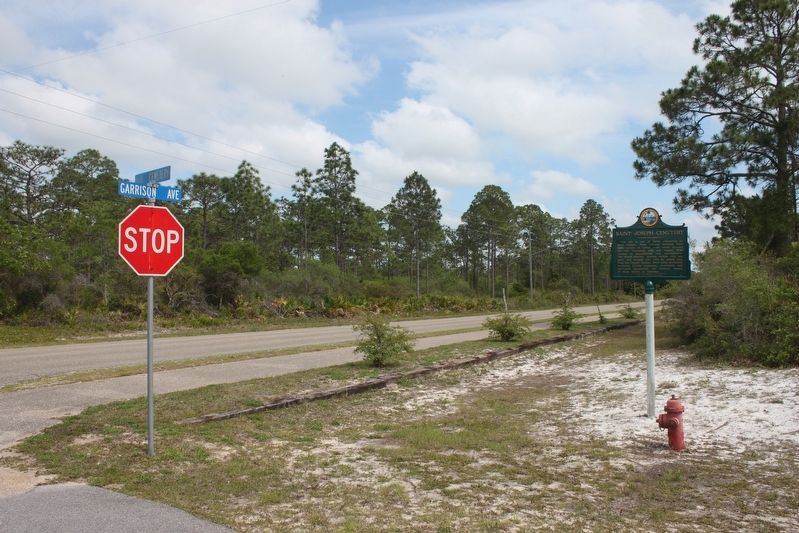
This site is one of three cemeteries of Saint Joseph. Many persons interred here were victims of yellow fever which plagued the city throughout July and August, 1841, causing its depopulation and abandonment. The dread disease, sparing neither rich . . . — — Map (db m167037) HM
With completion of St. Joseph & Lake Wimico Railroad, 1836, movement of cotton to shipside at St. Joseph, from the foremost cotton producing territory in the world, began here, thence to domestic and foreign ports. As a result, the young village . . . — — Map (db m167038) HM
A major Confederate saltworks, with daily capacity of 150 bushels, before completion, was located 200 feet north. Brick foundations were salvaged from ruins of the old City of St. Joseph. Salt processed by evaporation of seawater was one of . . . — — Map (db m27029) HM
Fort Place, forerunner of Wewahitchka, located one-quarter mile East was constructed in the early 1830's as a refuge from hostile Indians. It consisted of a hewn log blockhouse equipped with portholes for firearms, and was enclosed within a two . . . — — Map (db m283125) HM
The following persons are believed to be buried here:
Dr. Thomas H. Thompson, native of Charlestown
Editor of the Apalachicola Advertiser~1840
George Clark, of Boston~1841
Henry Langley, of Georgetown, Washington, D.C.~1844
Captain George . . . — — Map (db m167115) HM
(Front): In 1717, on this site, the French began erecting Fort Crèvecoeur within Spanish domain. On February 8, 1718, Jean-Baptiste Lémoyne de Bienville, acting Governor of Louisiana, dispatched his brother, Lémoyne de Châteagué to complete . . . — — Map (db m8164) HM
Thin black lines indicate changes in relevance. Between each pair of lines entries are ordered geographically but all have the same relevance.
* Inflectional forms of words are their plurals, singulars, and possessives as well as gramatical tenses and similar variations.