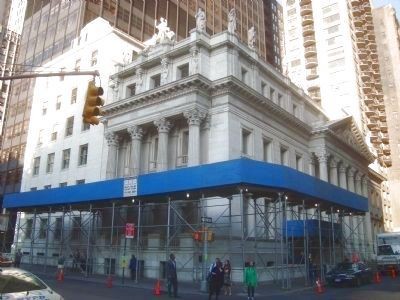
This building houses the Appellate Division of the Supreme Court of the State of New York for the First Judicial Department, which hears appeals in civil and criminal cases from New York and Bronx Counties. Designs for the courthouse by James Brown . . . — — Map (db m146926) HM
Built in 1812, this cottage was the last home of Edgar Allan Poe, one of America's greatest writers. It is listed on the National Register of Historic Places and is a proud New York City and State Landmark.
Saturday
10:00 am - 4:00 pm . . . — — Map (db m275758) HM
About the House
The Valentine-Varian House stands today as The Bronx's second oldest house. During the Revolutionary War (1776-1783), the home was occupied by British, Hessian, and American troops. Financial ruin forced the owner, Isaac . . . — — Map (db m275750) HM
About the Cottage
The Edgar Allan Poe Cottage, built circa 1812, is the final home of the famed writer. At the time that Poe, his ailing wife, Virginia, and mother-in-law, Mrs. Maria Clemm, moved in during the spring of 1846, the house was . . . — — Map (db m275753) HM
The Highbridge World War I Memorial, popularly known as the Highbridge Doughboy originally stood proudly at a small park triangle at Ogden and University Avenues in the University Heights or Highbridge section of the Bronx. It . . . — — Map (db m228746) HM
How did this become a monument?
The efforts to create a Memorial Grove coincided with a plan to erect a unified monument that would honor all servicemen from the Bronx. Bronx Parks Commissioner Thomas J. Dolen submitted plans for the war . . . — — Map (db m259985) HM
Glover’s Rock marks the site of the Battle of Pell’s Point on October 18, 1776. Before the American Revolution, the Siwanoy Native Americans used the rock as a lookout point along their trading route. The glacial granite rock is now named for . . . — — Map (db m98622) HM
Who is this monument dedicated to?
This large, glacial granite rock is named for Colonel John Glover (1732-1797) who, on Oct. 18, 1776, led a brigade of 843 Americans against British General William Howe (1720-1814) and 4,000 British . . . — — Map (db m275845) HM
What was here before?
Poe Cottage originally occupied a triangular plot where Kingsbridge Road turned east on the hill above what is now Fordham Road. Across the street was an apple orchard on land that is now Poe Park.
The white frame . . . — — Map (db m275754) HM
What was here before?
A creek, called Metipathe by the Lenape, once ran through this land into the Harlem River after following a course along what are now River and Jerome Avenues. When European settlers arrived, the creek was sold to John . . . — — Map (db m228714) HM
What was here before?
The rolling terrain of Tremont, named for three local hills—Fairmont, Mt. Eden and Mt. Hope—was once rural countryside and part of Westchester County. Later annexed to New York City, this property was long occupied by . . . — — Map (db m311639) HM
In memory of Sgt. Jerome M. Markowitz · Vienna, Austria · December 11, 1944 •
In memory of PFC Mortimer H. Herchick · Aachen, Belgium · March 1, 1945 · Awarded Bronze Star and Purple Heart Medal •
In memory of Cpl. Gilbert A. Van Nosdall · . . . — — Map (db m53840) WM
Thin black lines indicate changes in relevance. Between each pair of lines entries are ordered geographically but all have the same relevance.
* Inflectional forms of words are their plurals, singulars, and possessives as well as gramatical tenses and similar variations.