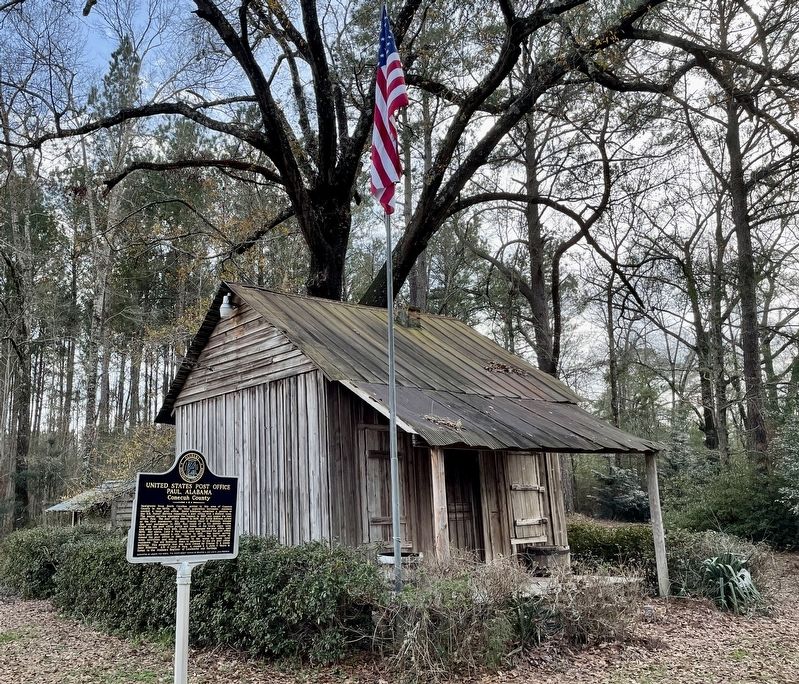
Immigrants from South Carolina settled in this area of Conecuh
County in the 1870s. As the local population increased, residents
needed a local post office. David Robinson submitted a petition to
the U.S. Postal Service requesting a post office . . . — — Map (db m167702) HM
Garrett Longmire had an early trading center, tavern and stage stop near here. He served as the postmaster when his store became a post office in 1818, one of the earliest in what was then the Alabama Territory. The Burnt Corn Post Office served as . . . — — Map (db m81298) HM
War of 1812 veteran John Green (1790-1882) settled in Burnt Corn in 1816. He held many public offices, established the first school, and represented Conecuh County in the state legislature in 1824 and 1829. He was the Conecuh delegate to the . . . — — Map (db m81285) HM
Midway was one of the first settlements established in Conecuh County along the Post Road which later became the Old Federal Road. Long serving as a hub for Indian trails branching out to the north, northeast and northwest, the Midway town site once . . . — — Map (db m81277) HM
In the early 1900s, Repton was a bustling railroad town along the Louisville and Nashville Railroad. Among other businesses, it boasted several hotels, banks, stores, a livery stable, cotton gin and the only hospital with a Board Certified . . . — — Map (db m100840) HM
Native of Alabama, Arkansas lawyer,
Colonel commanding 6th Arkansas
Confederate Infantry Regiment at Battle
of Shiloh in Tennessee, Commended for action at Helena and Fort Hindman in Arkansas, Brigader-General in Confederate Army, Commended . . . — — Map (db m191304) HM
Side 1
Doctor Reverend Hillary James Hawkins, who was affectionately known throughout the community as “Brown,” dedicated most of his adult life to providing spiritual guidance to blacks in Evergreen and surrounding . . . — — Map (db m81292) HM
Born in Conecuh County on June 24, 1883, Maggie Taylor was a
daughter of Daniel and Millie (Moye) Taylor. Her parents were among
thirteen enslaved people brought to the rural community of Nymph
by their owner, Stephen D. Miller. With little . . . — — Map (db m283846) HM
Among the nearly four hundred graves in Nymph's Historic Nazarene
Cemetery are the unmarked resting places of enslaved men and women
brought to this rural Conecuh County community by their owner
Stephen D. Miller Jr. in 1850. These included . . . — — Map (db m283847) HM
Thin black lines indicate changes in relevance. Between each pair of lines entries are ordered geographically but all have the same relevance.
* Inflectional forms of words are their plurals, singulars, and possessives as well as gramatical tenses and similar variations.