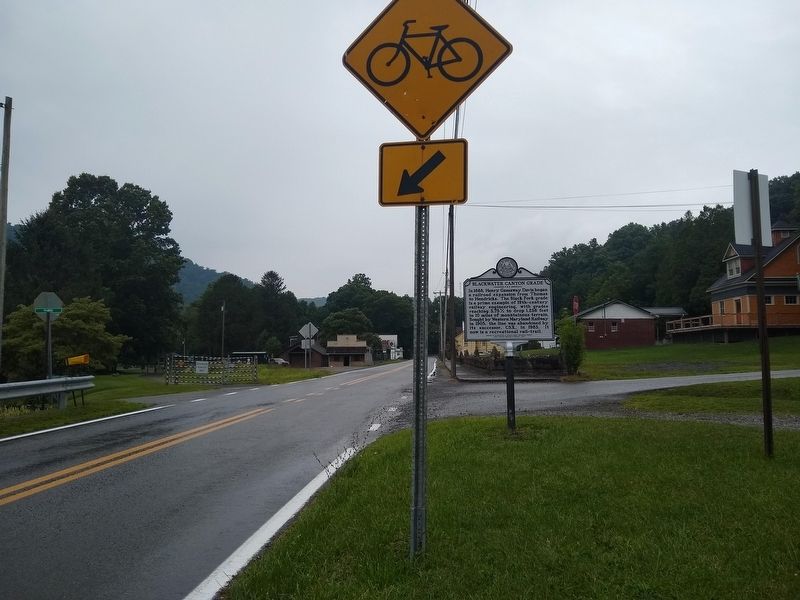
In 1888, Henry Gassaway Davis began a railroad expansion from Thomas to Hendricks. The Black Fork grade is a prime example of 19th-century railway engineering, with grades reaching 3.75% to drop 1,236 feet in 10 miles of mountainous terrain. Bought . . . — — Map (db m229947) HM
In 1892, Coketon Colored School teacher Carrie Williams sued the local school board for equal pay. She was represented by the first African American lawyer in WV, J.R. Clifford, in front of Judge Hoke. Local jury found for her and she won appeal at . . . — — Map (db m74854) HM
1861 - 1865 Corrick's Ford Battle engagement between Federal troops under Gen. T.A. Morris and Confederate troops under Gen. R.S. Garnett, one mile south, July 13, 1861. Garnett, mortally wounded in this action, was the first general to . . . — — Map (db m33621) HM
Segregated school located along the North Fork of the Blackwater that served Coketon, center of coal and coke empire of H. G. Davis. In 1892 teacher Carrie Williams, represented by J. R. Clifford, state’s first African Amerian lawyer, sued when . . . — — Map (db m82119) HM
Underground coal mining is dangerous and labor-intensive. Mine tunnels required careful engineering, and the Davis Coal and Coke Company built this Engineering Building to enable planning for efficient operations and good record-keeping. A . . . — — Map (db m153052) HM
A company store provided an industrial community with the necessities of life—as well as a means for a company to control its workforce. Lured by the lucrative prospect of mining coal for steelmaking, Henry Gassaway Davis and other . . . — — Map (db m153053) HM
"No shaft of shining marble, new From the sculptor's hand we raise for you No, here we lay A boulder drawn from the river-side Where brave men battled and bled and died." Karl Myers, Ode to the Battle of Corricks Ford, 1926 On US Route . . . — — Map (db m23766) HM
Although West Virginia was not universally a "Jim Crow" segregated state, state law required separate facilities for schooling. Davis and Coketon, a community near Thomas, each had separate schools for African American students. The African . . . — — Map (db m236910) HM
Davis Park was originally developed in 1906 by former U.S. Senator Henry Gassaway Davis (1823-1916). Senator Davis was a self-made millionaire successful in the rail, mining and banking industries. He was elected to the U.S. Senate from West . . . — — Map (db m232885) HM
Confederate forces retreated from this area after the "Philippi Races" (June 3, 1861), first land battle of the Civil War. At Huttonsville, 26 miles south, Confederate General Robert S. Garnett took command of the Army of the Northwest. His goal was . . . — — Map (db m253810) HM
Stone House Mansion, predominantly Georgian in style, was constructed in 1757, and is one of the oldest stone structures in Berkeley County. The property is listed in the National Register of Historic Places for its association with the Hite vs. . . . — — Map (db m167518) HM
The Thomas National Register Historic District is considered significant under Criterion A for its association with the settlement and development of Thomas and of Tucker County.
Though remote, the area has been of interest to explorers . . . — — Map (db m153055) HM
The Railroad
The West Virginia Central and Pittsburg (WVC&P) (Former Railyard, Tour No. 36) was founded by Henry Gassaway Davis, one of the most important figures in West Virginia history.
Davis began his career as a . . . — — Map (db m153060) HM