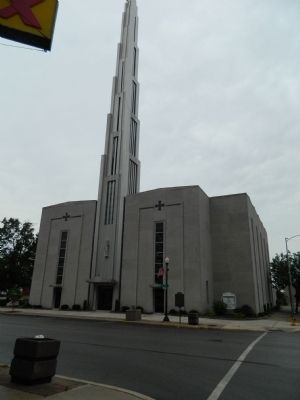
Father Tolton, the first negro priest in the United States, was born of slave parents in Brush Creek, Missouri, in 1854. Educated at Quincy schools, he returned to this city after his ordination in Rome, Italy, in 1886. He celebrated his first . . . — — Map (db m58799) HM
On Indian Mounds Park 0.1 miles west of South 5th Street, on the left when traveling east.
In 1804, the Sac and Fox cede their land between the Illinois and Mississippi Rivers to the United States. Nine years later, General Howard and 1,400 mounted rangers burn a Sac village near the future site of Quincy. Legend has it that the . . . — — Map (db m150073) HM
On 24th Street (Illinois Route 96) at Jersey Street, on the left when traveling south on 24th Street.
On an August night in 1842, Dr. Richard Eells, an active Quincy Abolitionist in the 1830-40's, was transporting a runaway slave named Charley to a safer location when his carriage was stopped near this spot by a posse searching for Charley. . . . — — Map (db m156857) HM
"Here, too, the father of the town, with other men of large renown, are gathered by that reaper stern, who cuts down each and all in turn" (Henry Asbury, Reminiscences of Quincy, Illinois". Referring to the leaders from an earlier . . . — — Map (db m150257) HM
On North 5th Street at Hampshire Street on North 5th Street.
"You are one of my most valued friends" (Lincoln letter to Abraham Jonas, 1860). Their friendship began in 1843 in Springfield when Lincoln and Jonas served together in the Illinois House of Representatives. Jonas became an early and . . . — — Map (db m58764) HM
On Maine Street, on the right when traveling east. Reported missing.
Statesman and politician Stephen A. Douglas began his distinguished national career in Quincy. A resident of the city from 1841-1847, he served as Associate Justice of the Illinois Supreme Court from 1841-1843, then in the U.S. House until he was . . . — — Map (db m149962) HM
"Who shall say, I am the superior, and you are the inferior?" asked Lincoln in July 1858. The Lincoln-Douglas Debates focused on slavery. During the October 13th Quincy debate Lincoln affirmed: "...in the right to eat the bread . . . — — Map (db m58798) HM
Woodland Cemetery—The necropolis that in life (Cornelius Volk) did so much to beaut(ify) and make attractive" (Quincy Daily-Herald, 1898). Among significant historical Woodland memorials are the gravestones of Orville and Eliza . . . — — Map (db m150258) HM
On 5th Street just south of Hampshire Street, on the right when traveling east.
Quincy was in a festive mood for the all-day event with bands, banners, and thousands of people in attendance. Historian E.B. Long said, "It was a carnival time in Illinois. Mobs of thousands journeyed by wagon, horseback, boat and . . . — — Map (db m150023) HM
Near Interstate 35 south of Iowa Highway 34, on the right when traveling south.
The Mormon Trail The Mormons of Nauvoo, Illinois, forced from their homes following the murder of their prophet, Joseph Smith, Jr., began their trek across Iowa in 1846 on the way to the Great Salt Lake Valley. From their first permanent . . . — — Map (db m237260) HM
Near Interstate 35 north of County Highway J52, on the right when traveling north.
The Mormon Trail The Mormons of Nauvoo, Illinois, forced from their homes following the murder of their prophet, Joseph Smith, Jr., began their trek across Iowa in 1846 on the way to the Great Salt Lake Valley. From their first permanent . . . — — Map (db m224588) HM
Eliza Jane was born in Nauvoo, Adams County, Illinois, on 26 July 1840. Her parents were Zerah and Mary Brown Pulsipher. She was 7 years old when persecution drove the saints west. She walked across the plains with her family, picking up buffalo . . . — — Map (db m14344) HM
On West 18th Street at Baynard Boulevard on West 18th Street.
African American Medal of Honor Recipients Memorial
The Medal of Honor takes its place in our country as the highest award for military valor. The honor, awarded by the President in the name of Congress, may only be accorded an . . . — — Map (db m173924) HM WM
Thin black lines indicate changes in relevance. Between each pair of lines entries are ordered geographically but all have the same relevance.
* Inflectional forms of words are their plurals, singulars, and possessives as well as gramatical tenses and similar variations.