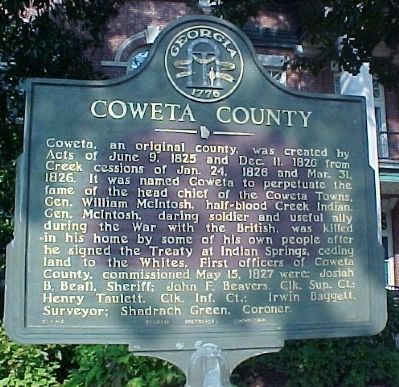
On East Court Street (U.S. 29) at North Court Street, on the left when traveling north on East Court Street.
Coweta, an original county, was created by Acts of June 9, 1825 and Dec. 11, 1826 from Creek cessions of Jan. 24, 1826 and Mar. 31, 1826. It was named Coweta to perpetuate the fame of the head chief of the Coweta Towns, Gen. William McIntosh, . . . — — Map (db m10497) HM
Near Millard Farmer Road 0.4 miles east of Old Corinth Road, on the right when traveling east.
You are standing on an old farm road where, on July 30, 1864, Union cavalrymen sweltering on tired horses were hurrying toward the Chattahoochee River. Confederate cavalrymen were hiding near the end of the road waiting for them. As the Yankees . . . — — Map (db m94659) HM
On North Court Square at East Court Square (U.S. 29), on the left when traveling west on North Court Square.
Ellis Gibbs Arnall was born in Newnan on March 20, 1907, and was one of the most influential and progressive Governors in Georgia’s history. After serving in the state legislature and as Georgia's Attorney General, Arnall was Georgia’s Governor . . . — — Map (db m48437) HM
On East Court Square (U.S. 29) at North Court Square, on the left when traveling north on East Court Square.
Born in Meriwether County, William Yates Atkinson settled in Newnan after receiving a law degree from the University of Georgia in 1877. Elected to the Georgia General Assembly in 1886, he served four terms in the House, becoming Speaker in 1892. . . . — — Map (db m48436) HM
Near Millard Farmer Road at Old Corinth Road, on the right when traveling east.
On June 17, 1908, a small group of ladies from Chapter 599 of the United Daughters of the Confederacy gathered at this place with a few Confederate veterans to dedicate a monument to "the only battle of the
Civil War fought in Coweta county." . . . — — Map (db m94669) HM
Near Millard Farmer Road 0.4 miles east of Old Corinth Road, on the right when traveling east.
Before dawn on July 27, 1864, Yankee buglers sounded "Boots and Saddles." At Mayson's Church just west of Atlanta, McCook's 1,600 cavalrymen mounted their horses and crossed a pontoon bridge spanning the Chattahoochee River at Turner's Ferry. . . . — — Map (db m94660) HM
Near Millard Farmer Road 0.4 miles east of Old Corinth Road, on the right when traveling east.
The Battle of Brown's Mill killed or wounded about 100 of McCook's men. Wheeler's casualties probably numbered fewer than 50. "The dead lay around us on every side, singly and in groups and piles; men and horses, - in some cases, apparently . . . — — Map (db m94668) HM
Near Millard Farmer Road 0.4 miles east of Old Corinth Road, on the right when traveling east.
Anxious to avoid a fight, McCook left the 8th Indiana to contend with the
Confederates at the depot while the rest of his command detoured south on the East Newnan Road. Upon reaching Land Lot 38, near Turkey Creek, the column veered to the . . . — — Map (db m94662) HM
Near Millard Farmer Road 0.4 miles east of Old Corinth Road, on the right when traveling east.
Ashby's ambush and Wheeler's headlong assault cut McCook's column to pieces. Most of the raiders dismounted south of the present-day Millard Farmer Road, rallying around a section of the 18th Indiana Battery, which unlimbered next to a log . . . — — Map (db m94665) HM
Near Millard Farmer Road 0.4 miles east of Old Corinth Road, on the right when traveling east.
Alarmed at Wheeler's approach and puzzled by Stoneman's absence, McCook conferred with his officers. Some wanted to turn back. Others urged him to ride completely around the Confederate army. After listening to their arguments, McCook issued . . . — — Map (db m94661) HM
On River Street near Bull Street, on the left when traveling south.
The colony of Georgia began on Savannah's waterfront in 1733. The riverfront has always played an important role in Georgia, whether as a colonial port, exporter of cotton, or tourist destination. The first commercial house below the bluff opened in . . . — — Map (db m4900) HM
Thin black lines indicate changes in relevance. Between each pair of lines entries are ordered geographically but all have the same relevance.
* Inflectional forms of words are their plurals, singulars, and possessives as well as gramatical tenses and similar variations.