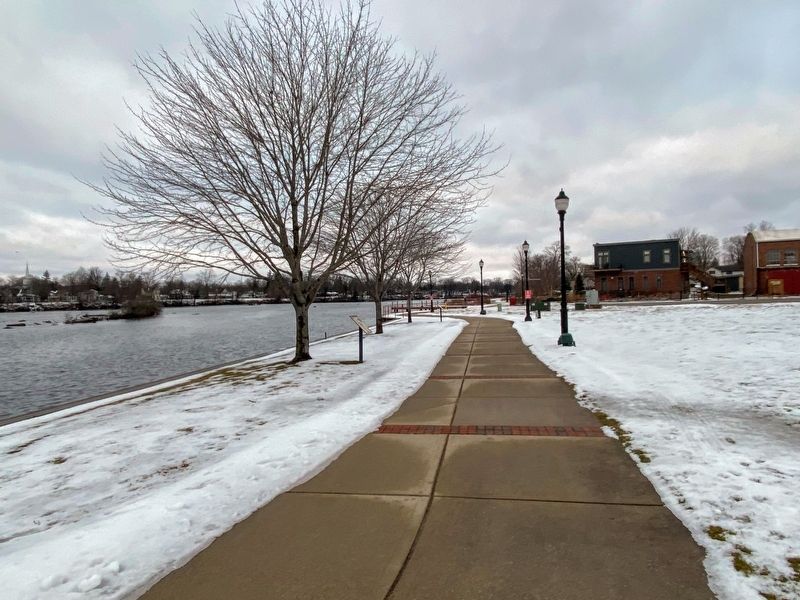
The Odawa were the people living in the Lowell area when white settlers arrived. They would have said they were Anishinabe, meaning the first people or the original people. The area was heavily forested with an abundance of wild animals such as . . . — — Map (db m217481) HM
On State Park Road, on the right when traveling south.
Since 1976, the Michigan Natural Resources Trust Fund, using revenue from the development of state-owned mineral resources, has helped the people of Michigan acquire and develop more that 46,000 acres of high quality recreational lands or . . . — — Map (db m279893) HM
Near Bowes Road near Fulton Street Southeast (Michigan Route 21), on the right when traveling south.
The Cabin This interpretive cabin is located on the site commemorated by the Daughters of the American Revolution in 1921 as the site of "The first trading post" in Lowell. The large stone marker gave directions close to this location. The . . . — — Map (db m216758) HM
The large Native American population at the Flat River made this area important to fur traders. French and American traders came to this area to trade in the winter, returning to Mackinac Island and Detroit in the summers.
The LaFramboise Post . . . — — Map (db m217480) HM
On River Street at Oak Street, on the left when traveling west on River Street.
In the summer of 1878, this building was constructed by John Mee and leased to Clark D. Gardner. The building measures 24 × 50, described following its construction as "without exception the finest of its kind north of Grand Rapids". It was . . . — — Map (db m97402) HM
Thin black lines indicate changes in relevance. Between each pair of lines entries are ordered geographically but all have the same relevance.
* Inflectional forms of words are their plurals, singulars, and possessives as well as gramatical tenses and similar variations.