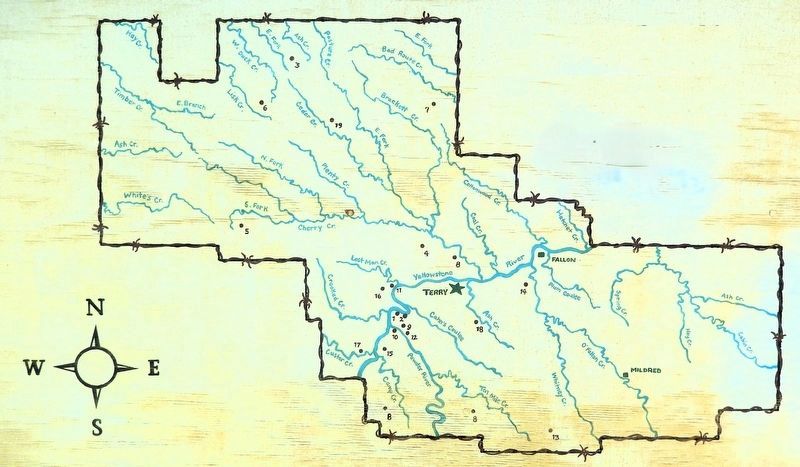
On Towne Avenue just south of Bowen Street, on the left when traveling south.
1. Historic grave site of Private George July 3, 1876 wounded in Custer battle 2. William Clark spent the night here July 30, 1806 3. Indian battle marker placed December 18, 1932; battle between Lt. Frank Baldwin, 110 men and 120 . . . — — Map (db m316300) HM
On Old Highway 10 near Powder River Road, on the right when traveling west.
Father DeSmet, accompanied by Trader Galpin and his wife traveled overland from thenMissouri River to meet the Hunkpapa Sioux at the Sitting Bull Council on June 20, 1868 for a peace conference.
Runners from Father DeSmet's were sent ahead to to . . . — — Map (db m253651) HM
On West Old Highgway 19 at Milwaukee Road, on the right when traveling south on West Old Highgway 19.
Work on the 225 mile Eastern Mountain scion of the Milwaukee Railroad took place 1907-1908
The Milwaukee ran through a region of river and creek valleys making for the building of many bridges. The Yellowstone was crossed three times between . . . — — Map (db m282915) HM
On Ten Mile Road at Park Street, on the right when traveling north on Ten Mile Road.
• A conference of businessmen from South Dakota in 1912 met to build a better road between Ipswich and Aberdeen, SD. This led to the development of the Yellowstone Trail which stretched from "Plymouth Rock to Puget Sound". • The Yellowstone Trail . . . — — Map (db m202882) HM
On Ten Mile Road just north of Park Street, on the left when traveling north.
In 1970, Congress enacted a Wilderness Act and designated 43,000 acres north of Terry in the badlands as a Wilderness Study Area. The Calypso Trail and Scenic View offer a grand look at the badlands area. Father DeSmet met with the Hunkpapa Sioux . . . — — Map (db m203104) HM
Near State Highway 287 at milepost 81 near Shelly Road, on the left when traveling north.
York (ca. 1770-1831) is the only name given for Captain William Clark's slave in the journals of Lewis and Clark (Moulton, 1988).
Lewis and Clark's journals frequently refer to York, a black slave to Captain William Clark. York played an . . . — — Map (db m141726) HM
Thin black lines indicate changes in relevance. Between each pair of lines entries are ordered geographically but all have the same relevance.
* Inflectional forms of words are their plurals, singulars, and possessives as well as gramatical tenses and similar variations.