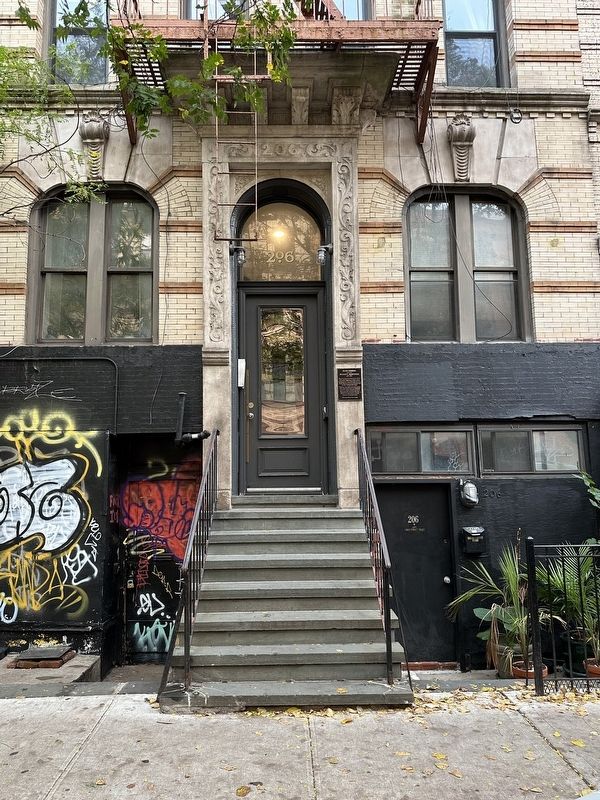
Greenwich Village Society for Historic Preservation Historical Markers
This series is meant for markers issued by the Greenwich Village Society for Historic Preservation, either soley by or in conjunction with other individuals or agencies. (Note the markers have also been issued under the name Village Preservation, as well). See Villagepreservation.org for more information.
By Andrew Ruppenstein, October 19, 2025
Allen Ginsberg (1926-1997) and William S. Burroughs (1914-1997) Marker - wide view
On East 7th Street west of Avenue C, on the left when traveling west.
The two writers lived here from 1952 to 1953 at the beginning of their careers,
hosting literary compatriot Jack Kerouac, whom Ginsberg famously photographed
on the building's fire escape.
Together, they helped form the nucleus of the Beat . . . — — Map (db m286943) HM
On East First Street, on the right when traveling west.
An extraordinary figure in the socialist and anarchist movement of the late 19th century, German-born Justus H. Schwab lived with his family and operated a saloon at 50 East 1st Street for nearly 30 tears.
Schwab’s saloon was an epicenter for . . . — — Map (db m124737) HM
On Cooper Square/Bowery near East 5th Street, on the right when traveling north.
In the 1960’s, this 1845 former rooming house became a laboratory for artistic, literary and political currents. Writers LeRoi Jones (later Amiri Baraka) and Hettie Jones, their Yugen magazine and Toten Press, musician Archie Shepp and painter . . . — — Map (db m131766) HM
On East 9th Street, on the right when traveling west.
Frank O’Hara (1926-1966)
The influential American poet Frank O’Hara lived at 441 East Ninth Street from 1959 to 1963. O’Hara was a leading member of the New York School of poetry as well as an accomplished art critic and a curator at the Museum of . . . — — Map (db m124696) HM
Painter, print-maker, and sculptor Frank Stella lived and worked here from 1978 to 2005, in what was originally a horse auction mart for the city’s elite, and then served as a women’s assembly line training center during World War II. Known . . . — — Map (db m200461) HM
On East 10th Street just east of 3rd Avenue, on the left when traveling east.
Photographer and painter Saul Leiter lived here from 1952 until 2013. Regarded as one of the preeminent photographers of the 20th century, he produced color work renowned for its painterly qualities and abstract elements. Leiter was a key . . . — — Map (db m286891) HM
On Second Avenue at East 6th Street, on the left when traveling south on Second Avenue.
Fans of live rock, folk, and blues music streamed through this entrance during the brief but memorable life of the Fillmore East. The great concert promoter Bill Graham brought The Who, Jimi Hendrix, Janis Joplin, the Grateful Dead, and many more . . . — — Map (db m148010) HM
On Fifth Avenue at West 13th Street, on the right when traveling south on Fifth Avenue.
This building served as
headquarters for the NAACP and
as the early home of numerous
other progressive, human rights,
and civil liberties organizations.
It also housed W.E.B. Dubois' The
Crisis magazine, a platform for
civil rights . . . — — Map (db m198570) HM
On East 13th Street west of University Place, on the right when traveling west.
Renowned writer Anaïs Nin operated her printing press here in the 1940s, where she personally helped produce some of her earliest publications, including their artwork and typeface, regarding these as an extension of her creative process. Her work . . . — — Map (db m200493) HM
On West 8th Street west of Fifth Avenue, on the right when traveling east.
Gertrude Vanderbilt Whitney founded the first museum dedicated to contemporary American art, the Whitney Museum of American Art, on this site in 1931. Next to it stood her own studio, where she and other major artists produced their work. She is . . . — — Map (db m286872) HM
On West 9th Street west of Fifth Avenue, on the left when traveling west.
The celebrated American muralist and decorative artist James Wall Finn lived here from 1900 until his death, first as a boarder, and then with his wife, Florence Lee Quinn, and their three children. He added the studio dormer window crowning the . . . — — Map (db m164482) HM
On Waverly Place east of 6th Avenue, on the right when traveling west.
The first African-American woman to write a play performed on Broadway, Lorraine Hansberry is best known for A Raisin in the Sun (1959), about a Chicago family living under racial segregation. The play’s title is taken from Langston’s . . . — — Map (db m124838) HM
On Fifth Avenue at West 13th Street, on the left when traveling north on Fifth Avenue.
The renowned pioneer of modern dance created radical new dances and rehearsed her company in this building during the 1930s and 40s. Graham also taught in a studio later named in her honor at The New School at 66 West 12th Street. Her dramatic . . . — — Map (db m124839) HM
On Great Jones Street west of Lafayette Street, on the left when traveling west.
Legendary jazz composer, bandleader,
multi-instrumentalist, and social activist
Charles Mingus lived here in 1966. A towering figure
in American music, he fused and transcended
musical genres, and pushed the boundaries of
bass playing and . . . — — Map (db m286663) HM
On Great Jones Street near Bowery, on the left when traveling west.
From 1983 to 1988 renowned artist Jean-Michel Basquiat lived and worked here, a former stable owned by friend and mentor Andy Warhol. Basquiat's paintings and other work established notion of high and low art, race and class, while forging a . . . — — Map (db m125233) HM
On Crosby Street at Bleeker Street, on the right when traveling north on Crosby Street.
In this building, the first female doctor in America, Elizabeth Blackwell, established the first hospital for, staffed, and run by women. The New York Infirmary for Women and Children opened on May 12, 1857, a date which was also the birthday of . . . — — Map (db m125234) HM
On Barrow Street at 7th Avenue, on the left when traveling south on Barrow Street.
Pioneering aviator Amelia Earhart lived
and volunteered as a social worker at Greenwich
House from 1927 to 1929. Her advocacy and
accomplishments helped break down gender
barriers in aviation. A record-setting solo
trans-Atlantic flight and an . . . — — Map (db m295837) HM
On LaGuardia Place south of West 3rd Street, on the right when traveling south.
Chaim Gross (1904-1991)
From 1963 until his death, the renowned American sculptor Chaim Gross lived and worked here. Born in the Carpathian mountains of Eastern Europe, Gross came to New York City in 1921 and emerged as a pioneer of the direct . . . — — Map (db m124837) HM
On Macdougal Street at Bleecker Street, on the right when traveling south on Macdougal Street.
In its post-war heyday, the San Remo was a meeting place for an unparalleled array of figures from the Beat movement, the New York School of poets and painters, and The Living Theater.
Regulars included Allen Ginsberg, Dylan Thomas, Jack . . . — — Map (db m106307) HM
On Grove Street west of Waverly Place, on the left when traveling west.
Alexander Murray Palmer Haley lived and maintained a writing studio here. Beginning in 1963 he conducted many in-depth interviews with Malcolm X for his first book, The Autobiography of Malcolm X. Published shortly after his assassination in . . . — — Map (db m164430) HM
On West Washington Place east of Sheridan Square, on the left when traveling east.
Here lived Frances Perkins, the first woman to serve as a presidential cabinet secretary. A lifelong champion of workers' rights, she served as Secretary of Labor in FDR's administration for twelve years, playing an instrumental role in the . . . — — Map (db m284850) HM
On Horatio Street west of Greenwich Street, on the left when traveling east.
The great American writer James Baldwin lived in an apartment here from 1958 through 1961. The power and eloquence of Baldwin's varied works impacted ideas about race, class, sexuality, and morality, and played an important role in the civil rights . . . — — Map (db m126178) HM
On Hudson Street, on the right when traveling south.
Jane Jacobs
May 4, 1916 - April 25, 2006
The author and urbanist bought this 1842
rowhouse in 1947 and remained until 1968.
While here, Jacobs helped lead successful
campaigns to ban cars from Washington
Square, to defeat Robert Moses' . . . — — Map (db m198537) HM
On West 10th Street at Waverly Place, on the right when traveling west on West 10th Street.
On April 21, 1966, members of the Mattachine Society, a pioneering gay rights organization, challenged a regulation that prohibited bars from serving LGBT people by staging a "Sip-In" at Julius', a bar with a large gay clientele.
With . . . — — Map (db m198561) HM
On Washington Street, on the right when traveling south.
This was the New York City home and studio of artist Roy Lichtenstein from 1988 until his death in 1997. Lichtenstein's signature style of mimicking mass media subjects and printing processes became a foundation for
early Pop Art and garnered him . . . — — Map (db m286765) HM
On Seventh Avenue at West 13th Street, on the right when traveling south on Seventh Avenue.
In 1972, Queens school teacher Jeanne Manford walked alongside her gay son, activist Morty Manford, at the Christopher Street Liberation Day parade, carrying a sign that read, “Parents of Gays: Unite in Support for Our Children.”
The . . . — — Map (db m288212) HM
On Bethune Street near Washington Street, on the left when traveling west.
This complex of buildings was built from c. 1860 to 1934. It served as the home of Bell Telephone Labs (1898 to 1966) where many technological innovations were developed or advanced, including radar, television and video telephones. It re-opened in . . . — — Map (db m133272) HM