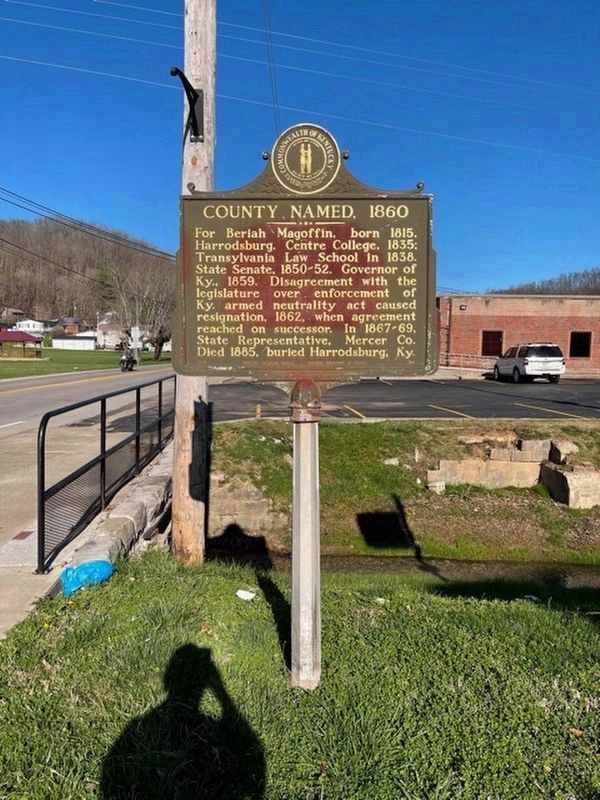
On Maple Street at Coal Branch Road, on the right when traveling east on Maple Street.
For Beriah Magoffin, born 1815, Harrodsburg. Centre College, 1835; Transylvania Law School in 1838. State Senate, 1850-52. Governor of Ky., 1859. Disagreement with the legislature over enforcement of Ky. armed neutrality act caused resignation 1862, . . . — — Map (db m121351) HM
Near East Maple Street at Coal Branch Road, on the right when traveling east.
Founded February 22, 1860 Through the efforts of Kentucky Representative Samuel Salyer Named in Honor of Kentucky Governor Beriah Magoffin — — Map (db m265550) HM
Near Kentucky Route 114 0.1 miles east of Route 404, on the right when traveling east.
Born in Bourbon County, Clay was the son of Congressman Brutus J. Clay and the nephew of Cassius M. Clay, Lincoln's Minister to Russia. He saw action at Middle Creek and later served with Wheeler's Cavalry in Tennessee. Wounded and captured during . . . — — Map (db m69140) HM
On Krummery Lane 0.3 miles north of Michigan Highway 106, on the right when traveling north.
Michigan farmers began to hire seasonal laborers to plant, weed and harvest crops in the early twentieth century.
From 1910 to 1950, most workers came from the Appalachian Mountain region of the U.S. At the end of the harvest, workers would . . . — — Map (db m221705) HM
Thin black lines indicate changes in relevance. Between each pair of lines entries are ordered geographically but all have the same relevance.
* Inflectional forms of words are their plurals, singulars, and possessives as well as gramatical tenses and similar variations.