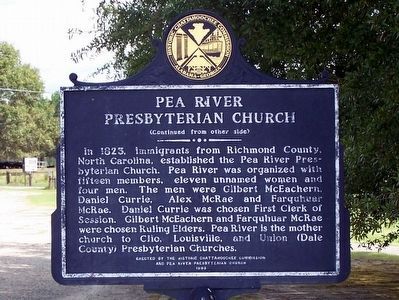
On Alabama Route 51 north of Clio Short Road, on the right when traveling north.
Barbour County’s “Little Scotland”
In the 1820’s before the Creek Indian Cession, Scot immigrants from Richmond County, North Carolina, settled this area of west Barbour County. Few other regions outside the motherland of Scotland have . . . — — Map (db m89605) HM
On Alabama 51 (Alabama Route 51) 0.1 miles north of Clio Short Road, on the right when traveling north.
This cemetery is the final resting place for many early pioneers who settled this area of Alabama. More than six generations of families from the surrounding communities including county elected officials, mayors of both Louisville and Clio, . . . — — Map (db m284709) HM
On State Highway 28 at Old Charleston Road (Local Road 38), on the left when traveling south on State Highway 28.
About four miles southeast is the site of the American Revolutionary Battle of Long Cane. On December 12, 1780, Lieutenant Colonel Isaac Allen and a British force of 400-500 men defeated Colonel Elijah Clarke and 100 Americans, an advanced . . . — — Map (db m241074) HM
On U.S. 1 0.6 miles south of Everetts Mill Road, on the right when traveling north.
As Sherman’s army moved north from Georgia on its path of destruction, one part entered North Carolina near here, March 4-7, 1865. — — Map (db m114035) HM
On Greene Street at 8th Street, in the median on Greene Street.
On this site May 8, 1845
The Southern Baptist Convention
was organized
by 327 delegates from the states of
Maryland, Virginia, North Carolina, South Carolina, Georgia, Alabama, Louisana, Kentucky and District of Columbia.
———
The . . . — — Map (db m210478) HM
Near Constitution Avenue Northwest (U.S. 50) east of 19th Street Northwest, on the right when traveling east.
In Congress, July 4, 1776.Unanimous Declaration of the thirteen united States of America.And for the support of this Declaration,
with a firm reliance on the protection of Divine Providence,
we . . . — — Map (db m137039) HM
Thin black lines indicate changes in relevance. Between each pair of lines entries are ordered geographically but all have the same relevance.
* Inflectional forms of words are their plurals, singulars, and possessives as well as gramatical tenses and similar variations.