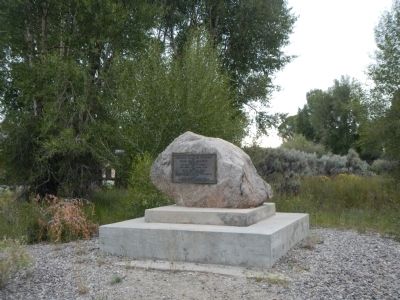
To
Narcissa Prentiss Whitman
and
Eliza Hart Spalding
Missionaries
First white women in Wyoming
and
First women over Oregon Trail
1836
July 6 to July 18 was spent at
“Green River Rendezvous” . . . — — Map (db m80518) HM
On U.S. 189 5.6 miles south of State Highway 235, on the right when traveling south.
He little knew that when he cut his name, or had it cut, in this stone, that it would be engraved in the annals of the West deeper than that of any other man. As one of the world's outstanding explorers he guided emigrants, railroads and army in . . . — — Map (db m308136) HM
Buried on Fontenelle Creek, exhumed 1897, taken to the U.S.Circuit Court at St. Louis, Mo., returned by a court order to Sublette County, Wyoming to be buried here July 27, 1935.
Placed
July 4, 1936
The Historical Landmark Commission
of . . . — — Map (db m80513) HM
On U.S. 191 1.9 miles north of State Highway 351, on the left when traveling north.
As the first federally funded road built west of the Mississippi, the Lander Road played an important role in emigrant travel. Beginning in 1859, emigrants used this 256-mile alternate route. This saved them up to seven days of travel, bypassed . . . — — Map (db m314935) HM
On U.S. 189 at Wyoming Highway 351, on the right when traveling south on U.S. 189.
You are standing just north of the route taken by thousands of people, cattle and horses migrating west on the Lander Cut-off, the northern fork of the Oregon Trail, starting in 1858. None settled here then. By the late 1870s, cattle from the west . . . — — Map (db m85813) HM
On Oregon Trail near Squaw Road (Federal Route BLM4106).
This point on the trail is called the Parting-of-the-Ways. The trail to the right is the Sublette or Greenwood Cutoff and to the left is the main route of the Oregon, Mormon, and California Trails. The Sublette Cutoff was opened in 1844 because it . . . — — Map (db m96684) HM
On U.S. 191 near Emigrant Trail, on the left when traveling north.
This maker consists of three plaques, each dealing with the Lander Cut-off.
“The Best Mountain Road in the West”
In 1857, Congress funded construction of the Fort Kearney-South Pass-Honey Lakes Wagon Road (Lander . . . — — Map (db m80540) HM
Thin black lines indicate changes in relevance. Between each pair of lines entries are ordered geographically but all have the same relevance.
* Inflectional forms of words are their plurals, singulars, and possessives as well as gramatical tenses and similar variations.