Axtell Park in Sioux Falls in Minnehaha County, South Dakota — The American Midwest (Upper Plains)
Prehistoric Prayer Rock
February 6, 2022
1. Prehistoric Prayer Rock Marker
-R.F. Pettigrew correspondence January 11, 1926
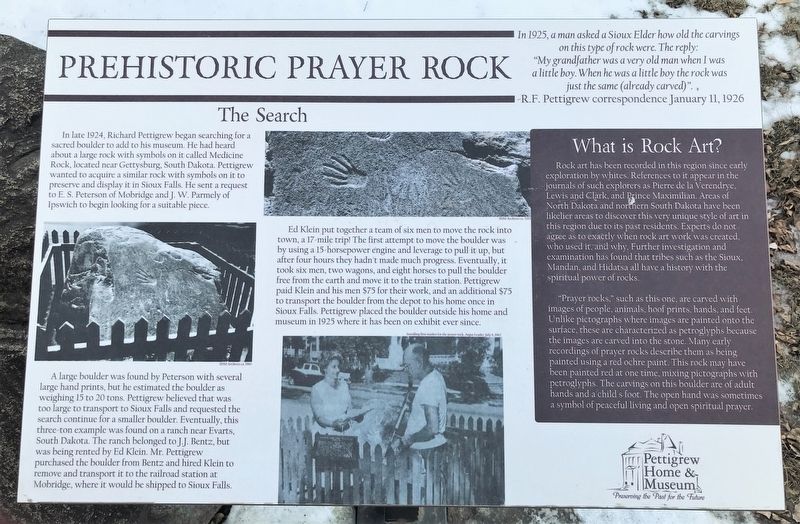
A large boulder was found by Peterson with several large hand prints, but he estimated the boulder as weighing 15 to 20 tons. Pettigrew believed that was too large to transport to Sioux Falls and requested the search continue for a smaller boulder. Eventually, this three-ton example was found on a ranch near Evarts, South Dakota. The ranch belonged to J.J. Bentz, but was being rented by Ed Klein. Mr. Pettigrew purchased
this page online
Ed Klein put together a team of six men to move the rock into town, a 17-mile trip! The first attempt to move the boulder was by using a 15-horsepower engine and leverage to pull it up, but after four hours they hadn't made much progress. Eventually, it took six men, two wagons, and eight horses to pull the boulder free from the earth and move it to the train station. Pettigrew paid Klein and his men $75 for their work, and an additional $75 to transport the boulder from the depot to his home once in Sioux Falls. Pettigrew placed the boulder outside his home and museum in 1925 where it has been on exhibit ever since.
February 6, 2022
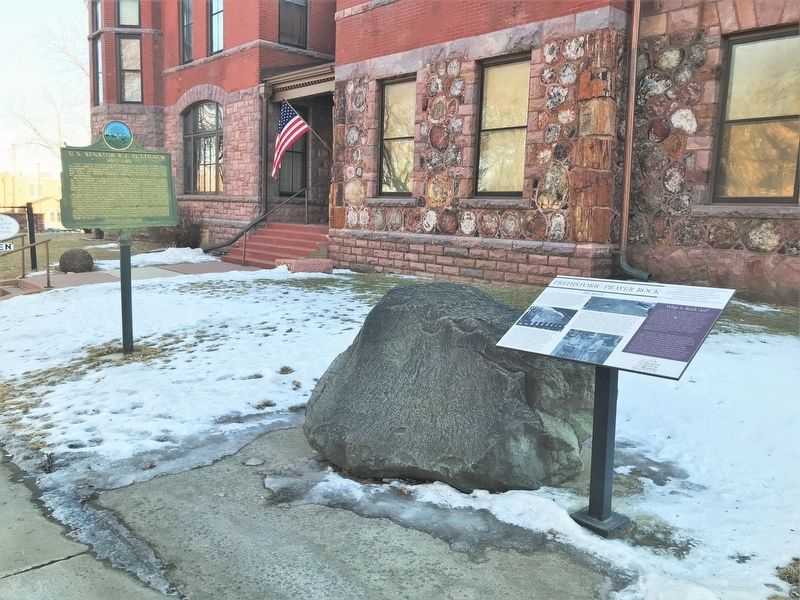
2. Prehistoric Prayer Rock Marker at the Pettigrew Home and Museum
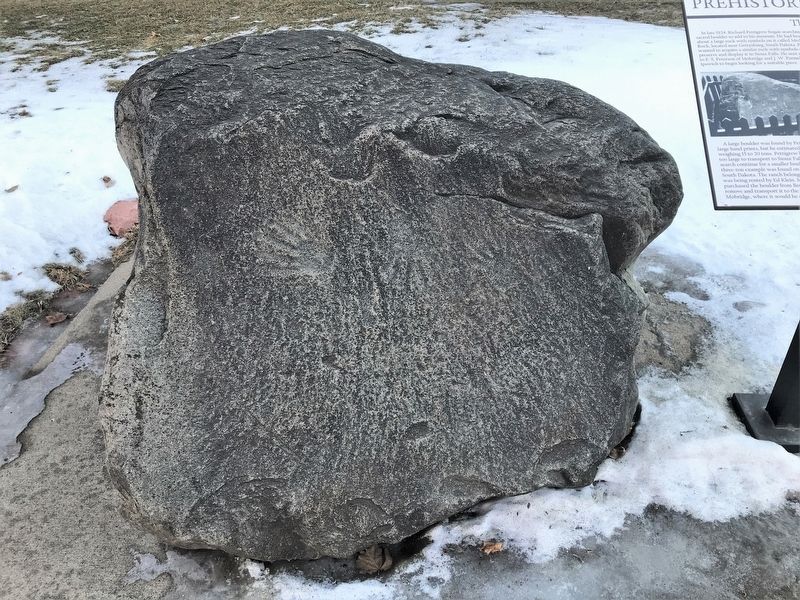
"Prayer rocks," such as this one, are carved with images of people, animals, hoof prints, hands, and feet. Unlike pictographs where images are painted onto the surface, these are characterized as petroglyphs because the images are carved into the stone. Many early recordings of prayer rocks describe them as being painted using a red ochre paint. This rock may have been painted red at one time, mixing pictographs with petroglyphs. The carvings on this boulder are of adult hands and a child's foot. The open hand was sometimes a symbol of peaceful living and open spiritual prayer.
Erected by Pettigrew Home & Museum.
Topics. This historical marker is listed in these topic lists: Anthropology & Archaeology • Arts, Letters, Music • Indigenous Peoples and Communities • Religion & Religious Structures. A significant historical year for this entry is 1924.
Location. 43° 32.909′ N, 96° 44.092′ W.
February 6, 2022
3. Prehistoric Prayer Rock

Regionally, this marker is in East River. It is also in the American Midwest, in the Lewis & Clark Corridor, in the Corn Belt, on the prairies, and on the Northern Plains. Globally, it is in North America, the Western Hemisphere, the Western World, and the Anglosphere. Historically, it finds itself in what was once Rupert’s Land and also the Louisiana Purchase.
Other nearby markers. At least 8 other markers are within walking distance of this marker: U.S. Senator R.F. Pettigrew (here, next to this marker); 215 N Duluth Avenue (about 300 feet away, measured in a direct line); The People's Party National Convention (about 500 feet away); Two Cemeteries (about 600 feet away); Kaufmann House Mystery (about 600 feet away); The Woman's Alliance (about 700 feet away); Dakota Conflict (about 800 feet away); Cathedral Historic District / Paving Stone Alley (approx. 0.2 miles away). Touch for a list and map of all markers in Sioux Falls.
Another marker is no longer nearby. Prehistoric Prayer Rock (was a few steps from this marker but has been reported to have been replaced with another marker now near it).
Related marker. Click here for another marker that is related to this marker.
Credits. This page was last revised on August 12, 2025. It was originally submitted on February 20, 2022. This page has been viewed 883 times since then and 70 times this year. Photos: 1, 2, 3. submitted on February 20, 2022.
