Pontiac in Oakland County, Michigan — The American Midwest (Great Lakes)
Oak Hill Cemetery
Photographed by Al Barrera
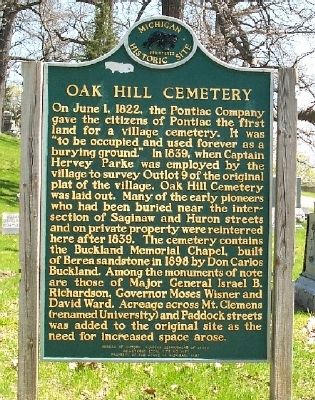
1. Oak Hill Cemetery Marker
On June 1, 1822, the Pontiac Company gave the citizens of Pontiac the first land for a village cemetery. It was "to be occupied and used forever as a burying ground." In 1839, when Captain Hervey Parke was employed by the village to survey Outlot 9 of the original plat of the village, Oak Hill Cemetery was laid out. Many of the early pioneers who had been buried near the intersection of Saginaw and Huron streets and on private property were reinterred here after 1839. The cemetery contains the Buckland Memorial Chapel, built of Berea sandstone in 1898 by Don Carlos Buckland. Among the monuments of note are those of Major General Israel B. Richardson, Governor Moses Wisner and David Ward. Acreage across Mt. Clemens (renamed University) and Paddock streets was added to the original site as the need for increased space arose.
(Back):
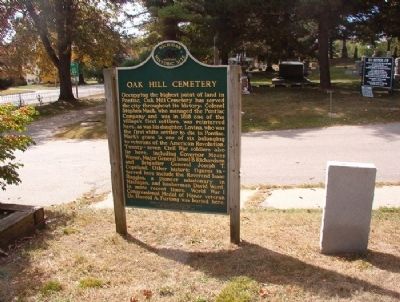
Occupying the highest point of land in Pontiac, Oak Hill Cemetery has served the city throughout its history. Colonel Stephen Mack, who managed the Pontiac Company and was in 1818 one of the village's first settlers, was reinterred here, as was his daughter, Lovina, who was the first white
this page online
Erected 1987 by State of Michigan. (Marker Number L1450.)
Topics and series. This historical marker is listed in these topic lists: Cemeteries & Burial Sites • War, US Civil • War, US Revolutionary • War, World I. In addition, it is included in the Michigan Historical Commission series list. A significant historical date for this entry is June 1, 1822.
Location. 42° 38.521′ N, 83° 17.117′ W. Marker is in Pontiac, Michigan, in Oakland County. It is on University Drive (State Highway 59), on the right when traveling west. Touch for map. Marker is at or near this postal address: 216 University Drive, Pontiac MI 48342, United States
Photographed by Al Barrera, September 29, 2004
2. Oak Hill Cemetery Marker

Regionally, this marker is in Southeast Michigan and in Greater Detroit. It is also in the American Midwest. Globally, it is in North America, the Western Hemisphere, the Western World, and the Anglosphere. Historically, it finds itself in what was once the Northwest Territory.
Other nearby markers. At least 8 other markers are within walking distance of this marker: Elizabeth Denison Forth (approx. 0.2 miles away); a different marker also named Oak Hill Cemetery (approx. 0.4 miles away); Pontiac Thrived (approx. 0.4 miles away); Pontiac Public Library (approx. 0.4 miles away); Pontiac Monument (approx. 0.4 miles away); Made in Pontiac (approx. 0.4 miles away); First Baptist Church (approx. 0.4 miles away); Inspiration Road (approx. half a mile away). Touch for a list and map of all markers in Pontiac.
Related markers. Click here for a list of markers that are related to this marker. Site of General Richardson's mortal wounding.
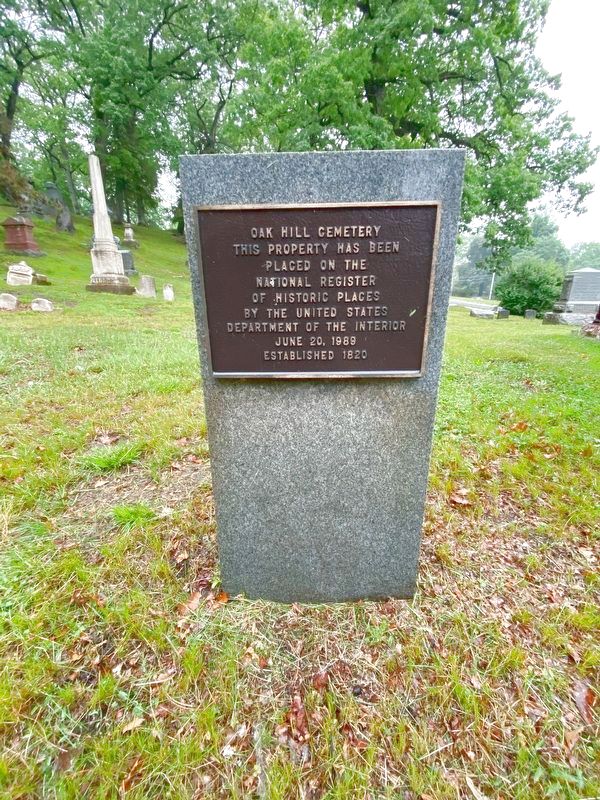
Also see . . . Oak Hill Cemetery. Oak Hill Cemetery was placed on the National Register of Historic Places in 1989. An excerpt from the 119-page
Photographed by Al Barrera, circa August 18, 2008
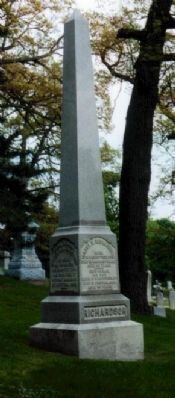
3. Oak Hill Cemetery Marker
General Isreal B. Richardson's grave of the 1st Michigan, k.i.a. at Antediem.
One of the oldest surviving Euro-American burying grounds in Michigan dating from the settlement period of the nineteenth century, the original part of Oak Hill Cemetery was established in 1839-41 on ground set aside for cemetery purposes in 1822. Oak Hill is also notable in a statewide context for the variety and quality of its nineteenth- and early twentieth-century funerary art and architecture. The cemetery grounds contain the remains of many of the city of Pontiac's leading citizens of the nineteenth and early twentieth centuries.(Submitted on June 30, 2026, by Joel Seewald of Madison Heights, Michigan.)
Photographed by J.T. Lambrou, May 28, 2021
4. Oak Hill Cemetery Marker
Added to NRHP June 20, 1989
Credits. This page was last revised on July 10, 2026. It was originally submitted on December 8, 2008, by Al Barrera of Brownstown, Michigan. This page has been viewed 4,146 times since then and 87 times this year. Last updated on May 30, 2021, by J.T. Lambrou of New Boston, Michigan. Photos: 1, 2. submitted on December 9, 2008, by Al Barrera of Brownstown, Michigan. 3. submitted on January 1, 2009, by Al Barrera of Brownstown, Michigan. 4. submitted on May 28, 2021, by J.T. Lambrou of New Boston, Michigan. • J. Makali Bruton was the editor who published this page.
