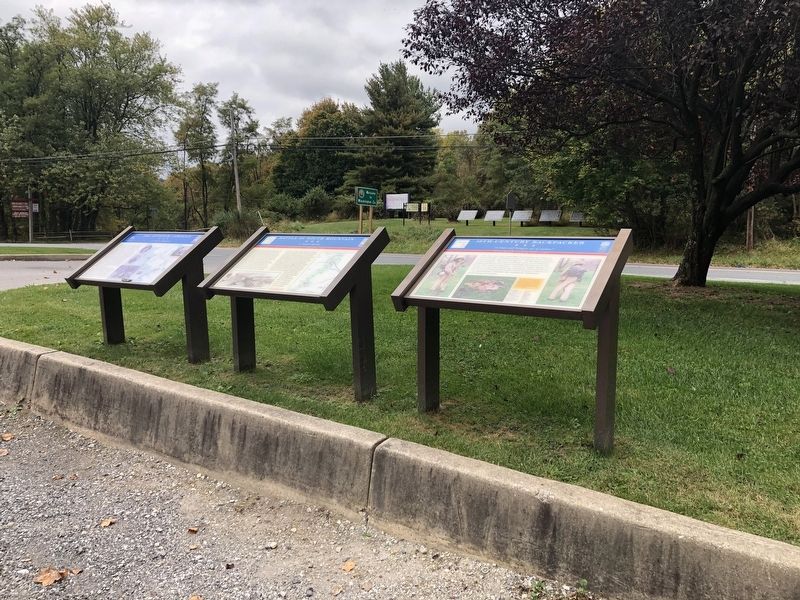
The Battle of South Mountain erupted on September 14, 1862, when elements of the Union army tried to drive the Confederate rear guard from Crampton’s, Fox’s, and Turner’s Gaps and break through to the western side of the mountain to attack . . . — — Map (db m1519) HM
No other document of the Civil War has generated so much controversy as Lee's Special Orders No. 191. These “Lost Orders” detailed the movements of Lee's army for the operation against Harpers Ferry. On September 9 Lee sent copies of the order to . . . — — Map (db m2042) HM
On September 4, 1862, General Robert E. Lee, hoping to shorten the war by winning a decisive victory on Northern soil, crossed the Potomac River into Maryland. Lee planned to draw the Army of the Potomac through South Mountain into Pennsylvania and . . . — — Map (db m2040) HM
(Left Side) On September 4, 1862, General Robert E. Lee, hoping to shorten the war by winning a decisive victory on Northern soil, crossed the Potomac River into Maryland. Lee planned to draw the Army of the Potomac through South Mountain into . . . — — Map (db m2039) HM
After crossing the Potomac River early in September 1862, Confederate Gen. Robert E. Lee reorganized the Army of Northern Virginia into three separate wings. On September 9, he promulgated his campaign strategy - to divide his army, send Gen. Thomas . . . — — Map (db m18381) HM
Mitchell, Co. F, 27th Indiana Volunteers, is buried in
Hartsville Baptist Cemetery. He found Confederate General
Lee's "Lost" Special Orders No. 191 near Frederick, MD, September 13, 1862. Union General McClellan then engaged Lee at the Battle . . . — — Map (db m63806) HM